
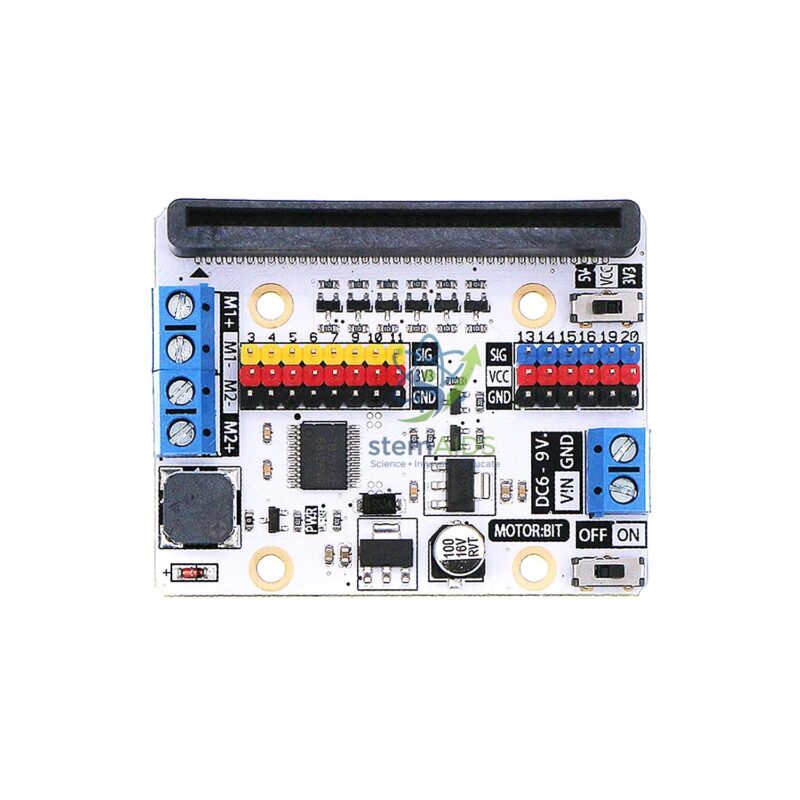
Quick Answer: A motor shield is a plug-on driver board that lets a small controller board run DC motors forward and in reverse at variable speed, using power from a separate battery. This Motor Shield is listed in LabEquip’s micro:bit robotics range; confirm the host board, motor channels and supply voltage before ordering.
Why a Controller Needs a Motor Driver
A controller pin supplies only a few milliamps at logic voltage, while even a small geared DC motor draws far more, especially as it starts. Connecting a motor straight to a pin can reset the board or damage it, and the voltage spike a motor produces when it switches off makes matters worse. The motor shield sits between the two: the controller sends low-power signals, and driver chips on the shield switch the motor current from a battery pack.
The heart of most boards of this kind is an H-bridge, four electronic switches arranged round the motor so current can flow through it in either direction. Closing one diagonal pair turns the motor forward, the other pair reverses it, and connecting both motor terminals together brakes it. Speed is set by pulse-width modulation (PWM): the driver switches the supply on and off many times a second, and the fraction of each cycle that it is on, the duty cycle, sets the average voltage the motor receives.
With two channels, one per wheel, students build a differential-drive car: both wheels forward to go straight, one faster than the other to curve, opposite directions to spin on the spot. Driver boards made for the micro:bit usually take the board in an edge-connector slot and have terminals for motors and battery. The number of channels, any servo headers and the supply range of this shield should be confirmed before planning a build.
Specifications
| Item | Motor driver shield (expansion board) for robotics projects |
| Motor type | Small DC motors, typically geared hobby motors |
| Control | Direction by H-bridge switching, speed by PWM from code |
| Power | Motors run from a separate battery, not from controller pins |
| Programming | Block coding or Python on the host board |
| Host board, channels and voltage range | Confirm at enquiry |
Care & Handling
- Check battery polarity against the terminal markings before connecting; a reversed supply can destroy the driver chip.
- Disconnect the battery before changing motor wires or inserting the controller board.
- Stop the program if a motor stalls against an obstacle; stalled motors draw their highest current and heat the driver.
- Keep screws and wire offcuts away from the underside of the board, which is unprotected.
Projects Students Build
- Two-wheel robot cars that drive, turn and spin on the spot
- Line-following and obstacle-avoiding vehicles once sensors are added
- Conveyor, winch or fan models driven by timed motor runs
- PWM lessons in which students measure wheel speed at different duty cycles
Why Choose LabEquip
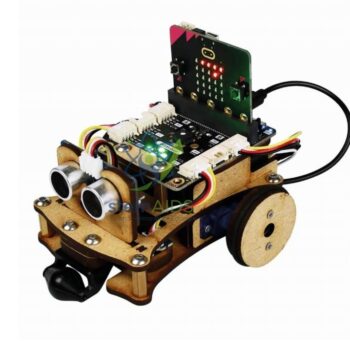
This shield suits schools and robotics clubs that want students to design their own vehicles instead of using a finished robot. LabEquip lists it in the STEM kits range next to the Bit car, a ready-built micro:bit chassis that makes a useful comparison. Share your motor and board details on the contact page so the right shield can be confirmed.
Frequently Asked Questions
Why can’t a motor be connected directly to the micro:bit pins?
The pins supply only a small current at logic voltage, far less than a motor needs, and a motor produces voltage spikes when it switches off. The shield’s driver handles the motor current and keeps those spikes away from the controller.
How does the shield reverse a motor?
It uses an H-bridge, a set of four switches around the motor. Switching one diagonal pair sends current one way and the other pair sends it the opposite way, so the motor turns forward or backward without rewiring.
What does PWM speed control mean?
Pulse-width modulation switches the motor supply on and off very quickly. The longer the on time in each cycle, the higher the average voltage and the faster the motor turns. In code this usually appears as a speed value such as 0 to 100 percent.
Why does my robot drift to one side at the same speed setting?
No two motors are identical, and friction in gearboxes and wheels differs too. Lower the speed of the faster side in code until the robot runs straight, or use line or distance sensors to correct it automatically.
Can the shield also drive servo motors?
Some driver boards include servo headers and some do not. A servo is controlled by a timed pulse rather than an H-bridge, so check whether this shield has servo outputs if your project needs one.
What battery should the shield use?
Use the supply range given in the shield documentation. Weak batteries cause slow motors and random resets of the controller, so start each lesson with fresh or fully charged cells.
Last Updated: September 2026





Reviews
There are no reviews yet.