


In Stock
Motor Shield
$11.28
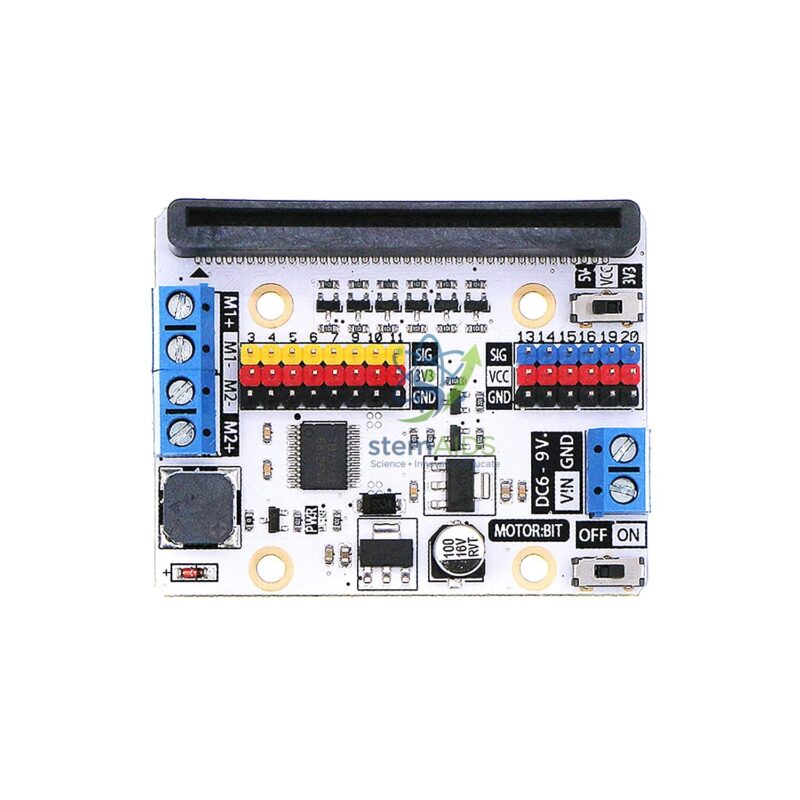
The Motor Shield for micro:bit by StemAids is a practical robotics expansion board designed to help students control DC motors using the BBC micro:bit platform. It is ideal for building moving robots, smart cars, line-following vehicles, classroom automation projects, and hands-on STEM learning models.
This motor shield allows learners to connect motors more easily without complicated wiring. By inserting or connecting the micro:bit with the shield, students can program motor direction, speed, start, stop, and movement logic using block-based coding or Python. It bridges the gap between coding and real-world mechanical motion, making it a valuable tool for robotics education.
The StemAids Motor Shield for micro:bit is suitable for schools, colleges, training centers, Atal Tinkering Labs, robotics workshops, and project-based learning environments. It helps students understand motor control, embedded systems, automation, electronics, and programming through practical experiments.
Key Features
- Designed for use with BBC micro:bit robotics and STEM projects
- Can control two DC motors for robot car and moving model applications
- Supports motor direction control including forward, reverse, stop, and braking functions
- Helps students learn speed control using PWM-based programming logic
- Easy motor and power connection terminals for classroom use
- Useful for line follower robots, smart cars, obstacle projects, and automation models
- Suitable for MakeCode block coding and Python-based micro:bit programming
- Supports hands-on learning in electronics, robotics, STEM, and coding
Product Specifications
| Product Name | Motor Shield for micro:bit |
|---|---|
| Brand | StemAids |
| Product Type | Motor Driver Shield / Robotics Expansion Board |
| Compatible Board | BBC micro:bit |
| Motor Support | Up to 2 DC motors |
| Motor Control Functions | Forward, Reverse, Stop, Brake, Speed Control |
| Typical Motor Driver | TB6612 or equivalent motor driver IC |
| Typical Input Voltage | 6V to 12V DC, depending on motor and shield configuration |
| Programming Support | MakeCode Blocks, JavaScript, Python |
| Application Area | Robotics, STEM Education, Motor Control, Automation Projects |
| Recommended User Level | Beginner to Intermediate |
| Usage Environment | School Labs, Robotics Labs, Coding Workshops, DIY Projects |
How to Use Motor Shield for micro:bit
- Connect the micro:bit: Insert or connect the BBC micro:bit securely into the motor shield as per the product connection guide.
- Connect the Motors: Attach one or two DC motors to the motor output terminals provided on the shield.
- Connect Power Supply: Use a suitable external battery or DC power source according to the motor voltage requirement. Avoid powering large motors directly from the micro:bit USB port.
- Open the Coding Platform: Use Microsoft MakeCode for block-based coding or Python for advanced programming.
- Write Motor Commands: Program the robot to move forward, reverse, turn left, turn right, stop, or change speed.
- Upload the Program: Transfer the code to the micro:bit and check the motor response.
- Test and Improve: Adjust speed, direction, delay time, and sensor logic to build a complete robotics project.
Educational Benefits
The StemAids Motor Shield for micro:bit helps students understand how software commands can control physical movement. It supports experiential learning by allowing learners to build working robots instead of only studying theoretical electronics.
Students can explore important STEM concepts such as motor polarity, voltage, current, PWM speed control, direction control, logic building, sensor-based movement, and automation. Teachers can use this product for classroom demonstrations, robotics competitions, coding sessions, and project-based assessments.
Applications
- micro:bit robot car projects
- Line follower robot models
- Obstacle avoidance robot projects
- STEM classroom demonstrations
- Motor direction and speed control experiments
- Automation and mechatronics learning activities
- School robotics competitions
- Coding and electronics training workshops
Why Choose StemAids Motor Shield for micro:bit?
StemAids focuses on practical STEM learning products that make classroom robotics simple, engaging, and project-oriented. The Motor Shield for micro:bit by StemAids is designed for students who want to convert coding knowledge into real movement-based applications. It supports hands-on robotics education and helps learners gain confidence in programming, electronics, and automation.
For schools and training institutes, this motor shield provides a useful platform for structured robotics learning. It reduces wiring complexity, supports beginner-friendly coding, and allows teachers to conduct repeatable classroom experiments. Its educational value makes it suitable for STEM labs, AI and robotics programs, and NEP 2020 skill-based learning initiatives.
SEO Keywords
Motor Shield for micro:bit, StemAids Motor Shield, micro:bit Motor Driver Shield, micro:bit Robotics Kit, Motor Driver Board for micro:bit, STEM Robotics Accessory, micro:bit Robot Car Shield, Educational Robotics Module, micro:bit Motor Control Board, Robotics Kit for Schools.
FAQ
1. What is a Motor Shield for micro:bit?
A Motor Shield for micro:bit is an expansion board that allows the BBC micro:bit to control DC motors for robotics and automation projects.
2. Can this shield control two motors?
Yes, most micro:bit motor shields are designed to control two DC motors, making them suitable for robot car and mobile robotics projects.
3. Is this product suitable for beginners?
Yes, the StemAids Motor Shield for micro:bit is suitable for beginners because it can be used with block-based programming through MakeCode. Advanced users can also use Python.
4. Can it be used in school STEM labs?
Yes, it is highly suitable for school STEM labs, robotics labs, innovation labs, coding classes, and hands-on science projects.
5. What type of projects can students make with it?
Students can make robot cars, line follower robots, obstacle avoidance robots, moving science models, automation projects, and motor control demonstrations.
6. Does the motor shield require external power?
Yes, DC motors generally require an external battery or power supply. The exact voltage should be selected according to the motor and shield rating.
7. Which programming platforms can be used?
Students can use Microsoft MakeCode, JavaScript, or Python depending on their learning level and project requirement.
8. Is the micro:bit included with this product?
The micro:bit board may or may not be included depending on the supplied package. Please check the final product package details before purchase.
You must be logged in to post a review.
Bestsellers

Sale
Sale
Sale


Reviews
There are no reviews yet.