

Sale
In Stock
Magnesium Oxide Ionic Bond Model
Original price was: ₹850.00.₹440.00Current price is: ₹440.00.
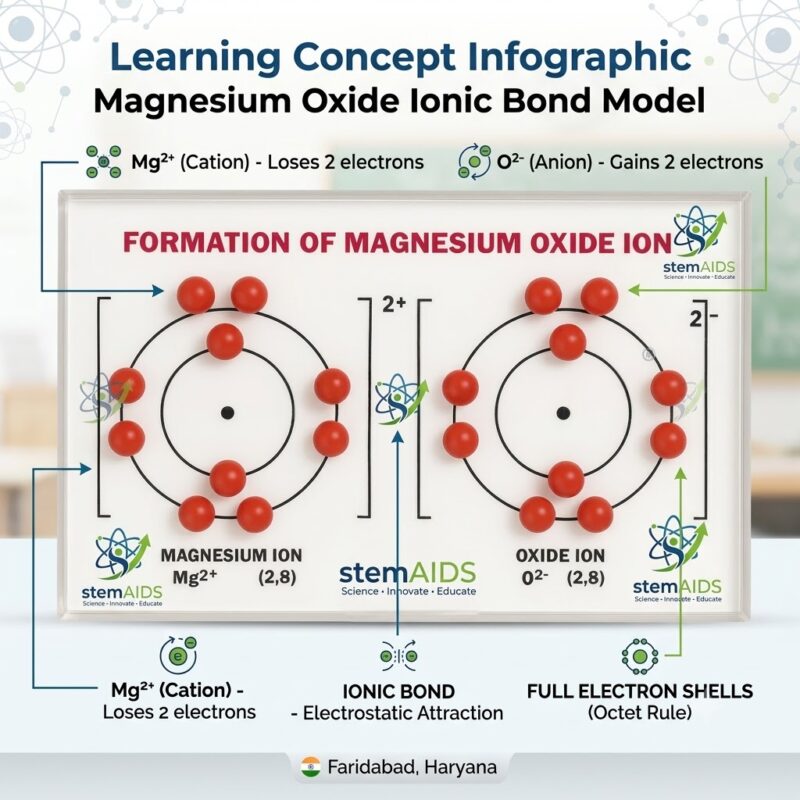
The Magnesium Oxide Ionic Bond Model is a chemistry teaching model used for explaining electron transfer and ionic bonding between magnesium and oxygen. It helps students, chemistry teachers and laboratory instructors visualise the formation of Mg²⁺ and O²⁻ ions and their arrangement within a repeating ionic crystal lattice.
Product Description
The STEMAids Magnesium Oxide Ionic Bond Model provides a three-dimensional representation of bonding in magnesium oxide. During formation, a magnesium atom loses two valence electrons and forms an Mg²⁺ ion, while an oxygen atom gains two electrons and forms an O²⁻ ion.
The oppositely charged ions attract through electrostatic forces and form an extended lattice rather than separate MgO molecules. The model supports lessons on electron configuration, ion formation, charge balance, empirical formulae and ionic-solid properties. Its exact ion arrangement, scale, colours and construction method must be confirmed against the current STEMAids specification.
Key Features
- Demonstrates electron transfer: Shows why magnesium loses two electrons while oxygen gains two.
- Identifies ion charges: Clearly distinguishes Mg²⁺ cations from O²⁻ anions.
- Explains charge balance: Illustrates why magnesium oxide has the empirical formula MgO.
- Represents an ionic lattice: Helps learners move beyond simplified molecule-like diagrams.
- Supports structure-property learning: Connects strong electrostatic attraction with characteristic ionic-solid behaviour.
- Provides spatial understanding: Makes the repeating arrangement easier to interpret than a flat diagram alone.
- Suitable for group teaching: Supports classroom demonstrations, chemistry practical discussions and science exhibitions.
Technical Specifications
|
Specification |
Detail |
|
Product name |
Magnesium Oxide Ionic Bond Model |
|
Brand |
STEMAids |
|
Product category |
Ionic bonding model / chemistry teaching model |
|
Model capacity |
One magnesium oxide bonding or lattice representation |
|
Represented compound |
Magnesium oxide, MgO |
|
Represented ions |
Magnesium ions, Mg²⁺, and oxide ions, O²⁻ |
|
Bonding concept |
Electrostatic attraction between oppositely charged ions |
|
Intended users |
Secondary-school students, college beginners, chemistry teachers and laboratory instructors |
|
Standards or certifications |
No product-specific certification publicly verified |
What’s Included in the Kit
- Magnesium-ion elements
- Oxide-ion elements
- Connectors, lattice supports or mounting components
- Electron-transfer or shell-diagram elements
- Display base or supporting stand
- Assembly diagram and teaching guide
Applications and Uses
- Explaining valence-electron transfer from magnesium to oxygen.
- Teaching the formation of Mg²⁺ and O²⁻ ions.
- Demonstrating electrical neutrality in the MgO formula.
- Introducing ionic lattices and electrostatic attraction.
- Comparing ionic bonding with covalent and metallic bonding.
- Relating lattice structure to melting point and electrical conductivity.
- Supporting chemistry revision, demonstrations and exhibitions.
How to Use the Magnesium Oxide Ionic Bond Model
- Place the model on a stable surface or assemble it according to the supplied guide.
- Identify the elements representing magnesium and oxygen.
- Review the outer-electron arrangement of each neutral atom.
- Demonstrate the transfer of two electrons from magnesium to oxygen.
- Identify the resulting Mg²⁺ and O²⁻ charges.
- Arrange or examine the ions in the represented repeating lattice.
- Explain why the charges balance in a one-to-one MgO ratio.
- Compare the model with a dot-and-cross diagram and lattice illustration.
Safety and handling: Do not force connectors or lift the complete model by one ion element. Keep small detachable components away from young children unless the product is approved for their age group.
Care & Maintenance
- Remove dust with a soft, dry cloth or brush.
- Support the model from its base when moving it.
- Do not bend connectors or apply excessive pressure to ion elements.
- Store loose components in a labelled container away from heat and moisture.
Why Choose STEMAids
STEMAids develops educational models, laboratory resources and hands-on STEM products for schools and institutional learning. Buyers can explore related educational science models, chemistry laboratory equipment, STEM learning kits and the complete scientific and educational product range. Request the current model photograph, ion arrangement, material specification and packing list before procurement.
Frequently Asked Questions
What is a Magnesium Oxide Ionic Bond Model used for?
It is used to explain electron transfer, ion formation, charge balance and the repeating ionic structure of magnesium oxide.
Which ions are present in magnesium oxide?
Magnesium oxide contains Mg²⁺ ions and O²⁻ ions.
Why is the formula magnesium oxide written as MgO?
One Mg²⁺ ion and one O²⁻ ion have equal and opposite charges, producing an electrically neutral one-to-one ratio.
Is magnesium oxide a molecule?
In standard chemistry descriptions, solid magnesium oxide is treated as an extended ionic lattice rather than a substance composed of separate MgO molecules.
Does the model show electron shells?
The displayed features are not publicly verified. Confirm whether electron-shell or dot-and-cross elements are included.
Is the model suitable for schools?
Yes. It is suitable for supervised secondary-school and introductory college lessons on bonding, ions and chemical structure.
Explore more educational science models from STEMAids for chemical bonding, atomic structure and classroom demonstrations.
Recommended primary image ALT text: Magnesium Oxide Ionic Bond Model showing Mg2+ and O2− ions in a lattice.
Recommended detail image ALT text: Chemistry model illustrating electron transfer from magnesium to oxygen.
Recommended application image ALT text: Teacher explaining magnesium oxide ionic bonding with a three-dimensional model.
You must be logged in to post a review.
Bestsellers




Sale

Sale

Sale
Sale


Reviews
There are no reviews yet.