

Sale
In Stock
Magnesium Oxide Ionic Bond Model
Original price was: $9.59.$4.96Current price is: $4.96.
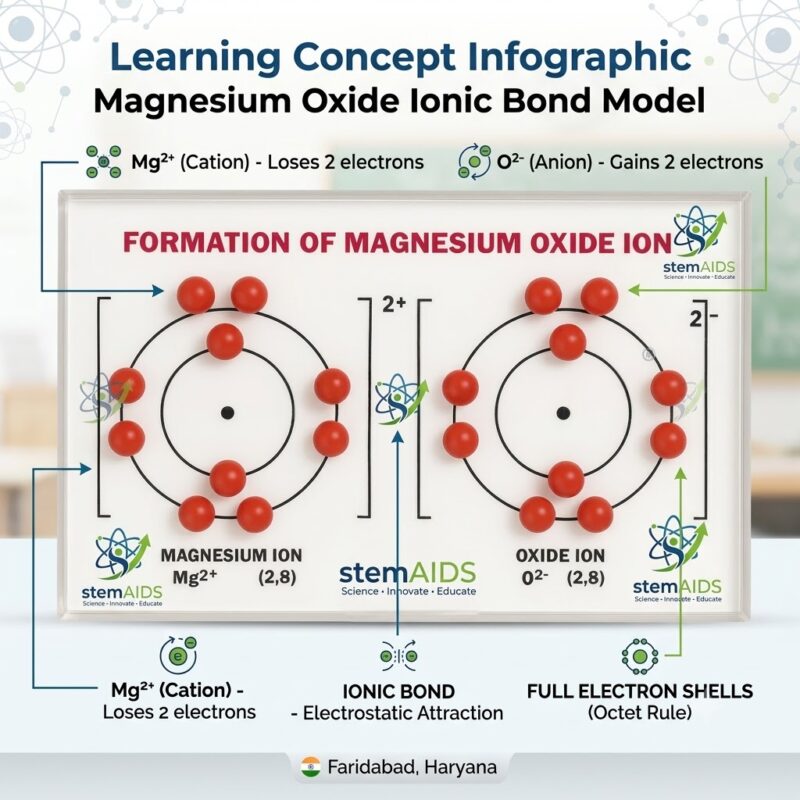
Quick Answer: The Magnesium Oxide Ionic Bond Model is a chemistry teaching display showing how magnesium and oxygen form an ionic bond. A magnesium atom (2,8,2) transfers two electrons to an oxygen atom (2,6), producing a magnesium ion Mg²⁺ and an oxide ion O²⁻, both with the stable 2,8 arrangement and held together by electrostatic attraction.
Two Electrons Transferred
The listing image of the magnesium oxide ionic bond model shows the two ions side by side, each drawn as a nucleus with concentric electron shells of coloured beads, labelled Mg²⁺ (2,8) and O²⁻ (2,8). Showing the ions after transfer, rather than just the atoms, helps students see that both partners have reached the same full outer shell as the noble gas neon.
Magnesium, in Group 2, has two electrons in its outer shell and loses them relatively easily. Oxygen, in Group 16, has six outer electrons and needs two more. When the two electrons move from magnesium to oxygen, magnesium is left with 12 protons but only 10 electrons, a charge of 2+, and oxygen has 8 protons and 10 electrons, a charge of 2−. Because the charges are equal and opposite, the formula is simply MgO, one ion of each.
Compared with sodium chloride, where single charges are involved, the doubly charged ions in magnesium oxide attract each other much more strongly. That is why magnesium oxide has a very high melting point and is used to line furnaces. In the laboratory the compound is made by burning magnesium ribbon, which gives a brilliant white flame and leaves white magnesium oxide powder; shaken with water, it turns red litmus blue, showing that it is a basic oxide.
Applications
- Teaching electron transfer and ionic bonding in Classes 9 and 10
- Drawing dot-and-cross diagrams for compounds with 2+ and 2− ions
- Linking the burning of magnesium ribbon to the structure of the product
- Explaining why ionic compounds have high melting points
Specifications
| Item | Ionic bonding model of magnesium oxide |
| Magnesium ion | Mg²⁺, electron arrangement 2,8 |
| Oxide ion | O²⁻, electron arrangement 2,8 |
| Electrons transferred | Two, from magnesium to oxygen |
| Format | Display showing both ions with bead electrons, as pictured |
| Size and mounting | Confirm at enquiry |
Care & Handling
- Wipe with a dry or slightly damp soft cloth and avoid soaking the printed labels.
- Hold the display by its frame or base, not by the electron beads.
- Store it upright or flat in a cupboard away from direct sunlight so the colours do not fade.
Why Choose LabEquip
Chemistry teachers buy this model for the chemical bonding chapter, where it follows naturally after single-charge examples. LabEquip lists it in the STEM kits range with the Formation of Sodium Ion Model, which shows the simpler one-electron case for comparison, and the Acid Base Experiment Kit for testing basic oxides. Ask for quantities on the contact page.
Frequently Asked Questions
Why does magnesium lose two electrons?
Magnesium has the arrangement 2,8,2. Losing its two outer electrons leaves the stable 2,8 arrangement of neon, which takes far less energy than gaining six more electrons would.
Why is the formula MgO and not MgO2?
The magnesium ion carries a charge of 2+ and the oxide ion a charge of 2−. One of each balances the charges exactly, so the ratio is one to one.
What holds the ions together?
Electrostatic attraction between the positive magnesium ions and the negative oxide ions. In the solid, each ion is surrounded by ions of the opposite charge in a repeating three-dimensional lattice.
Why does magnesium oxide have a higher melting point than sodium chloride?
Its ions carry double charges and are smaller, so the attraction between them is much stronger. More energy is needed to separate them, which gives a far higher melting point.
How is magnesium oxide made in the school lab?
By heating magnesium ribbon in air in a crucible, or holding it in a flame with tongs. It burns with a dazzling white light, so students should not stare at the flame, and white magnesium oxide remains.
Is magnesium oxide acidic or basic?
Basic. As a metal oxide it reacts with water to form magnesium hydroxide, which turns red litmus blue, and it neutralises acids, which is why it is used in some antacids.
Last Updated: September 2026
You must be logged in to post a review.
Bestsellers




Sale

Sale

Sale
Sale


Reviews
There are no reviews yet.