


Sale
In Stock
Heat Conductivity Apparatus
Original price was: ₹650.00.₹315.00Current price is: ₹315.00.
Quick Answer: The Heat Conductivity Apparatus is a school physics set for comparing thermal conductors: several rods of different metals radiate from a common hub, so heat applied at the centre travels outward along each rod at the same time. The listing image labels copper, brass and aluminium rods, with an insulated wooden handle.
Racing Heat Along Different Metal Rods
Conduction is the transfer of heat through a solid from particle to particle, and in metals free electrons carry much of that energy quickly. The heat conductivity apparatus turns this idea into a fair comparison. Each rod starts at the same hub, so each receives heat from the same source at the same moment, and the only thing that changes from one rod to the next is the metal.
In the classic form of the experiment, a small blob of wax is placed at the same distance along every rod, or a matchstick or pin is fixed to each one with wax. As heat spreads outward, the wax melts first on the rod that conducts most readily. Copper normally finishes first, aluminium follows and brass comes after them, which gives pupils an order they can relate to cooking pans and heat sinks.
The listing image shows the rods fanning out from a central junction on a wooden handle, which stays cool because wood is a poor conductor. The image also labels electrical connections, so the heating method intended for this model, whether flame or electrical, and the full list of metals should be confirmed before ordering.
Applications
- Ranking metals as thermal conductors in a lower-secondary heat unit
- Explaining why cooking pans have metal bases and wooden or plastic handles
- Discussing heat sinks, radiators and other designs that move heat away quickly
- Fair-test practice: naming the independent, dependent and control variables
Specifications
| Apparatus type | Multi-rod thermal conduction comparator |
| Rod metals labelled in image | Copper, brass and aluminium |
| Layout | Rods radiating from one central hub |
| Handle | Wood, a thermal insulator |
| Typical indicator | Wax blobs or wax-fixed pins at equal distances |
| Heating method and full rod list | Confirm at enquiry |
Care & Handling
- Clean old wax from every rod before a new trial, since leftover wax changes the melting time.
- Let the hub and rods cool fully before handling or packing; metal stays hot long after the wax has set.
- Use a heat-resistant mat under the apparatus and keep the wooden handle away from any flame.
- Wipe the rods dry after use and store them so they are not bent, as a kinked rod changes the heat path.
Why Choose LabEquip
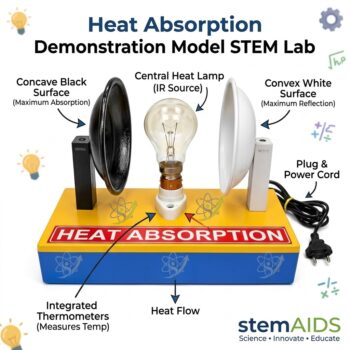
Middle-school science teachers buy this set to make the difference between conductors and insulators visible within a single lesson. LabEquip offers it as part of the STEM kits range; for the radiation side of heat transfer, the Heat Absorption Demonstration Model makes a useful companion. Request a quote through our contact page.
Frequently Asked Questions
Which metal usually conducts heat fastest in this experiment?
Copper is normally the first to melt its wax, followed by aluminium and then brass. Iron or steel, if included, conducts more slowly again. The order reflects how easily each metal passes heat energy along through its free electrons and vibrating particles.
Why must the rods be the same length and thickness?
A thicker rod carries more heat, and a shorter distance to the wax gives an earlier melt, so differences in size would hide the effect of the metal. Keeping dimensions equal makes it a fair test in which the metal is the only variable being changed.
Why is the handle made of wood?
Wood is a poor conductor of heat, so very little energy travels from the hot hub into the handle. That keeps the handle cool enough to hold and gives a built-in example of an insulator beside the metal conductors.
Is conduction the same as convection?
No. Conduction passes heat through a material without the material itself moving, which is how heat travels along these solid rods. Convection needs a fluid such as air or water, where warmer regions rise and carry heat with them.
What can go wrong with the wax method?
If the wax blobs are different sizes or placed at slightly different distances, they melt at uneven times. Draughts can cool one side more than another, and a hub heated off-centre favours the nearest rod. Repeating the trial and averaging the times makes the ranking more trustworthy.
How can I show that non-metals are poor conductors?
The wooden handle already demonstrates this. Many teachers add a quick side-by-side check with a wooden spoon and a metal spoon standing in the same beaker of hot water, which shows the same contrast without altering the apparatus.
Last Updated: September 2026
You must be logged in to post a review.
Bestsellers


Sale
Sale

Sale


Reviews
There are no reviews yet.