

Sale
In Stock
Heat Absorption Demonstration Model
Original price was: $19.18.$9.48Current price is: $9.48.
Quick Answer: The Heat Absorption Demonstration Model is a physics apparatus that places a lamp midway between two curved dishes, one black and one white, so that both receive the same radiation. Students compare how warm each surface becomes and learn why dark, matt surfaces absorb radiant heat better than light, shiny ones.
Comparing Two Surfaces in Equal Radiation
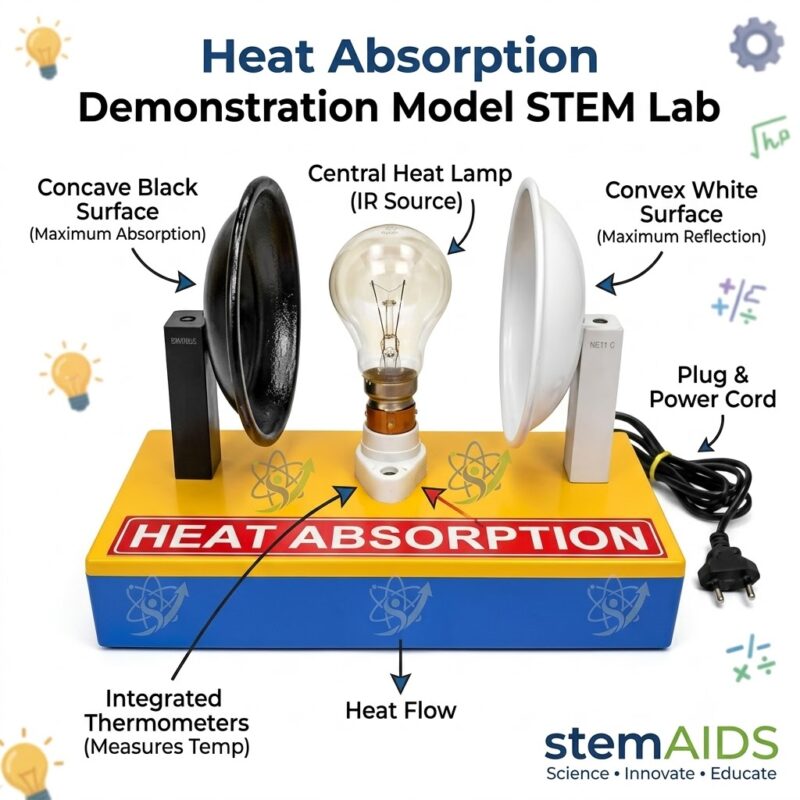
The listing image of the heat absorption demonstration model shows a mains-powered lamp in the centre of a long base, with a black concave dish on one side and a white dish on the other, each on its own post. Because the lamp is midway between them, both dishes receive the same amount of infrared and visible radiation. Any difference in how warm they become must therefore come from their surfaces, which makes this a fair test built into the apparatus.
Black surfaces absorb most of the radiation that falls on them and warm quickly; white and shiny surfaces reflect much of it and stay cooler. Teachers often fix a drawing pin to the back of each dish with a small blob of wax: the pin on the black side drops first as the wax melts. The image labels also mention thermometers, but how temperatures are read on this unit should be checked at enquiry.
The same principle explains many everyday designs. Solar water heaters and cooker panels are black, houses in hot climates are often painted white, and emergency blankets are shiny to reflect body heat back. Good absorbers are also good emitters, so the lesson leads naturally to why a black kettle cools faster than a polished one.
Specifications
| Item | Radiant heat absorption comparison apparatus |
| Heat source | Central lamp, mains powered (listing image) |
| Surfaces compared | Black dish and white dish facing the lamp |
| Layout | Lamp midway between the two surfaces on one base |
| Concepts | Absorption, reflection and emission of infrared radiation |
| Temperature measurement method | Confirm at enquiry |
Care & Handling
- Allow the lamp and dishes to cool before touching or moving the heat absorption demonstration model.
- Keep the black and white finishes clean and unscratched; a film of dust changes how they absorb.
- Unplug the lamp after use and check the cable and plug before each lesson.
- Remove any wax from the dishes with warm water, not by scraping.
Investigations
- Comparing the rate at which black and white surfaces warm up in equal radiation
- Running the wax-and-pin race to show which surface absorbs heat faster
- Discussing colour choices for solar collectors, roofs and clothing
- Linking absorption to emission in the next lesson on cooling
Why Choose LabEquip
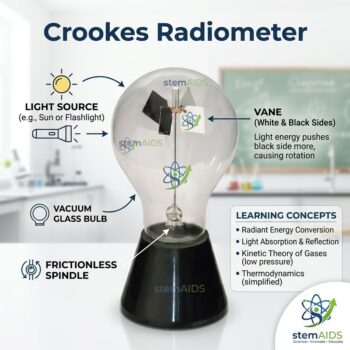
Teachers covering heat transfer need a quick, visual comparison of absorbers that works within one lesson. LabEquip lists this model in its STEM kits range, and the Crookes Radiometer offers a second way to show dark and light surfaces responding differently to radiation. Send your enquiry through the contact page.
Frequently Asked Questions
Why does the black surface warm up faster?
A dark, matt surface absorbs most of the infrared and visible radiation that reaches it, converting it into internal energy. A white or shiny surface reflects much of the radiation away, so less energy stays in it and its temperature rises more slowly.
Why is the lamp placed exactly between the two surfaces?
Radiation spreads out from the lamp, so a closer surface would receive more energy. Placing both at the same distance means they receive equal radiation, and the only variable left is the surface itself.
How does the wax and pin method work?
A small blob of wax holds a drawing pin to the back of each dish. As each dish heats up, the wax softens and the pin falls. The pin on the better absorber drops first, giving a clear result without reading thermometers.
Are good absorbers also good emitters?
Yes. A surface that absorbs radiation well also emits it well at the same temperature. That is why a hot object with a black surface cools faster than a similar object with a shiny surface.
Where is this principle used in everyday life?
Solar water heater panels are painted black to absorb sunlight, white roofs and clothing keep buildings and people cooler in hot weather, and reflective emergency blankets keep body heat in. Firefighters’ protective suits are often shiny for a similar reason.
Is the lamp safe for students to use?
The lamp and the dishes become hot, so students should not touch them during or just after a run. The unit is mains powered and should be set up by the teacher on a dry bench, with the cable routed where no one can trip on it.
Last Updated: September 2026
You must be logged in to post a review.
Bestsellers

Sale
Sale

Sale


Reviews
There are no reviews yet.