



In Stock
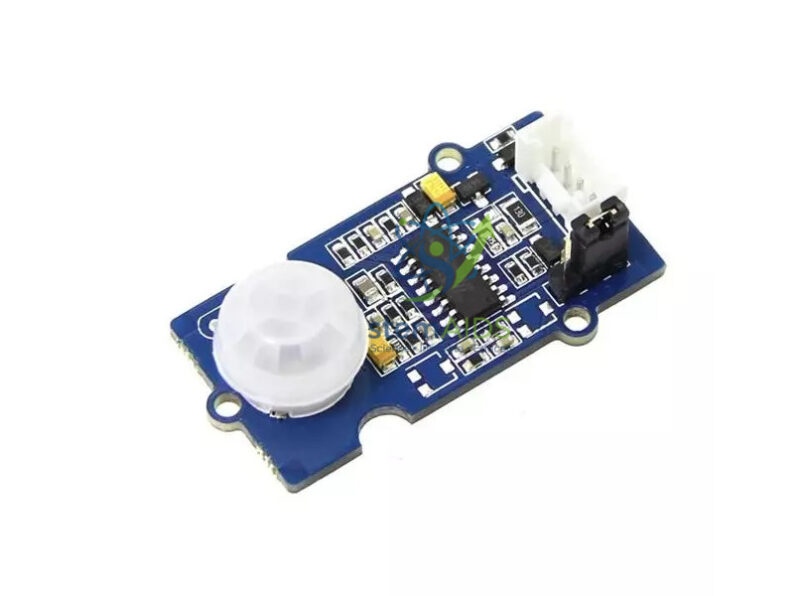
Grove PIR Motion Sensor
$7.42
Quick Answer: The Grove PIR Motion Sensor is a passive infrared sensor module on a Grove board that detects the movement of warm bodies, such as people or animals, and outputs a digital HIGH when motion is sensed. The Grove PIR motion sensor is the standard input for intruder alarms and automatic-light projects.
Sensing Movement Through Infrared
Every warm object gives off infrared radiation, and people give off much more than the walls around them. A PIR sensor contains a pyroelectric element that produces a small signal when the infrared falling on it changes. The white dome on the front is a Fresnel lens that divides the view into zones, so a person walking across the room passes from zone to zone and creates the changing signal the sensor detects.
‘Passive’ is the key word: the sensor sends nothing out and only receives. That is why it detects movement rather than presence. A person sitting perfectly still stops registering after a short time, which students can test, and which explains why automatic lights in offices sometimes switch off on people who are working quietly.
After power-up a PIR sensor needs a short settling period before its readings are reliable, and each detection holds the output HIGH for a set time. Detection range, hold time and any adjustment options depend on the version and should be confirmed before ordering.
Applications
- Intruder alarms sounding the Module Buzzer Grove
- Automatic lights for corridors or model houses
- Movement logs recording the time of each detection
- Energy-saving projects that switch outputs off when a room is empty
- Wildlife triggers at a bird table, logging when animals visit
Specifications
| Sensor | Passive infrared (PIR) motion detector, Grove module |
| Detects | Movement of warm bodies across its field of view |
| Output | Digital HIGH on detection |
| Connection | Grove digital port |
| Range, hold time and adjustments | Confirm at enquiry |
Care & Handling
- Keep the Fresnel lens of the Grove PIR Motion Sensor clean and uncracked, and do not press on the dome.
- Mount it away from heaters, radiators and sunny windows, whose changing warmth can cause false triggers.
- Allow a settling period after switching on before testing, and keep people out of view while it settles.
- Keep it under cover in outdoor projects; the board is an open circuit, not a sealed unit.
Why Choose LabEquip
Security and smart-home builds are among the most popular projects in school electronics clubs, and a motion sensor sits at the centre of them. LabEquip lists the PIR sensor in its Stem Kits range together with the Grove 2-position switch often used to arm it; send your class quantities through the contact page.
Frequently Asked Questions
Why doesn’t the sensor detect someone sitting still?
The pyroelectric element only produces a signal when the infrared reaching it changes. Someone who stays motionless creates no change, so once the hold time ends the output drops LOW and stays there until they move.
What is the white dome for?
It is a Fresnel lens that collects infrared from a wide area and divides it into zones. Movement between zones creates the changing signal the sensor detects, which widens and sharpens its coverage.
Why does the alarm go off when nobody is there?
Common causes are warm air from a heater, sunlight moving across the floor, a pet, or reading the sensor before it has settled after power-up. Move the sensor and add a short start-up delay in code.
Can it see through glass?
Usually not. Window glass is largely opaque to the long-wavelength infrared given off by the human body, so a sensor placed behind a window misses movement on the other side.
How long does the output stay HIGH after motion?
Each detection holds the output HIGH for a set time, which varies between PIR versions and may be adjustable on some boards. Measure it by printing the time of each change in code.
Which port does it use?
A digital port, because the output is simply HIGH for motion detected and LOW otherwise. The program can poll it in the main loop or respond through an interrupt for a faster reaction.
Last Updated: September 2026
You must be logged in to post a review.
Bestsellers

Sale

Sale

Sale

Sale


Reviews
There are no reviews yet.