

In Stock
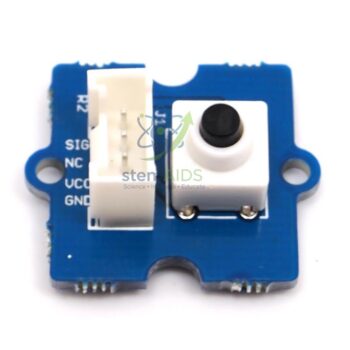
Grove magnetic switch
₹214.00
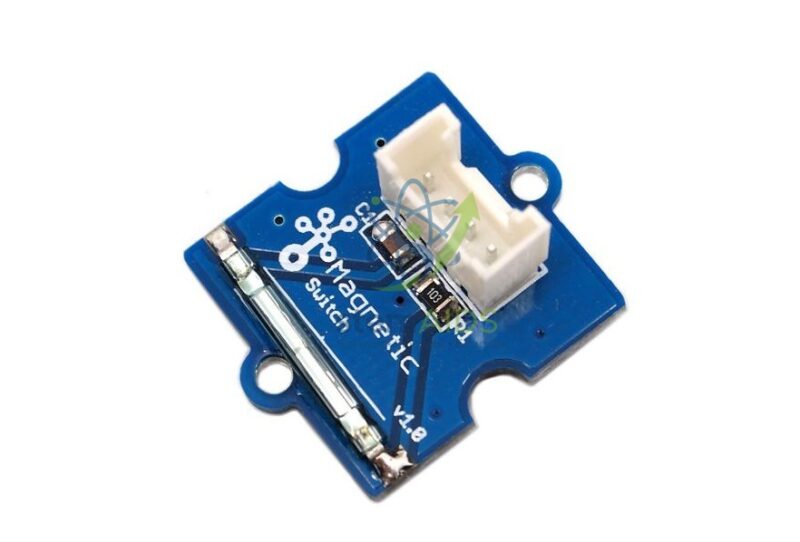
Quick Answer: The Grove magnetic switch is a Grove plug-in module built around a reed switch, a pair of thin metal contacts sealed in a small glass tube that close when a magnet comes near. The microcontroller reads it as a digital input, so students can detect a door opening, a wheel turning or an object arriving.
How a Reed Switch Responds to a Magnet
Inside the glass envelope, two flexible ferromagnetic reeds lie with a small gap between their tips. A nearby magnet magnetises both reeds so they attract each other and touch, closing the circuit. Take the magnet away and the reeds spring apart. The magnet never touches the switch, so it can sense through a thin wooden or plastic panel.
Reed-switch modules of this kind are mostly normally open, meaning the contacts stay apart until a magnet arrives. The module gives the microcontroller a clean high or low signal, and the code only has to watch for a change. Counting changes turns the same sensor into a counter: a magnet on a bicycle wheel passing the switch once per turn gives revolutions, and with the wheel circumference students can calculate distance and speed.
Switch modules do not always come with a magnet, and the switching distance depends on magnet strength and on its orientation to the tube, so confirm both when ordering. The glass tube is fragile, which affects handling.
Specifications
| Item | Reed switch mounted on a Grove module board |
| Operation | Contacts close when a magnet is brought near |
| Output | Digital signal read by the microcontroller |
| Connection | Grove 4-pin cable to a digital port |
| Senses through | Thin non-magnetic materials such as wood or plastic |
| Magnet supplied and switching distance | Confirm at enquiry |
Projects and Lessons
- Door or window alarm that sounds a buzzer when the magnet moves away
- Wheel or fan revolution counter for speed and distance calculations
- End-stop detection in a model lift, gate or sliding door
- Comparing reed switches with Hall-effect sensors in a lesson on magnetism
Care & Handling
- Do not bend the reed switch leads close to the glass, as the glass seal can crack.
- Keep strong magnets away from the micro:bit compass, computer drives and magnetic-stripe cards.
- Store the module and magnet apart so the magnet does not collect metal filings from the bench.
Why Choose LabEquip
Physics and computing teachers both use magnetic switches, since the module links magnetism with digital input in a single activity. You will find it in the LabEquip STEM kits range, and door-alarm builds often add the Grove Mini PIR sensor as a second trigger. For group quantities, use the contact page.
Frequently Asked Questions
How close does the magnet need to be?
It depends on the magnet’s strength and on how it lines up with the glass tube. A small magnet typically has to come within a short distance, and lining it up with the length of the tube helps. Students can measure the switching distance as an experiment.
What is the difference between a reed switch and a Hall-effect sensor?
A reed switch has metal contacts that physically close and needs no power of its own to operate. A Hall-effect sensor is a solid-state chip that detects the field electronically and needs a supply. Reed switches are simple to demonstrate, while Hall sensors have no moving parts to wear.
Why does my counter record more than one pulse per turn?
Mechanical contacts can bounce, opening and closing several times within a few milliseconds as they meet. Adding a short delay after each detected change, called debouncing, gives one clean count per pass of the magnet.
Does the switch work through a door frame?
It works through thin wood, plastic or card, because these do not block a magnetic field. Iron or steel between the magnet and the switch diverts the field and stops it working, so on metal doors mount both parts on the surface.
Is a reed switch normally open or normally closed?
Reed-switch modules for classroom use are usually normally open, closing when the magnet is present. Some reed switches are made normally closed or changeover. Test the module with a magnet and watch the reading to see which way it behaves.
Can the magnetic switch count objects on a conveyor?
Yes, if each object carries a small magnet. Each pass closes the switch once, and the code adds to a total shown on a display. For objects without magnets, a light gate or an infrared sensor is the usual alternative.
Last Updated: September 2026
You must be logged in to post a review.
Bestsellers

Sale
Sale

Sale
Sale


Reviews
There are no reviews yet.