




In Stock
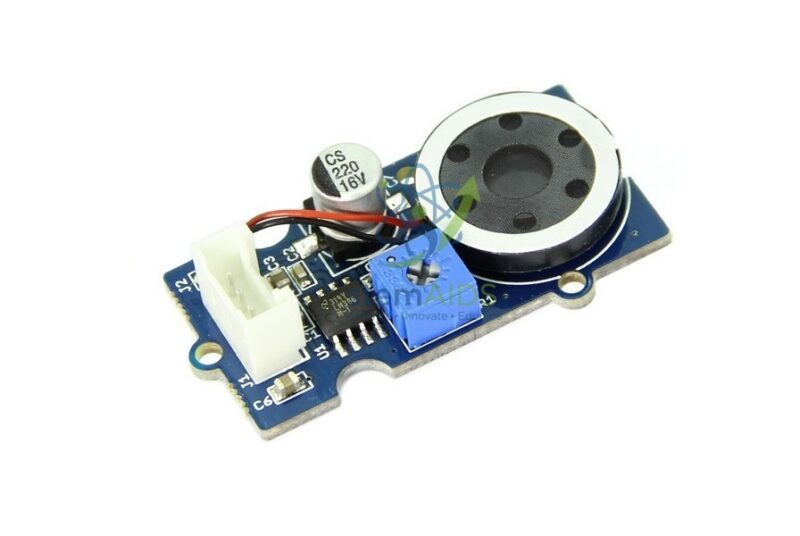
Grove Amplifier Speaker
₹345.00
Quick Answer: The Grove Amplifier Speaker is a sound output module that combines a small loudspeaker with an amplifier circuit on a Grove-connector board. Driven by a signal from a microcontroller pin, the Grove amplifier speaker plays tones, melodies and sound effects more clearly than a simple buzzer.
Why the Speaker Needs an Amplifier
A microcontroller pin can switch only a small current, far less than a loudspeaker coil needs to move its cone and push enough air to be heard across a room. The amplifier on the Grove Amplifier Speaker boosts the pin’s signal to drive the speaker properly, so the controller only has to supply the waveform. The frequency of that waveform sets the pitch students hear.
That makes the module a natural bridge between coding and the physics of sound. The A above middle C has a frequency of 440 hertz, and each octave up doubles the frequency, so students can build a scale in code from a table of frequencies or calculate it. Varying note lengths adds rhythm, and a whole tune becomes an array of frequencies and durations.
Where a project needs only an alert beep, the smaller Module Buzzer Grove is enough. Whether this speaker board has a volume adjuster, and its supply voltage, should be confirmed before ordering.
Specifications
| Module | Loudspeaker with on-board amplifier, Grove board |
| Input | Tone or waveform signal from a microcontroller pin |
| Connection | Grove port on a shield or Grove-ready board |
| Typical use | Melodies, sound effects and distinct alert tones |
| Volume control and supply voltage | Confirm at enquiry |
Applications
- Playing melodies stored as arrays of note frequencies and durations
- Doorbells and alarms with different tones for different events
- Investigating pitch and frequency, including the range of frequencies students can hear
- Game sound effects and sensor-driven instruments, such as a light-controlled theremin with the Grove Light Sensor
Care & Handling
- Keep the cone of the Grove Amplifier Speaker clear of pencils and fingers; a dented cone buzzes.
- Start with short tones and low volume when testing, especially when several groups share a room.
- Keep the speaker away from compasses used in the same lesson, since its magnet deflects the needle.
- Unplug power before swapping Grove cables, and store the module in a padded box.
Why Choose LabEquip
Music-and-coding activities are a popular way into programming, and a speaker gives them a sound worth hearing. LabEquip lists this speaker in its Stem Kits range next to the buzzer and sensor modules; enquire about class quantities through the LabEquip contact page.
Frequently Asked Questions
How is the speaker different from the Grove buzzer?
The buzzer is designed for simple beeps. The speaker, with its amplifier, reproduces a wider range of frequencies with a cleaner tone, so melodies and sound effects sound more natural.
How do I play a musical note?
Generate a square wave at the note’s frequency, for example with the tone function in Arduino code. The A above middle C has a frequency of 440 hertz, and moving up an octave doubles the frequency.
Can it play recorded audio such as speech?
Not by itself with simple tone code. Playing recordings needs a way to store and output audio samples, such as an audio player module. The speaker is intended for tones and generated sounds.
Why is the sound quiet or distorted?
Check the Grove cable and port, the supply voltage on the shield and any volume setting on the board. Very low or very high frequencies also sound weaker on a small speaker than mid-range tones.
What physics can students investigate with it?
Pitch and frequency, octaves, beats heard when two close frequencies play on separate speakers, and the upper limit of human hearing, which varies between people and usually falls with age.
Is it suitable for younger pupils?
Yes, with guidance. Block-based coding tools can play notes and tunes without text code, so primary pupils can compose short melodies while older students work with frequency tables and arrays.
Last Updated: September 2026
You must be logged in to post a review.
Bestsellers


Sale

Sale

Sale


Reviews
There are no reviews yet.