


Sale
In Stock
Giant Yo-Yo model
Original price was: ₹1,150.00.₹565.00Current price is: ₹565.00.
Quick Answer: The Giant Yo-Yo Model is a large version of a yo-yo, also known as a Maxwell wheel: a heavy disc on an axle hangs from two cords wound around the axle on a tall frame. When released, the disc spins as it falls and then climbs back up, showing how gravitational potential energy is shared between linear and rotational kinetic energy.
Energy in a Falling, Spinning Disc
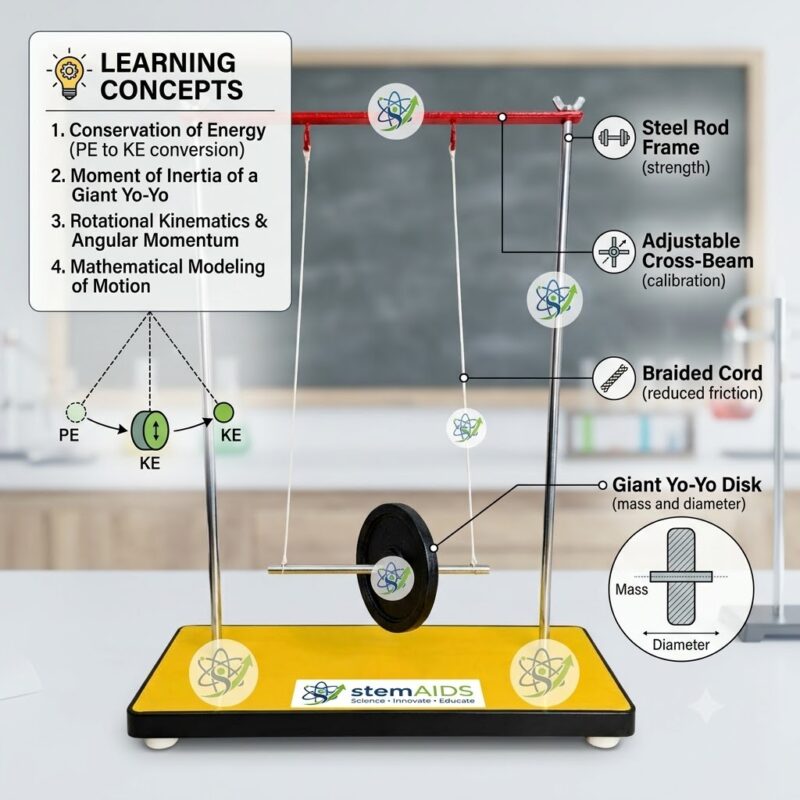
In the listing image, the giant yo-yo model is a black disc on a thin axle, hung from a cross-beam by two cords, one on each side of the disc, on a frame with two steel uprights and a flat base. The cords are wound around the axle to lift the disc to the top. When it is let go, the cords unwind and the disc spins faster and faster as it drops. At the bottom the cords begin to rewind the other way, and the disc climbs almost back to its starting height before falling again.
The disc falls much more slowly than a stone dropped beside it. Part of the gravitational potential energy it loses becomes rotational kinetic energy, so less is left for moving downward. For a disc of mass m, moment of inertia I and axle radius r, the acceleration is g / (1 + I/mr²). Because the axle is thin, I/mr² is large and the acceleration is only a small fraction of g, which makes the motion easy to time.
Each climb is slightly lower than the last because friction and air resistance convert some energy to heat, giving a clear, visible example of energy dissipation. With a stopwatch and a metre rule, students can find the acceleration, calculate the moment of inertia and compare it with the value from the disc’s measured mass and radius. The disc mass and frame height should be confirmed at enquiry.
Measurements and Demonstrations
- Comparing the fall of the yo-yo with free fall
- Timing the descent to find the acceleration and moment of inertia
- Showing energy transfer between potential, translational and rotational forms
- Measuring rebound heights to estimate the energy lost per cycle
Specifications
| Item | Maxwell wheel (large yo-yo) demonstration |
| Rotating part | Heavy disc on an axle (listing image) |
| Suspension | Two cords wound on the axle, hung from a cross-beam |
| Frame | Two uprights on a flat base |
| Concepts | Conservation of energy, rotational kinetic energy, moment of inertia |
| Disc mass and frame height | Confirm at enquiry |
Care & Handling
- Wind the two cords evenly on the axle so the disc falls level and does not twist.
- Check the cords for wear before each lesson; a snapped cord drops a heavy disc.
- Keep feet and hands clear of the space below the disc.
- Level the frame and adjust the cross-beam so both cords are the same length.
Why Choose LabEquip
Physics teachers covering rotational mechanics look for apparatus that turns the equations into a motion students can time themselves. LabEquip lists this model in its STEM kits range with the Bicycle Wheel Gyroscope, which carries rotation on to angular momentum. Enquire through the contact page.
Frequently Asked Questions
Why does the yo-yo fall more slowly than a dropped ball?
Some of the energy released as it falls goes into making the disc spin. Less energy is left for downward motion, so it accelerates much more gently than free fall. The thinner the axle, the more of the energy goes into rotation.
Why does it climb back up after reaching the bottom?
At the bottom the disc is spinning fast. The cords begin to wind on to the axle in the opposite direction, and the rotational kinetic energy is converted back into gravitational potential energy as the disc rises.
Why does each climb end a little lower?
Friction in the cords, air resistance and the jerk at the bottom convert some energy into heat and sound. The total energy of the moving disc decreases each cycle, so the height it reaches keeps falling until it stops.
How can students find the moment of inertia?
Measure the distance fallen and the time taken to find the acceleration. The acceleration equals g divided by one plus I over m r squared, so with the measured mass and axle radius, I can be calculated and compared with half the mass times the disc radius squared, the value for a uniform disc.
Is the giant yo-yo the same as a Maxwell wheel?
Yes, in principle. A Maxwell wheel is the laboratory form of the yo-yo, named after James Clerk Maxwell, with a heavy wheel on an axle suspended by two threads so that it falls and rises repeatedly.
Is the model safe in the classroom?
Yes, with care. The disc is heavy and gains speed as it falls, so keep hands and feet out of its path, check the cords before use, and stop the disc by hand only when it is near the top of its climb and moving slowly.
Last Updated: September 2026
You must be logged in to post a review.
Bestsellers




Sale
Sale

Sale
Sale


Reviews
There are no reviews yet.