
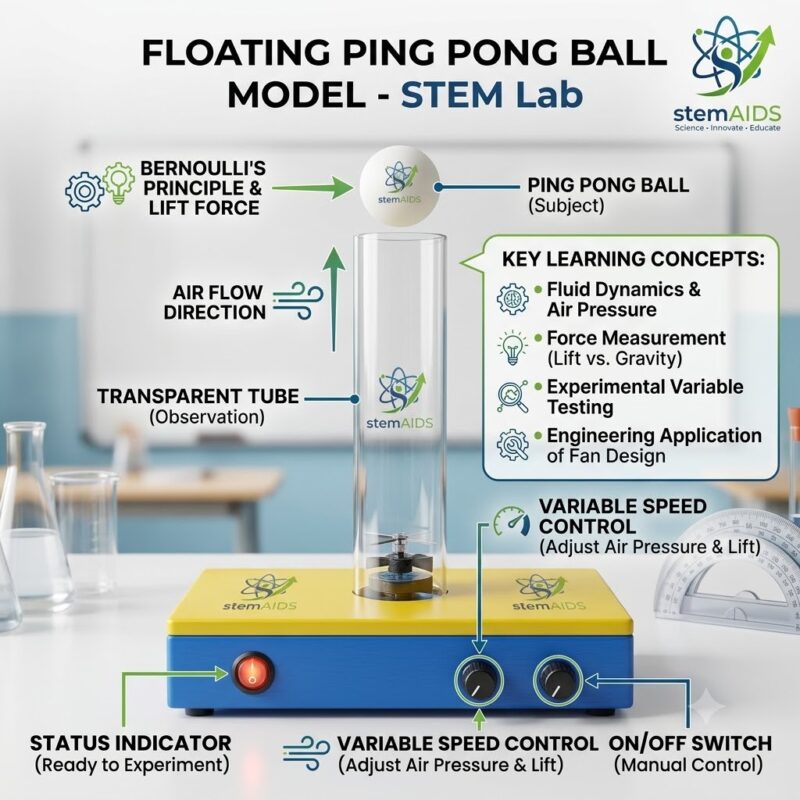
The Floating Ping Pong Ball Model is a physics demonstration apparatus used for suspending a lightweight ball in a directed stream of air. It helps students, science teachers and laboratory instructors explore airflow, pressure distribution, drag, force balance and stable levitation through one visible classroom experiment.
Product Description
The STEMAids Floating Ping Pong Ball Model provides a practical demonstration of fluid flow around a lightweight spherical object. A blower or fan directs air upward through a nozzle, producing a jet that exerts an upward aerodynamic force on the ball.
When the upward force balances the ball’s weight, the ball remains suspended. If it moves partly outside the jet, the airflow pattern and resulting pressure and momentum forces can direct it back toward the moving-air column. The precise blower, nozzle, ball and airflow-control configuration must be confirmed from the current STEMAids specification.
Key Features
- Demonstrates airflow levitation: Suspends a lightweight ball in a continuous upward air stream.
- Shows force balance: Helps learners compare downward gravitational force with upward aerodynamic force.
- Introduces pressure differences: Supports discussion of how airflow speed and pressure vary around the ball.
- Demonstrates stable positioning: Shows how the ball can return toward the air jet after a small sideways displacement.
- Supports nozzle-angle experiments: May allow the ball to remain in an inclined air stream where the confirmed design permits adjustment.
- Encourages observation and prediction: Learners can test different balls, airflow settings and nozzle positions.
- Suitable for group demonstrations: Supports physics lessons, STEM activities and science exhibitions.
Technical Specifications
|
Specification |
Detail |
|
Product name |
Floating Ping Pong Ball Model |
|
Brand |
STEMAids |
|
Product category |
Airflow demonstration apparatus / fluid-dynamics teaching model |
|
Setup capacity |
One airflow-levitation demonstration unit |
|
Teaching concepts |
Air pressure, drag, gravity, momentum transfer, force balance and fluid flow |
|
Intended users |
Primary and secondary students, science teachers, STEM instructors and laboratory staff |
|
Standards or certifications |
No product-specific certification publicly verified |
What’s Included in the Kit
- Air blower, fan or pumping unit
- Vertical or adjustable airflow nozzle
- Ping-pong ball or lightweight ball set
- Airflow controller or speed switch
- Supporting base, housing and protective grille
- Power adapter, cable or battery holder
- Operating instructions and activity guide
Applications and Uses
- Demonstrating the levitation of a lightweight ball in an air jet.
- Comparing gravitational and aerodynamic forces.
- Introducing Bernoulli-related pressure concepts.
- Explaining drag and momentum transfer from moving air.
- Investigating stability after sideways displacement.
- Comparing balls with different masses, diameters or surfaces.
- Supporting fluid-dynamics lessons and science exhibitions.
How to Use the Floating Ping Pong Ball Model
- Place the apparatus on a stable, level and dry surface.
- Inspect the blower, nozzle, grille, cable and ball for damage.
- Position the nozzle vertically unless another angle is approved.
- Connect only the specified power source.
- Switch on the airflow at its lowest practical setting.
- Place the supplied ball carefully above the centre of the air jet.
- Adjust the airflow gradually until the ball remains suspended.
- Move the nozzle slightly or disturb the ball gently to observe its stability.
- Switch off the apparatus before changing attachments or cleaning it.
Safety and handling: Keep fingers, hair, paper and loose clothing away from blower openings. Use only lightweight approved balls, do not block the air inlet and disconnect the apparatus before inspection or cleaning.
Care & Maintenance
- Disconnect power before cleaning the blower or nozzle.
- Remove dust from air inlets and protective grilles regularly.
- Keep the ping-pong balls clean, dry and free from dents.
- Store the apparatus away from moisture, impact and excessive heat.
Why Choose STEMAids
STEMAids develops educational models, experiment kits and laboratory products for practical science instruction. Buyers can explore related physics laboratory products, educational science models, STEM learning kits and the complete scientific and educational product range. Request the current blower rating, nozzle arrangement, ball specifications, electrical requirements and packing list before procurement.
Frequently Asked Questions
What is a Floating Ping Pong Ball Model used for?
It is used to demonstrate how an upward air stream can suspend and stabilise a lightweight ball.
Why does the ping-pong ball float?
The moving air exerts an upward aerodynamic force. The ball remains at a height where this upward force approximately balances its weight.
Why does the ball stay inside the air stream?
When the ball moves sideways, the altered airflow and pressure distribution can create a restoring force that directs it back toward the jet.
Is the demonstration explained only by Bernoulli’s principle?
No. Bernoulli-related pressure differences are relevant, but drag, momentum transfer, entrainment and the shape of the air jet also contribute.
Can other balls be used?
Only suitably lightweight balls should be tested. A ball that is too heavy, large or irregular may not levitate and could overload the blower.
Does the apparatus include variable airflow?
The control configuration is not publicly verified. Confirm whether the supplied model includes adjustable blower speed or a fixed airflow setting.
Explore more physics laboratory apparatus from STEMAids for pressure, airflow and fluid-dynamics demonstrations.
Recommended primary image ALT text: Floating Ping Pong Ball Model suspending a lightweight ball above an airflow nozzle.
Recommended detail image ALT text: Physics airflow apparatus showing a ping-pong ball balanced in a vertical air jet.
Recommended application image ALT text: Students observing stable ball levitation with a Floating Ping Pong Ball Model.




Reviews
There are no reviews yet.