
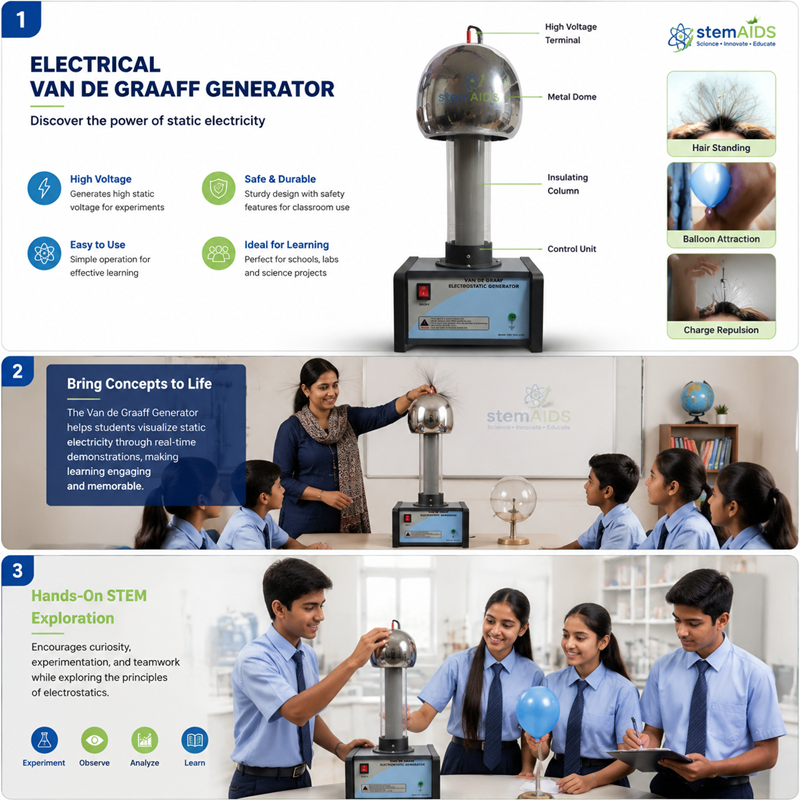
Quick Answer: The Electrical Van De Graaff Generator is a motor-driven electrostatic generator that builds up a large static charge on a metal dome. The listing image shows a polished dome on an insulating column above a base with a control unit, used for hair-raising, balloon attraction and charge-repulsion demonstrations.
How the Belt Charges the Dome
Inside the insulating column an electric motor drives a belt, typically rubber, over two rollers. Contact and rubbing between the belt and the lower roller transfer charge, a process called triboelectric charging, and the belt carries that charge upward. At the top, a comb of sharp points close to the belt collects the charge and passes it to the dome. Because like charges repel, the charge spreads over the outer surface of the dome, and it keeps building up as long as the belt runs.
In this electrical version the belt is driven by the motor in the base and started from the control unit, rather than turned by a hand crank, which leaves the presenter free to run demonstrations with both hands. The dome’s rounded shape matters: charge concentrates at sharp points and leaks into the air there, so a smooth sphere holds a much larger charge before sparking.
A Van de Graaff generator performs poorly in humid air, which lets charge leak away, so demonstrations are usually strongest on dry days. Accessories such as a discharge sphere, and the motor’s supply rating, should be confirmed when ordering.
Specifications
| Apparatus type | Belt-driven electrostatic generator |
| Drive | Electric motor in the base with a control unit, as pictured |
| Collector | Metal dome on an insulating column |
| Charging principle | Triboelectric charging carried up by a moving belt |
| Demonstrations shown in image | Hair standing, balloon attraction, charge repulsion |
| Supply rating and accessories | Confirm at enquiry |
Applications
- Hair-raising demonstrations of like charges repelling
- Showing attraction of light objects and repulsion of charged foil or paper
- Spark discharge to an earthed sphere as an introduction to lightning
- Charging a gold leaf electroscope for further electrostatics work
Care & Handling
- Discharge the dome with an earthed sphere or wand before anyone touches it or the machine is moved.
- Keep the belt and column clean and dry; dust and moisture let charge leak away.
- Keep phones, laptops and other electronics well clear of the dome and any sparks.
- Follow the instructions on belt tension for long storage, so the belt does not take a permanent set.
Why Choose LabEquip
Physics departments and science centres buy the electrical model for regular demonstrations where a hand crank would tie up the presenter. LabEquip offers it within the STEM kits range, and the Gold Leaf Electrostatic Apparatus makes a natural partner for detecting the charge it produces. Reach us through our contact page.
Frequently Asked Questions
What makes a volunteer’s hair rise during the demonstration?
A volunteer standing on an insulating base and resting a hand on the dome charges up along with it. Each hair receives charge of the same sign, and like charges repel, so the hairs push away from each other and from the head. Fine, dry, clean hair shows the effect most clearly.
How does humidity affect the charge the dome can hold?
Water vapour in the air and a thin film of moisture on surfaces let charge leak away almost as fast as the belt delivers it. In dry conditions the air insulates better, so the dome can build up a much larger charge.
Why does the charge collect on the outside of the dome?
Charges of the same sign repel each other and move as far apart as they can. On a conductor, the farthest they can get is the outer surface, so the inside of the dome carries almost no charge. This is also why a metal car body shields its occupants.
How safe is the discharge for a school class?
The voltage is high but the charge stored is small, so on a school machine the spark is usually a sharp sting rather than an injury. People with pacemakers or other implanted electronic devices must stay away, and the dome should always be discharged before it is touched.
Why is the top a rounded dome instead of a pointed shape?
On a sharply curved surface the charge density, and the field just outside it, rise until the surrounding air breaks down and conducts, so charge sprays away from points. A smooth, rounded surface spreads the charge evenly and can hold much more before a discharge occurs.
What does the motor actually do?
The motor supplies the mechanical work needed to carry charge up the belt against the repulsion of the charge already on the dome. That work is stored as electrical potential energy, which is released when the dome sparks to a nearby conductor.
Last Updated: September 2026






Reviews
There are no reviews yet.