








Sale
In Stock
Earth’s Shape Due to Rotation Model
Original price was: $15.23.$7.50Current price is: $7.50.
Quick Answer: The Earth’s Shape Due to Rotation Model is a hand-cranked apparatus in which flexible metal hoops, fixed to a vertical spindle, flatten at the top and bulge at the middle when spun quickly. It shows why a rotating Earth is an oblate spheroid rather than a perfect sphere.
Why Spinning Flattens a Sphere
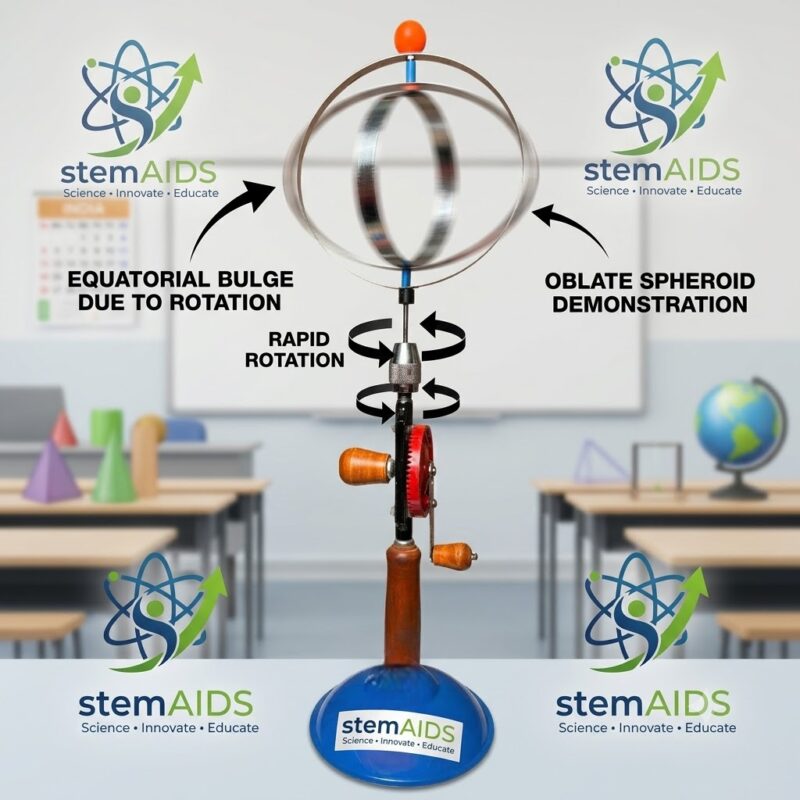
In the listing image the model has two crossed metal hoops forming a sphere around a vertical spindle, driven by a hand crank through gears and mounted on a wooden stem and a heavy base. In this classic design the hoops are fixed at the bottom and free to slide on the spindle at the top. At rest they form a circle; turn the handle and, as the spindle whirls, the hoops spread outwards at the middle and the top collar slides down, so the sphere squashes into a flattened shape.
The explanation lies in circular motion. Every part of a spinning hoop needs a centripetal force to keep it on its circular path, and the parts at the ‘equator’ travel in the largest circles at the highest speed. The springy metal can only supply that force by bending outward, so the equator bulges and the poles move closer together. The faster the rotation, the greater the flattening.
Earth behaves the same way, though far less dramatically. Its daily rotation makes the equatorial diameter slightly larger than the polar diameter, a difference of a few tens of kilometres on a planet roughly 12,700 km across. Faster-spinning planets such as Jupiter and Saturn are visibly flattened in telescope images, which gives students a striking comparison.
Specifications
| Item | Rotating-hoop model of the oblate Earth |
| Drive | Hand crank with gearing to a vertical spindle (listing image) |
| Rotating part | Flexible metal hoops that flatten as they spin |
| Mounting | Upright stem on a round base |
| Concepts | Centripetal force, oblate spheroid, planetary rotation |
| Hoop count and overall height | Confirm at enquiry |
Where the Model Is Used
- Geography and Earth science lessons on the true shape of Earth
- Physics lessons on centripetal force and circular motion
- Comparing the flattening of Earth, Jupiter and Saturn
- Discussing why objects weigh very slightly less at the equator than at the poles
Care & Handling
- Turn the crank smoothly and build speed gradually; jerking the handle strains the gear teeth.
- Keep fingers and loose hair away from the hoops while they spin.
- If the top collar sticks on the spindle, clean it and apply a trace of light oil.
- Store the model upright and do not rest anything on the hoops, which can be bent out of shape.
Why Choose LabEquip
Geography and physics teachers both use this model, one for the shape of the planet and the other for circular motion, so it often serves a whole department. LabEquip lists it in the STEM kits range alongside the Bicycle Wheel Gyroscope, another rotation demonstration. Ask about quantities on the contact page.
Frequently Asked Questions
Why do the hoops bulge in the middle but not at the top?
The middle of each hoop travels around the widest circle, so it needs the greatest centripetal force. The springy metal bends outward until its tension supplies that force. Points near the spindle move in small circles and hardly bulge, so the top collar is pulled downward.
Is Earth really flattened at the poles?
Yes, slightly. Rotation makes the diameter through the equator a few tens of kilometres larger than the diameter through the poles. The shape is called an oblate spheroid; from space Earth still looks round because the difference is small compared with its size.
Does spinning faster always give more flattening?
On the model, yes, up to the point where the hoops reach the limit of their flexibility. For planets, faster rotation and a less rigid interior both increase flattening, which is why the rapidly spinning gas giants are noticeably squashed.
Why do objects weigh slightly less at the equator?
There are two reasons: a point on the equator is a little farther from Earth’s centre, and part of the gravitational pull is used to keep it moving in a circle as Earth spins. The combined effect is less than one percent, but it is measurable.
What age group is the model suitable for?
Middle school pupils can watch and describe the change of shape, while senior physics students can explain it with centripetal force. Because it is hand-cranked and needs no power supply, it is easy to use in any classroom.
How should the model be demonstrated?
Stand it on a firm bench, hold the base steady and turn the handle slowly at first so students see the round shape. Then increase the speed to show the flattening, and slow down again to show the hoops spring back.
Last Updated: September 2026
You must be logged in to post a review.
Bestsellers


Sale
Sale
Sale
Sale


Reviews
There are no reviews yet.