



Sale
In Stock
DIY 3D Hologram Maker Set
Original price was: $14.66.$7.22Current price is: $7.22.
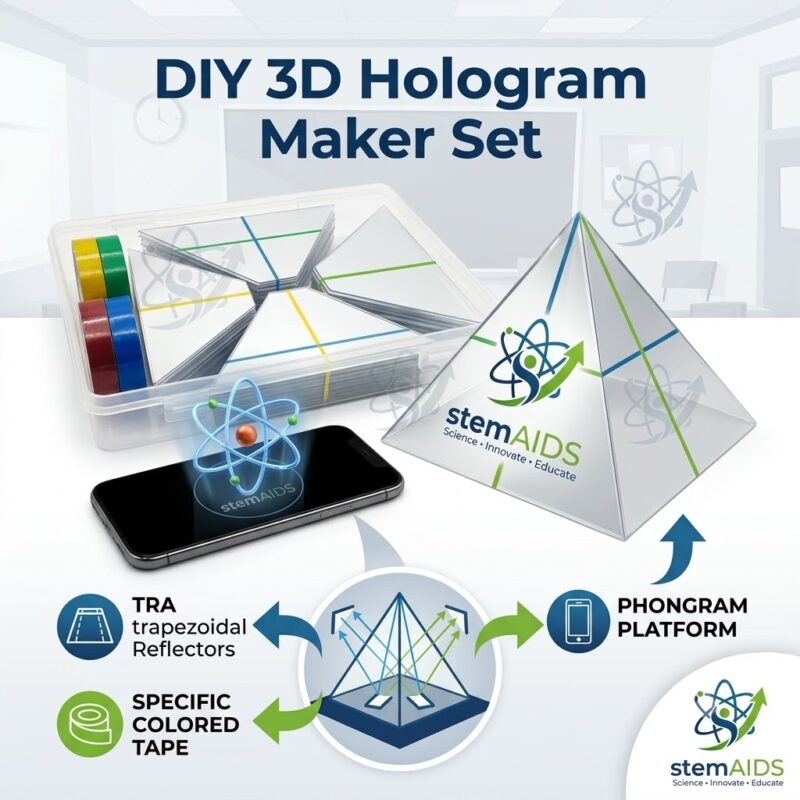
Quick Answer: The DIY 3D Hologram Maker Set is a build-it-yourself optics kit for making a clear four-sided pyramid that sits on a smartphone screen. When a special four-view video plays, each face reflects one view toward the viewer, and together they create a floating image in the middle, the illusion known as Pepper’s ghost.
What the Pyramid Actually Does
The listing image of the DIY 3D hologram maker set shows transparent trapezoidal reflector sheets, coloured tape for joining them and a platform for a phone, with the finished pyramid placed on the screen. Each side of the pyramid is tilted at about 45 degrees to the screen, so light from the part of the video beneath that side is reflected out horizontally to the viewer.
The picture is really a reflection, a virtual image that seems to hang inside the pyramid, so strictly it is not a hologram. A true hologram records the interference pattern of laser light and rebuilds the whole wavefront, whereas this effect is the stage trick named after John Henry Pepper, who used an angled sheet of glass to put ghosts on a Victorian theatre stage. Explaining that distinction is one of the most useful outcomes of the project.
Building the pyramid also teaches careful making. Students measure and cut or fold the four trapezoids to match, tape the edges squarely and learn that small errors in angle make the four views misalign. Videos for the effect show the same object four times around a black centre; many are freely available, and older students can make their own with free video software. Whether the phone platform and a cutting template are included should be confirmed when ordering.
Care & Handling
- Peel any protective film from the sheets only after cutting, so the faces stay free of scratches.
- Clean the sheets with a soft cloth; paper towels leave fine scratches that blur the image.
- Store the finished pyramid in a box so the taped edges are not crushed.
- Take care with craft knives or scissors if the sheets need trimming, and cut on a mat.
Applications
- Optics lessons on reflection, virtual images and partial reflection
- Design-and-make projects where accuracy of construction affects the result
- Digital media activities in which students produce their own four-view videos
- Science fair exhibits explaining why the display is not a true hologram
Specifications
| Item | Build-your-own smartphone reflection pyramid set |
| Reflectors | Four transparent trapezoidal sheets |
| Assembly | Coloured tape to join the sheets, as shown in the listing image |
| Display source | Smartphone or tablet playing a four-view video (device not assumed to be included) |
| Effect | Floating virtual image by Pepper’s ghost reflection |
| Platform and template contents | Confirm at enquiry |
Why Choose LabEquip
Teachers running STEM clubs, maker spaces or optics projects usually choose this set because the build fits into one session and the result impresses. LabEquip lists it in the STEM kits range, and teachers who want to take the reflection theme further often add the Reflection of Light Experiment Kit for measured ray work. Contact us through the contact page.
Frequently Asked Questions
Is the image a real hologram?
No. It is a reflected virtual image, the same illusion as the Pepper’s ghost stage trick. A true hologram is recorded with laser light and shows depth by rebuilding the light waves, while this effect relies on angled transparent sheets reflecting a flat video.
Why do the sheets need to be at 45 degrees?
A sheet tilted at 45 degrees to the screen reflects light rising from the screen out sideways towards the viewer’s eye. At other angles the reflected image tilts or moves out of view, so the four images no longer meet at the centre.
What kind of video should be played?
Use a hologram-style video showing the same object four times, arranged around a black centre with each view turned to face one side of the pyramid. The black background matters, because bright areas would reflect too and wash out the floating image.
Why does the effect look better in a dark room?
The reflection is faint compared with room light passing through the sheets. In a darkened room the only bright thing is the reflected video, so the image appears to float with nothing competing for attention.
Can any smartphone be used?
Most phones work if the narrow end of the pyramid fits the screen and the brightness is turned up. Larger screens give a larger image, and a tablet can be used if the pyramid is scaled up to match.
What skills does the project build?
Students practise measuring, cutting and assembling to a tolerance, apply the law of reflection to explain the effect, and use digital tools if they create their own four-view videos. It combines design, physics and media work in one activity.
Last Updated: September 2026
You must be logged in to post a review.
Bestsellers

Sale
Sale
Sale


Reviews
There are no reviews yet.