





Sale
In Stock
Center of Gravity Demonstration Apparatus
Original price was: $10.15.$4.96Current price is: $4.96.
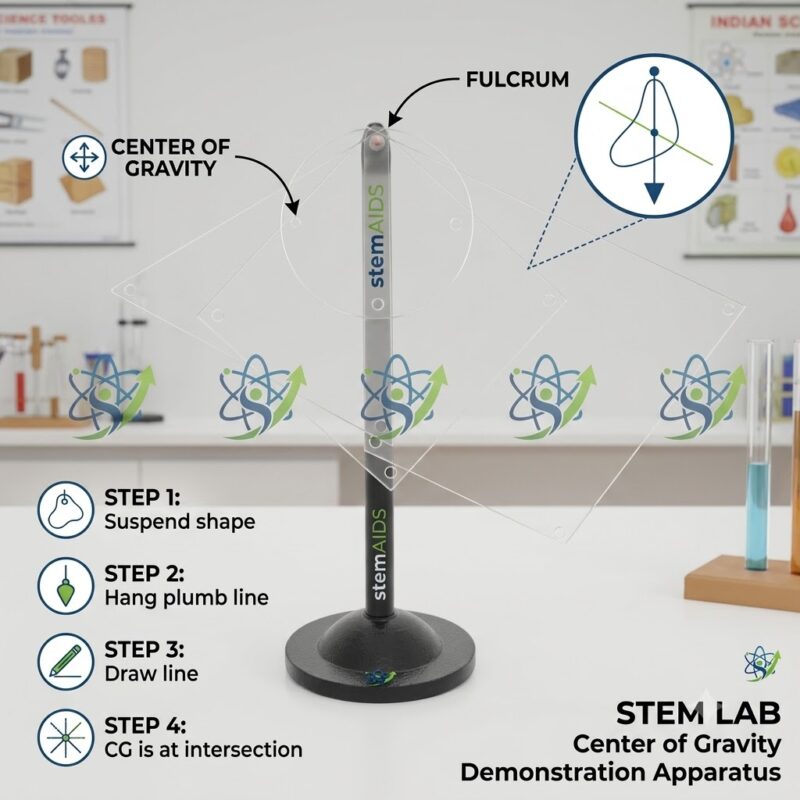
Quick Answer: The Center of Gravity Demonstration Apparatus is a stand-and-plumb-line set for locating the balance point of flat shapes. A lamina hangs freely from a pin at the top of the stand, a plumb line hangs from the same pin, and lines drawn from two or more suspension points cross at the centre of gravity.
The Suspension Method, Step by Step
When a flat object hangs freely from a pin, it swings until its centre of gravity lies directly below the point of suspension. At that position the weight acting through the centre of gravity has no turning effect about the pin. A plumb line hung from the same pin therefore passes through the centre of gravity, and tracing along the thread marks one line on which the balance point must lie.
The listing image shows a tall stand on a heavy round base with a fulcrum pin at the top, an irregular transparent shape hanging from it and a four-step guide: suspend the shape, hang the plumb line, draw the line, and find the centre of gravity where the lines intersect. Hanging the shape from a second hole gives a second line, and a third hole acts as a check, because all three lines should meet at one point.
With this center of gravity apparatus the idea can be taken further. An L-shaped or ring-shaped lamina has its centre of gravity in empty space, off the material itself, which surprises most students. The shapes supplied and their material should be confirmed when ordering.
Specifications
| Apparatus type | Suspension stand for locating centre of gravity |
| Stand | Upright pillar on a weighted round base |
| Suspension | Fulcrum pin at the top of the stand |
| Shapes | Flat irregular laminae with suspension holes |
| Reference line | Plumb line hung from the same pin |
| Number and material of shapes | Confirm at enquiry |
Care & Handling
- Make sure each shape swings freely on the pin before tracing; friction at the hole shifts the line.
- Mark lines with a washable pen, or on paper placed behind the shape, so the laminae can be reused.
- Wind the plumb line around its bob after use to stop the thread tangling or kinking.
- Store laminae flat so they do not bend, since a warped shape no longer hangs in one plane.
Applications
- Finding the centre of gravity of regular and irregular laminae by suspension
- Checking the result by balancing the shape on a pencil point
- Discussing stability and why low, wide objects are harder to topple
- Linking to design examples such as buses, racing cars and loaded shelves
Why Choose LabEquip
Schools buy this apparatus for the forces topic, where finding the centre of gravity is a standard practical before moments and stability. LabEquip includes it in the STEM kits range, and the Gravity Demonstration Toy shows the same idea in a balancing figure that younger pupils enjoy. Order through our contact page.
Frequently Asked Questions
Why does the plumb line pass through the centre of gravity?
A freely hanging object comes to rest with its centre of gravity directly below the pivot, because only then does its weight produce no turning effect. The plumb line hangs straight down from the same pivot, so it lies along the vertical line through the centre of gravity.
Why hang the shape from three points instead of two?
Two lines are enough to fix the point where they cross. A third line is a check: if it passes through the same point, the method was carried out carefully. If the three lines form a small triangle, the centre of gravity lies inside it and the size of the triangle shows the experimental error.
Can the centre of gravity lie outside the object?
Yes. For a ring, a horseshoe or an L-shape, the lines cross in the empty space the shape surrounds. The object still balances as if all its weight acted at that point, which is also why a high jumper arching over a bar can have the centre of gravity outside the body.
What is the difference between centre of gravity and centre of mass?
Centre of mass is the average position of an object’s mass. Centre of gravity is the point where its weight acts. In a uniform gravitational field, such as near the ground in a classroom, the two are at the same place, so school physics usually treats them as one.
How does centre of gravity affect stability?
An object topples when a vertical line through its centre of gravity falls outside its base. A low centre of gravity and a wide base allow a bigger tilt before this happens, which is why racing cars sit low and table lamps have heavy bases.
How can the result be checked without the stand?
Place the lamina flat on the tip of a pencil at the marked point. If the centre of gravity has been found correctly, the shape balances horizontally. Trying a rectangle first, where the answer is the point at which the diagonals cross, is a useful warm-up.
Last Updated: September 2026
You must be logged in to post a review.
Bestsellers

Sale

Sale
Sale


Reviews
There are no reviews yet.