
Sale
In Stock
Brachistochrone Experiment Model
Original price was: ₹1,300.00.₹640.00Current price is: ₹640.00.
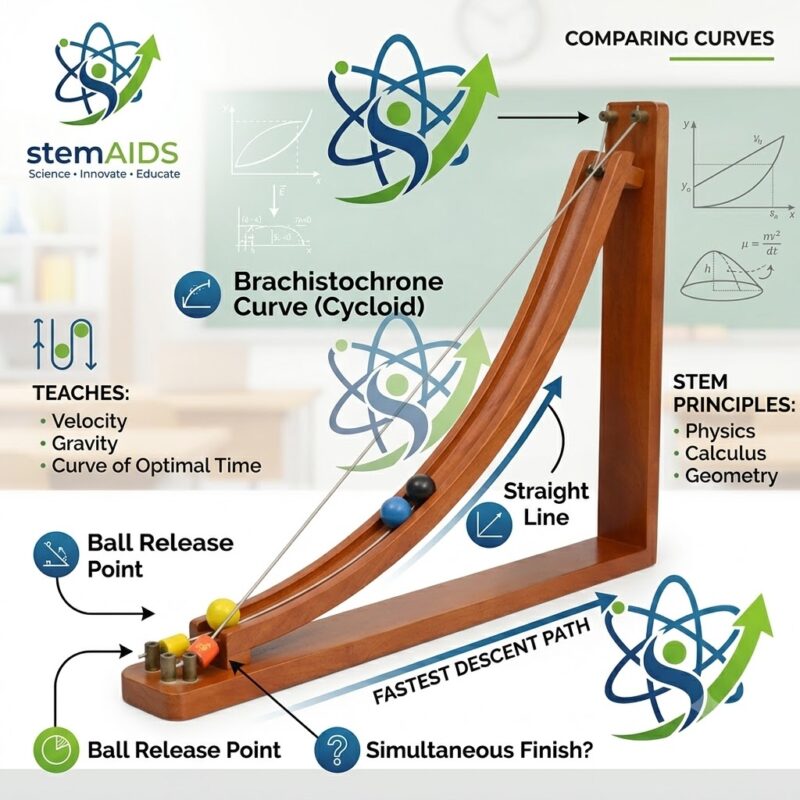
The Brachistochrone Experiment Model is a physics and mathematics demonstration apparatus used to compare gravity-driven descent times along different paths. It is intended for school, college, university and STEM laboratories, helping learners observe why a cycloidal path gives the least theoretical travel time in the ideal brachistochrone problem.
Product Description
The STEMAids Brachistochrone Experiment Model turns the “curve of fastest descent” into an observable laboratory activity. Learners release matched rolling bodies under equivalent starting conditions and compare arrival times. The experiment connects gravitational potential energy, acceleration, kinematics, cycloidal geometry and the calculus of variations.
For dependable comparison, the apparatus must hold its paths securely and permit consistent release conditions. STEMAids-specific materials, dimensions, track configuration, rolling-body specification and release method were not available in the indexed product data reviewed for this draft. Confirm these fields before publication or procurement. See related physics lab instrumentation and mathematics laboratory kits.
Key Features
- Visual path comparison: Demonstrates how path geometry affects travel time under gravity.
- Cross-disciplinary learning: Connects mechanics, energy, cycloids, optimisation and calculus of variations.
- Repeatable method: Supports repeated trials when the model is level, clean and consistently operated.
- Flexible analysis: Permits observation with a stopwatch, slow-motion video or compatible timing equipment.
- Classroom utility: Supports demonstrations, group discussion and student-led experimental work.
- Transparent accuracy limits: Friction, rolling resistance, alignment and release timing can affect results.
- Supervised operation: Designed for controlled use with small rolling components kept secure.
Technical Specifications
|
Specification |
Detail |
|
Product name |
Brachistochrone Experiment Model |
|
Brand |
STEMAids |
|
Category |
Physics Lab Products / Mechanics Demonstration Models |
|
Capacity |
Not applicable; non-volumetric demonstration apparatus |
|
Operating principle |
Comparison of gravity-driven travel time along paths of different geometry |
|
Standards or certifications |
None verified for this specific model |
|
Recommended users |
Schools, colleges, universities, physics and mathematics labs, STEM centres |
What’s Included in the Kit
- Brachistochrone model assembly
- Rolling bodies or balls
- Release arrangement
- Base or support frame
- Experiment instructions or manual
Applications / Uses
- Demonstrating the brachistochrone, or curve of fastest descent.
- Comparing the shortest-distance path with the minimum-time path.
- Teaching gravitational energy, acceleration and rolling motion.
- Introducing cycloids, optimisation and calculus of variations.
- Conducting timing, video-analysis and experimental-uncertainty activities.
- Supporting mechanics practicals, STEM demonstrations and science exhibitions.
How to Use the Brachistochrone Experiment Model
- Place the model on a firm, level and vibration-free bench.
- Inspect the paths and remove dust or debris.
- Position matched rolling bodies at equivalent release points.
- Release them simultaneously without adding a push.
- Observe and record which body reaches the endpoint first.
- Repeat several trials and compare the recorded times.
- Discuss how a steep initial descent produces speed earlier in the motion.
Safety and handling: Use under teacher or laboratory supervision. Keep fingers clear of the release arrangement, prevent rolling bodies from falling from the bench, and stop using damaged or misaligned components.
Care & Maintenance
- Wipe the paths with a soft, dry, lint-free cloth.
- Store the model in a dry cabinet protected from dust and impact.
- Keep matched rolling bodies together.
- Check alignment and fasteners before use; do not force adjustments.
Why Choose STEMAids
STEMAids develops and supplies educational science models, STEM kits, DIY kits, teaching-learning materials and laboratory products. Its official product overview states that development is supported by in-house research, development and quality assurance. The company serves schools and educators in India and abroad and supports customised or bulk institutional requirements. Explore its STEM learning kits for related hands-on resources.
Frequently Asked Questions
What is a brachistochrone experiment model used for?
It compares descent times along differently shaped paths and demonstrates the curve of fastest descent under gravity.
Why can the cycloidal path be faster than a straight path?
The cycloid descends steeply at the start, allowing the body to gain speed earlier. In the ideal frictionless problem, this produces the minimum travel time.
Can this model be used in schools and colleges?
Yes. It is suitable for supervised secondary-school, college and university demonstrations, with the analysis adapted to the learners.
What concepts can students study with it?
Students can study gravity, kinematics, energy conversion, rolling motion, cycloidal geometry, optimisation, experimental error and calculus of variations.
What material is the STEMAids model made from?
The material was not verified in the available product data. Confirm the track, frame, base and rolling-body materials before publishing or ordering.
Does the physical model prove the ideal theory exactly?
No. It demonstrates the principle experimentally, but friction, rolling resistance, alignment and release timing can affect measured results.
Request the confirmed configuration from STEMAids and browse the physics lab products category for related teaching apparatus.
You must be logged in to post a review.
Bestsellers
Sale

Sale
Sale


Reviews
There are no reviews yet.