
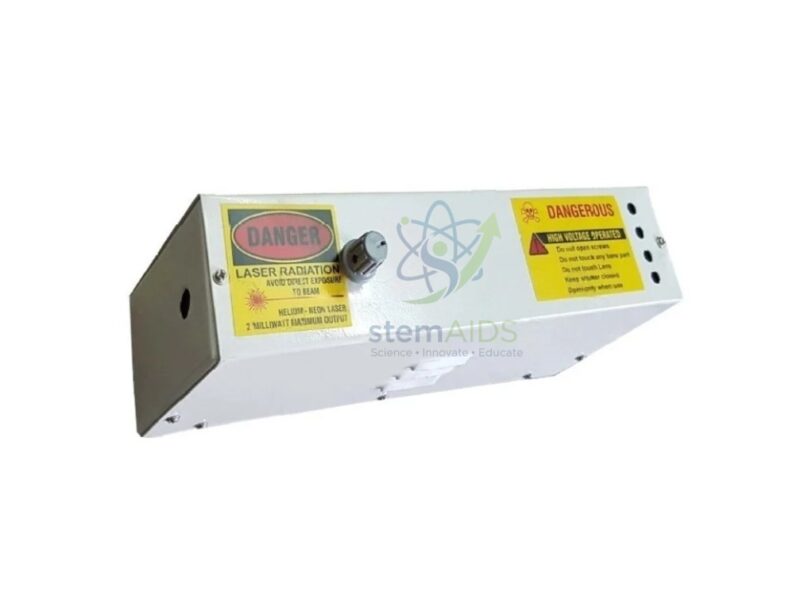
Quick Answer: The Helium Neon (He-Ne) Laser is a gas laser in which an electric discharge through a mixture of helium and neon produces a narrow, highly monochromatic and coherent beam. A He-Ne laser is a standard light source for diffraction, interference and polarisation experiments in college optics laboratories.
How a Helium-Neon Laser Produces Its Beam
A high-voltage discharge through the gas tube excites helium atoms. Because one of their excited energy levels lies very close to a level in neon, collisions hand the energy on to neon atoms, building up more neon atoms in the upper level than in the lower one, a population inversion. Light passing through the tube then triggers stimulated emission, in which each excited atom releases a photon in step with the passing light.
Mirrors at the two ends of the tube form an optical cavity that sends the light back and forth many times, amplifying it at each pass; one mirror lets a small fraction through as the output beam. Most helium-neon tubes are built for the red line at 632.8 nm, the value found in physics data books, although other colours exist. The colour, output power and safety class of this laser should be confirmed at enquiry.
Experiments That Need a Steady, Monochromatic Beam
The beam’s single, well-known wavelength and high coherence make it the reference source for wave optics. Students use it for single-slit diffraction, Young’s double slit fringes, determining the spacing of a diffraction grating, measuring the thickness of a hair or wire from its diffraction pattern, and for interferometers such as the Jamin interferometer. Its steady output also suits polarisation work and Malus’s law.
Laser Safety in Teaching Labs
Never look into the beam or at a mirror-like reflection of it. Keep the beam below eye level, end it on a matt, non-reflective target, and remove watches and rings that could reflect it. Follow the warning labels and local rules for the laser’s class. The tube runs from a high-voltage supply, so covers must stay closed and only qualified people should open the unit.
Experiments
- Young’s double-slit and single-slit diffraction experiments
- Measuring the line spacing of a diffraction grating
- Interferometry, including Jamin and Michelson arrangements
- Polarisation studies and Malus’s law
Specifications
| Type | Helium-neon gas laser |
| Output | Continuous, monochromatic, coherent beam |
| Typical experiments | Diffraction, interference, interferometry and polarisation |
| Power | Tube driven from a high-voltage supply, built in or separate |
| Wavelength, output power, safety class and mounting | Confirm at enquiry |
Care & Handling
- Allow the He-Ne laser a short warm-up so that its output settles before taking readings.
- Keep the exit window clean and capped when not in use; clean it only with lens tissue.
- Mount the laser firmly so the beam cannot swing unexpectedly across the room.
- Switch off and unplug before moving it, and never open the housing.
Why Choose LabEquip
Colleges and universities buy a helium-neon laser as the dependable light source at the heart of their wave-optics practicals. LabEquip lists it with its physics lab equipment. Share the experiments you run through the contact page so suitable output and mounting can be discussed.
Frequently Asked Questions
Why is a He-Ne laser preferred to a diode laser for interference work?
A helium-neon laser usually gives a narrower spread of wavelengths, a longer coherence length and a cleaner beam shape. Diode lasers are compact and inexpensive and suit many school experiments, but fringes from a He-Ne source are typically steadier and sharper.
What colour is the beam?
Most helium-neon lasers emit red light at 632.8 nm, but versions emitting green, yellow or orange light are also made. The colour of this particular laser should be checked when ordering.
Why does the laser need a warm-up?
As the tube warms, its length and gas conditions settle, and the output power and mode become steadier. Readings taken after warm-up are more consistent.
Is this laser safe for students to use?
It can be used safely under supervision with clear rules: no looking into the beam, beam kept below eye level, reflective objects removed and the beam stopped on a matt target.
Why is the beam so narrow and parallel?
The mirrors at each end of the tube only amplify light travelling along the tube axis, so the beam that emerges spreads very little and stays narrow over long distances.
Why does the laser need a high voltage?
A high voltage is required to start and maintain the electrical discharge in the gas. It is contained within the supply and tube housing, which is why the unit must never be opened by users.
Last Updated: October 2026




Reviews
There are no reviews yet.