
Sale
In Stock
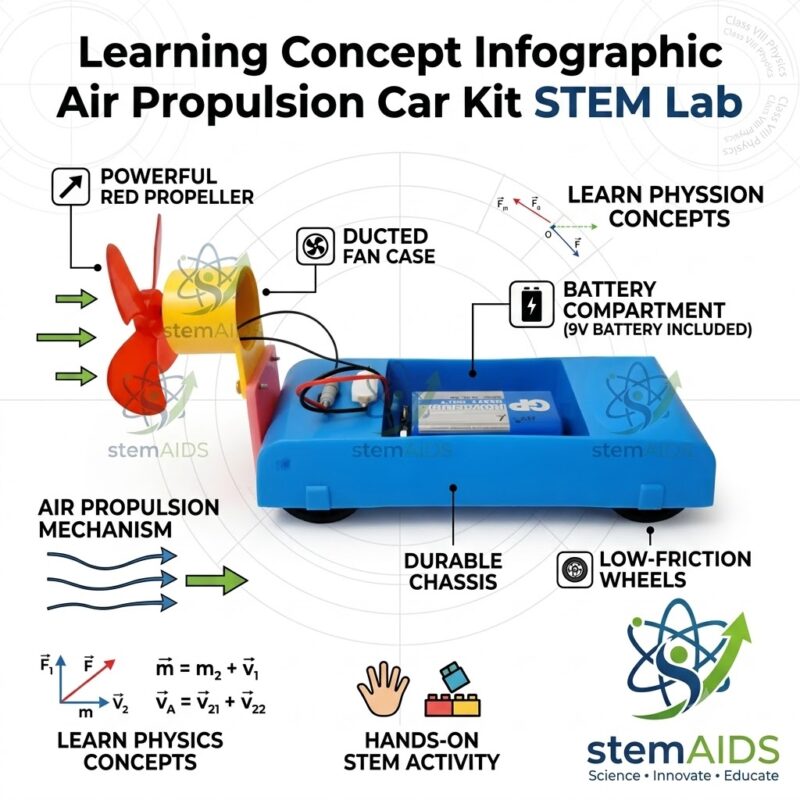
Air Propulsion Car Kit
Original price was: $8.46.$4.12Current price is: $4.12.
Quick Answer: The Air Propulsion Car Kit is a build-it-yourself model car pushed forward by a stream of air rather than by driven wheels, used to teach thrust, Newton’s third law, friction and engineering design. Students assemble the car, test it and improve it.
Thrust from Moving Air
An air-propelled car pushes air backwards, and by Newton’s third law the air pushes the car forwards. Kits of this kind use either a balloon that releases stored air through a nozzle or a small motor turning a propeller; confirm which drive this kit uses. In both cases the wheels are not driven and only need to roll freely, so performance depends on how much thrust the air stream gives and how little is lost to friction.
That makes the car well suited to design iteration. Students measure how far or how fast it travels, then change one thing: nozzle size, balloon inflation or propeller angle, axle alignment, wheel size or total mass. Each change is tested three times and averaged, giving a fair-test investigation that ends in a reasoned design rather than a lucky result.
Older students can go further. Force equals the rate of change of momentum, so a narrow nozzle gives faster air but less mass per second; friction in the axles and air resistance on the body oppose motion; and the car speeds up only while thrust exceeds these losses. Timing runs along a corridor with a tape measure and stopwatch turns the lesson into a data exercise that leads on to rockets and jet engines.
Investigations
- Distance travelled against balloon size or propeller setting
- Effect of added mass on acceleration
- Reducing axle friction and measuring the improvement
- Class design challenge for the longest or straightest run
Specifications
| Item | Air-propelled model car construction kit |
| Propulsion | A stream of air directed backwards, from a balloon or a propeller depending on design |
| Wheels | Free-rolling, not driven |
| Concepts | Thrust, Newton’s third law, friction and air resistance |
| Activity | Assembly, testing and design improvement |
| Drive type, parts and materials | Confirm at enquiry |
Care & Handling
- If the kit uses balloons, inflate them with a hand pump for hygiene and replace any that are thin or torn.
- Keep fingers clear of a spinning propeller when a motor drive is running.
- Check that the wheels spin freely and the axles are straight before each test.
- Run cars on a clear floor, away from stairs and doorways.
Why Choose LabEquip
Science and technology teachers use this kit as a first engineering project because it shows forces clearly and rewards careful building. LabEquip lists it among the STEM science kits in its STEM kits range, next to the DIY Hydraulic Jack Model. Share your class size through the contact page.
Frequently Asked Questions
How does air make the car move?
The car pushes air backwards, and the air pushes the car forwards with an equal and opposite force. This is Newton’s third law, the same principle used by jet engines and rockets.
Does the kit use a balloon or a propeller?
Air-propulsion car kits use one or the other. The drive type of this kit should be confirmed at enquiry, as it changes the investigations you can plan.
Why does my car curve to one side?
Usually the axles are not parallel, a wheel rubs on the body or the air stream does not point straight back. Check the alignment and make sure the nozzle or propeller is centred.
How can students make the car go further?
Reduce friction by aligning the axles, reduce mass where possible and direct all the air straight backwards. Change one thing at a time and test each change fairly.
Why does adding mass slow the car?
The same thrust accelerates a heavier car less, because acceleration equals force divided by mass. Extra mass also increases rolling friction.
What age group suits the air propulsion car kit?
It works from upper primary, where the focus is on building and fair testing, to secondary school, where students measure speed and discuss momentum and forces.
Last Updated: September 2026
You must be logged in to post a review.
Bestsellers


Sale
Sale

Sale


Reviews
There are no reviews yet.