
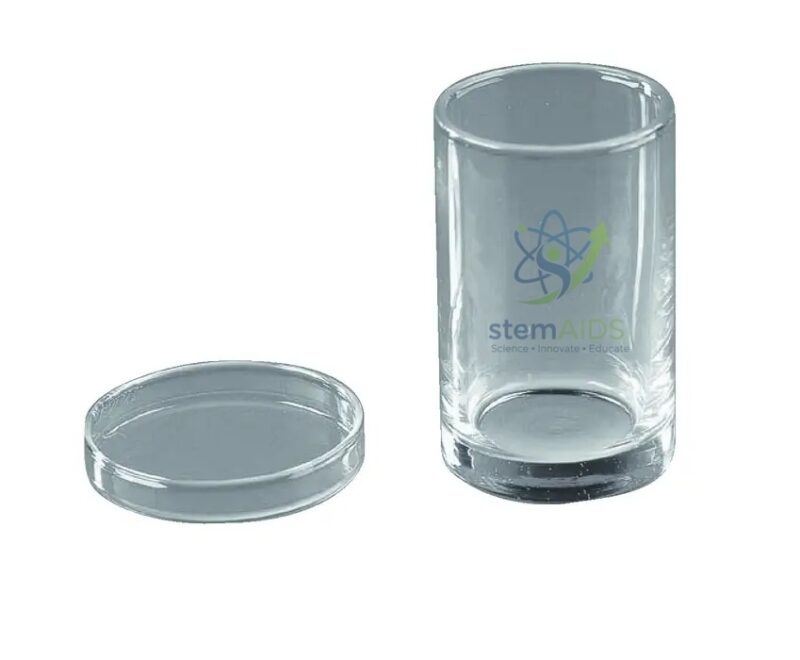
Quick Answer: This TLC development tank is a cylindrical glass jar with a flat glass lid, as pictured, in which a thin layer chromatography plate stands in a shallow layer of solvent. Closing the TLC development tank keeps the air inside saturated with solvent vapour, so the solvent rises evenly and Rf values can be repeated.
Why Thin Layer Chromatography Needs a Closed Tank
As the solvent climbs a TLC plate, it also evaporates from the surface. In an open beaker that evaporation is uneven, the solvent front curves, spots streak and Rf values change from one run to the next. In a closed glass tank the air quickly fills with solvent vapour, evaporation from the plate almost stops, and the front rises as a straight line.
Glass is used because it resists the organic solvents common in TLC, such as ethyl ethanoate, propanone and hydrocarbon mixtures, and because students can watch the solvent front through the wall without lifting the lid.
Preparing the Tank
Pour in solvent to a depth that stays below the pencil baseline on the plate. Many teachers line part of the inside wall with a piece of filter paper wetted with the solvent and close the lid for a few minutes before the plate goes in, which saturates the tank faster. Lower the plate in with tweezers, keep it upright and away from the paper lining, replace the lid, and take the plate out when the front is near the top. Mark the front in pencil at once, before it evaporates.
Specifications
| Product | Thin layer chromatography development tank |
| Shown in photograph | Cylindrical glass jar with flat glass lid |
| Purpose | Holds the solvent and keeps the atmosphere saturated with its vapour |
| Used with | TLC plates, solvent, filter paper lining, tweezers |
| Jar height and diameter | Confirm at enquiry |
Uses
- Developing TLC plates for purity checks in organic chemistry practicals
- Separating ink, food dye or leaf pigment mixtures on narrow plates
- Running reference compounds beside an unknown to compare Rf values
- Small-scale paper chromatography strips that fit inside the jar
Care & Handling
- Use and open the tank in a fume cupboard or well-ventilated area when volatile solvents are inside
- Keep flames and hot plates away from solvent-filled tanks
- Return used solvent to a labelled waste container rather than pouring it down the sink
- Wash and dry the jar and lid after use and store the lid separately to avoid chipping the rim
Why Choose LabEquip
Chemistry and physical science teachers choose a glass tank because it stands up to the solvents that plastic containers cannot. LabEquip supplies it with TLC plates as part of its chemistry and physics lab equipment range, and you can contact LabEquip to choose a tank height for your plates.
Frequently Asked Questions
Why does the tank need a lid?
The lid traps solvent vapour so the air inside becomes saturated. The plate then stops losing solvent by evaporation, the front rises evenly and the Rf values are more reliable.
How deep should the solvent be?
Shallower than the pencil baseline on the plate, so the spots sit above the liquid. If the solvent covers the spots, they dissolve into the pool.
What is the filter paper lining for?
A piece of solvent-soaked filter paper on the inside wall gives a large evaporating surface, so the tank fills with vapour faster before the plate is added.
Can the tank be used for paper chromatography?
Yes, for strips short enough to stand in the jar with the lid on. Longer paper strips need a taller tank or a cylinder.
Which solvents can be used in a glass tank?
Glass resists water and common organic solvents. The limits come from safety rather than the glass: use flammable or harmful solvents only with ventilation and away from ignition sources.
Why did my solvent front run unevenly?
The usual causes are a tank that was not saturated, a plate touching the wall or lining, or a plate standing at an angle. Let the tank stand closed before use and keep the plate upright.
Last Updated: October 2026






Reviews
There are no reviews yet.