
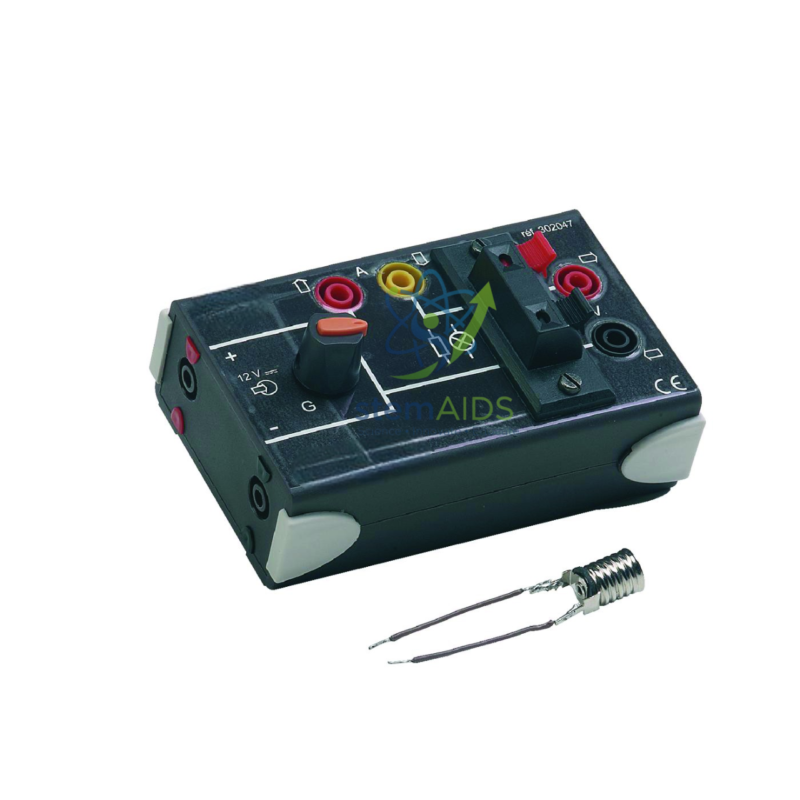
Quick Answer: The Study of Ohm’s Law module is a compact circuit unit with terminal sockets for measuring the current through a component as the voltage across it is varied, so students can plot a voltage-current graph and test whether the component obeys Ohm’s law. The product photograph shows it with a small filament lamp, a useful contrast for any Ohm’s law experiment.
What Ohm’s Law Says and When It Holds
Ohm’s law states that the current through a metallic conductor is proportional to the voltage across it, provided its temperature and other physical conditions stay the same. Written as V = IR, it predicts a straight-line graph through the origin, and the gradient of voltage against current is the resistance.
Fixed resistors follow the law closely over normal currents. Many components do not: a filament lamp, a diode and a thermistor all give curved graphs, and recognising which is which is part of what students are expected to learn.
Setting Up the Measurement
The module in the photograph is a dark case with coloured terminal sockets and a control knob on its top face. The ammeter goes in series with the component so the same current flows through both; the voltmeter goes in parallel across the component alone. Students raise the voltage in steps, note pairs of readings, and then take a second set on the way down to check for drift.
Switching off between readings at higher currents keeps the component close to room temperature, which is the condition the law depends on.
Applications
- Verifying Ohm’s law for a fixed resistor and finding its resistance from the gradient
- Plotting the curved characteristic of a filament lamp and explaining it by heating
- Comparing two resistors and showing the steeper line belongs to the larger resistance
- Practising correct placement of ammeter and voltmeter
Specifications
| Product | Study of Ohm’s Law: circuit module for V-I measurements |
| Panel | Terminal sockets and a control knob, as photographed |
| Shown with | Small filament lamp for non-ohmic comparison |
| Graph produced | Voltage against current, gradient gives resistance |
| Components fitted in the module | Confirm at enquiry |
Care & Handling
- Set the supply to zero before switching on and raise it in small steps
- Keep currents within the values marked for the module and lamp
- Let a hot lamp cool before removing it from its holder
- Store the module with its leads unplugged and the lamp packed separately
Why Choose LabEquip
Physics departments assembling electricity experiment kits for schools tend to buy Ohm’s law units in sets, one per bench pair, because every student needs to take these readings personally. LabEquip supplies them with related boards such as the electricity transmission model among its physics equipment; class quantities can be arranged through the contact page.
Frequently Asked Questions
How is resistance found from the graph?
Plot voltage on the vertical axis and current on the horizontal axis. For an ohmic component the points lie on a straight line through the origin, and its gradient equals the resistance in ohms.
Why is the graph for the lamp curved?
As current increases the filament gets hotter, and the resistance of a metal rises with temperature. Each extra step in voltage therefore produces a smaller increase in current, bending the graph.
Where do the ammeter and voltmeter go?
The ammeter goes in series with the component so the full current passes through it. The voltmeter connects in parallel, across the component’s two terminals only.
Why should readings be taken quickly at higher currents?
Current heats the component, and heating changes resistance. Taking each reading promptly and switching off between readings keeps the temperature steady, which is a condition of Ohm’s law.
Does every component obey Ohm’s law?
No. Filament lamps, diodes, LEDs and thermistors are non-ohmic, because their resistance changes with current, temperature or direction. Only components whose graph is a straight line through the origin obey the law.
What else is needed to use the module?
A variable low-voltage DC supply, an ammeter, a voltmeter and a set of laboratory leads. Digital multimeters can serve as both meters if two are available.
Last Updated: October 2026




Reviews
There are no reviews yet.