
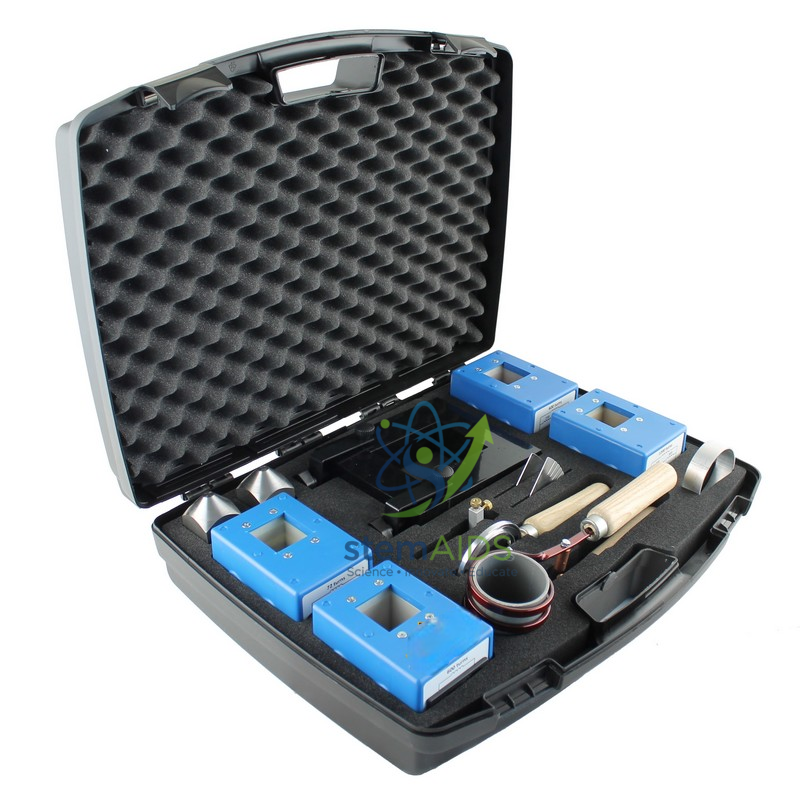
Quick Answer: The Démotransfo transformer study kit is a carrying case holding boxed coil modules and accessories for investigating transformers, as shown in the product photograph. It lets a class move from building a transformer to measuring its turns ratio, losses and efficiency with one organised set.
A Transformer Course in One Case
A typical sequence starts with mutual induction: switching a direct current on and off in one coil and watching a meter on a second coil kick. Next comes an alternating supply on the primary, giving a steady alternating voltage on the secondary, then a series of turns-ratio measurements. Finally a load is connected so that input and output power can be compared and the efficiency worked out.
A kit packed in a carrying case fits that progression, because every lesson uses the same modules, kept together and returned to fitted places. Missing parts are spotted at once, which matters when several groups share one set over a term.
Specifications
| Kit | Transformer study set in a carrying case |
| Contents | Boxed coil modules and accessories, as pictured |
| Topics | Mutual induction, turns ratio, losses and efficiency |
| Also needed | Low-voltage AC and DC supplies, meters and leads |
| Complete contents list | Confirm at enquiry |
Where the Energy Goes in a Transformer
Measurements with the kit usually show an efficiency below 100 percent, and the parts in the case make the reasons easy to explain. Copper losses are the heating of the coils by the current, I²R. Iron losses occur in the core: eddy currents, kept small by laminations, and hysteresis, the energy needed to keep reversing the magnetisation. Flux leakage, where some flux from the primary misses the secondary, lowers the output further.
Practicals Covered
- Mutual induction with a switched direct current
- Turns-ratio measurements on step-up and step-down arrangements
- Efficiency of a loaded transformer
- Comparing the output with and without a closed core
Care & Handling
- Check the contents against the case layout after every lesson
- Use the kit only with low-voltage supplies; mains voltage must never be connected to the modules
- Close the case and store it flat, away from damp
- Wipe modules with a dry cloth and keep sockets free of dust
Why Choose LabEquip
The study case suits departments that want a complete, portable transformer course that can move between laboratories, and it sits naturally among electricity experiment kits for schools because one case covers several practicals. LabEquip also offers the smaller Démotransfo essential kit and other physics lab equipment; ask for the contents list via the contact page.
Frequently Asked Questions
What topics can the study kit cover?
Mutual induction, the turns-ratio rule, step-up and step-down transformers, the effect of the core, and transformer losses and efficiency.
What is the difference between copper losses and iron losses?
Copper losses are the heating of the coils by the current flowing in them. Iron losses happen in the core, through eddy currents and the repeated reversal of its magnetisation.
Why does a switched direct current produce only a brief pulse in the second coil?
An emf is induced only while the flux is changing. Switching the current on or off changes the flux for a moment, so the meter kicks once and returns to zero.
How is efficiency calculated?
Divide the output power, secondary voltage times secondary current, by the input power, primary voltage times primary current, and multiply by 100 to give a percentage.
Why is a carrying case useful for shared kits?
Each item has its own place, so groups can see at once whether anything is missing, and the parts are protected when the kit moves between rooms.
Can students use it themselves?
Yes, under supervision. With low-voltage supplies and boxed modules it is suited to group practicals in senior school physics.
Last Updated: October 2026




Reviews
There are no reviews yet.