
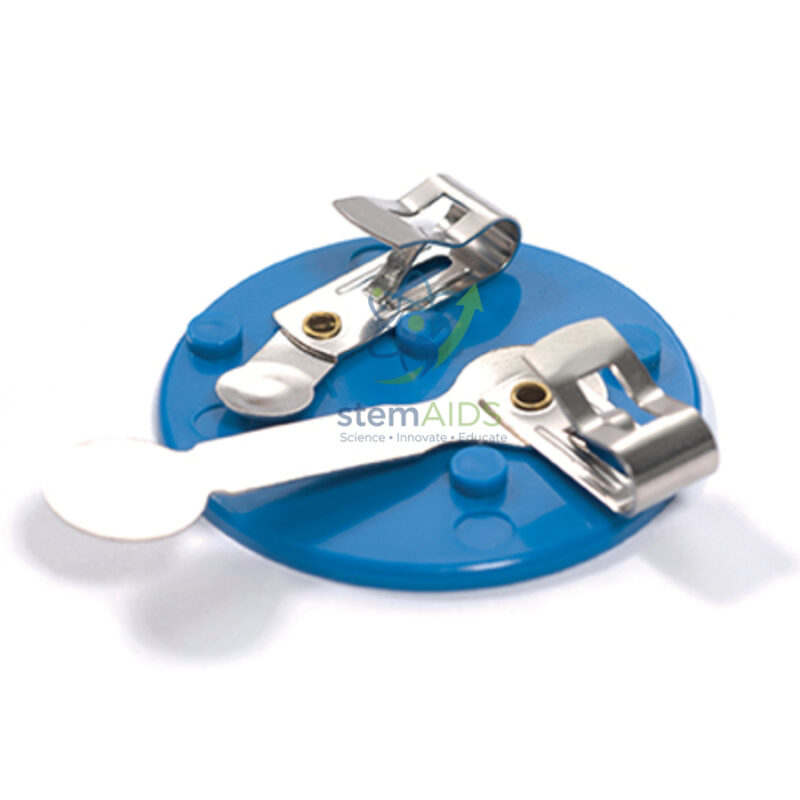
Quick Answer: This student switch is a simple on-off switch made for school circuit work, with terminals that take the leads students use on the bench. The student switch is used to open and close circuits, to show where a switch must go to control a component, and to build logic circuits from switches.
Open and Closed Circuits
A switch does one simple job: it makes or breaks a gap in the conducting path. Closed, current flows around the loop; open, there is no complete path and every component in that loop stops at once. A switch large enough to see and operate easily turns this abstract idea into something students can feel and watch, especially when paired with a lamp or LED that responds instantly.
Switching mechanisms and terminal styles vary between designs, and the version supplied should be matched to the leads in use, which is worth confirming before ordering a class set. Whatever the mechanism, its electrical job in a simple circuit is the same: on or off.
Where the Switch Goes Matters
In a series circuit a switch anywhere in the loop controls everything, which students can prove by moving it from one position to another. In a parallel circuit a switch in the main line controls all the branches, while one placed in a branch controls only that branch. Two switches then open the door to logic: in series both must be closed for the lamp to light, the AND function; in parallel either one will do, the OR function. A two-switch truth table built this way is a natural bridge to logic gates in electronics.
Specifications
| Type | On-off switch for student circuits |
| Function | Makes or breaks the circuit path |
| Use | Series, parallel and switch-logic practicals |
| Circuits | Low-voltage student circuits |
| Mechanism and terminal type | Confirm at enquiry |
Lessons It Supports
- Controlling lamps, buzzers and motors in first circuits
- Comparing switch positions in series and parallel circuits
- Building AND and OR logic with two switches and a protected green LED
- Switching the supply on only while readings are taken, to save cells and limit heating
Care & Handling
- Use the student switch only in low-voltage circuits; it is not designed for mains.
- Operate it by hand without forcing, and set aside any switch that feels stiff or loose for checking.
- Keep the contacts dry and dust-free so they close cleanly.
- Tighten the terminals firmly onto the leads so a loose wire is not mistaken for a faulty switch.
Why Choose LabEquip
Every circuit practical needs switches, so schools order them by the class set with lamps, buzzers and sources. LabEquip supplies student switches within our physics lab equipment range; tell us the lead and terminal type you use through the contact page.
Frequently Asked Questions
Why does one switch turn off all the lamps in a series circuit?
A series circuit has only one path for current. Opening the switch anywhere in that path breaks it, so no current flows through any component. Moving the switch to another position in the loop makes no difference.
How do I switch off one lamp while leaving another on?
Connect the lamps in parallel and place a switch in the branch of the lamp you want to control. Opening that switch breaks only its branch; the other lamp stays lit because its branch is still complete.
How can two switches make an AND or an OR circuit?
With two switches in series with a lamp, both must be closed for it to light, which is AND logic. With the switches in parallel, closing either one lights the lamp, which is OR logic. Writing out the four combinations gives the truth table for each.
Is the student switch safe for mains use?
No. It is designed for the low voltages of school circuit work. Mains switching needs switches rated, enclosed and installed for mains voltage.
What type of switch is this?
It is an on-off switch for student circuits. Classroom switches are made as push, toggle, slide and knife types, and the mechanism and terminal style of this model should be confirmed at enquiry to match your leads.
Why should circuits be switched off between readings?
Leaving current flowing drains cells, warms components such as resistance wires and thermistors so that their resistance changes, and makes readings drift. Closing the switch only while a reading is taken keeps results consistent.
Last Updated: October 2026





Reviews
There are no reviews yet.