
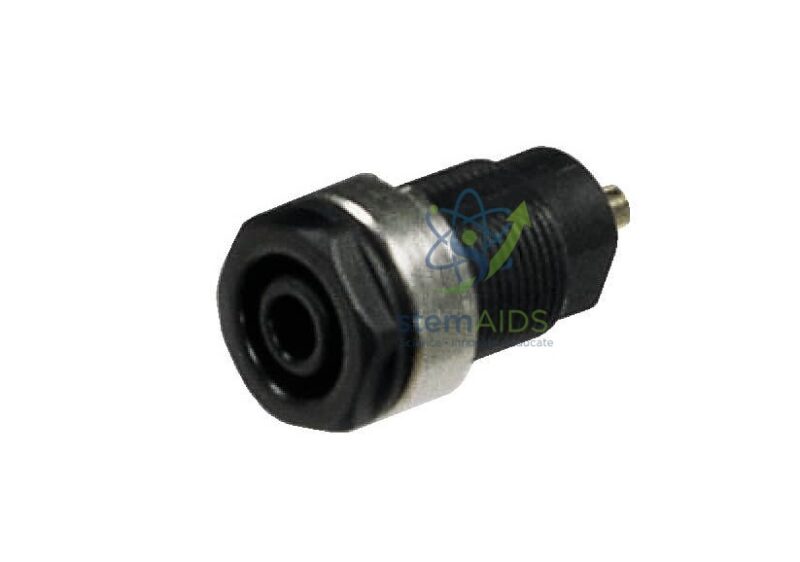
Quick Answer: These solder terminal safety sockets are panel-mounting sockets with an insulating shroud at the front for safety banana plugs and a solder connection at the back for the internal wire. They give a permanent, vibration-resistant joint when building or repairing apparatus panels.
A Permanent Joint Behind the Panel
In the product photograph the socket is black, with a shroud at the front and a threaded body that passes through the panel and is held by a nut. The wire inside the box is soldered to the rear terminal, making a joint with low contact resistance that cannot work loose. That makes the solder version suitable for apparatus that is moved around a lot, such as module boards stored in trays and carried between rooms.
The front of the socket behaves exactly like any other shrouded socket: a safety lead’s sleeved plug pushes into the recess, and no metal is left exposed. The choice between this and the screw-terminal version depends on the job. Solder suits finished, long-lived panels; screws suit panels that will be altered.
Soldering Without Damage
The insulating parts of a socket can soften if the terminal is held at soldering temperature for too long. Tin both the wire and the terminal first, then make the joint quickly with a hot, clean iron, and let it cool without moving the wire. A crocodile clip on the terminal acts as a small heat sink. Slide a piece of heat-shrink sleeving onto the wire before soldering and move it over the joint afterwards, so the finished connection is insulated. These steps also make a useful practical for students learning hand soldering on real hardware.
Specifications
| Product | Safety sockets with solder terminal |
| Front | Shroud for safety banana plugs |
| Mounting | Threaded body and nut through a drilled panel |
| Wire connection | Solder terminal at the rear |
| Colour in the photograph | Black |
| Panel hole size and colour range | Confirm at enquiry |
Where Solder Sockets Are Used
- Permanent safety connections on apparatus boxes and module boards
- Repairing panels where a soldered socket has failed
- Electronics projects where vibration could loosen screw terminals
- Soldering practice on real laboratory hardware
Care & Handling
- Keep the soldering iron on the terminal only as long as needed so the shroud does not deform
- Insulate the finished joint with heat-shrink sleeving
- Tighten the panel nut before soldering, so turning it afterwards does not twist the wire
- Inspect the shroud for cracks; a damaged socket should be replaced, not taped
Why Choose LabEquip
Electronics teachers and lab technicians building durable module panels choose solder terminal safety sockets for joints that survive years of handling. LabEquip supplies them with screw-terminal sockets and adapters; ask for a mixed order through our contact page or see more physics equipment.
Frequently Asked Questions
Why choose a solder terminal over a screw terminal?
A soldered joint does not loosen with vibration or temperature changes and has a low, stable contact resistance. It suits panels that are finished and handled often. A screw terminal is quicker to change if the wiring may be altered.
Will soldering damage the socket?
Not if the joint is made quickly with a hot, clean iron. Prolonged heating can soften the insulating parts, so tin the wire and terminal first and use a clip as a heat sink if needed.
Which solder should be used?
Ordinary electronics solder wire with a flux core is used for this kind of joint. Follow the school’s policy on lead-free solder and fume extraction when soldering in class.
Can these sockets be fitted to an existing panel?
Yes, if the panel hole matches the socket body. Remove the old socket, fit the new one with its nut, then solder the internal wire to the terminal.
Do safety leads fit these sockets?
Yes. The shrouded front is designed for the sleeved plugs of safety leads, so the metal parts remain covered once the plug is inserted.
Should the joint be insulated after soldering?
Yes. Slide heat-shrink sleeving over the joint and shrink it, so no bare metal is exposed inside the box where other wires or tools could touch it.
Last Updated: October 2026




Reviews
There are no reviews yet.