
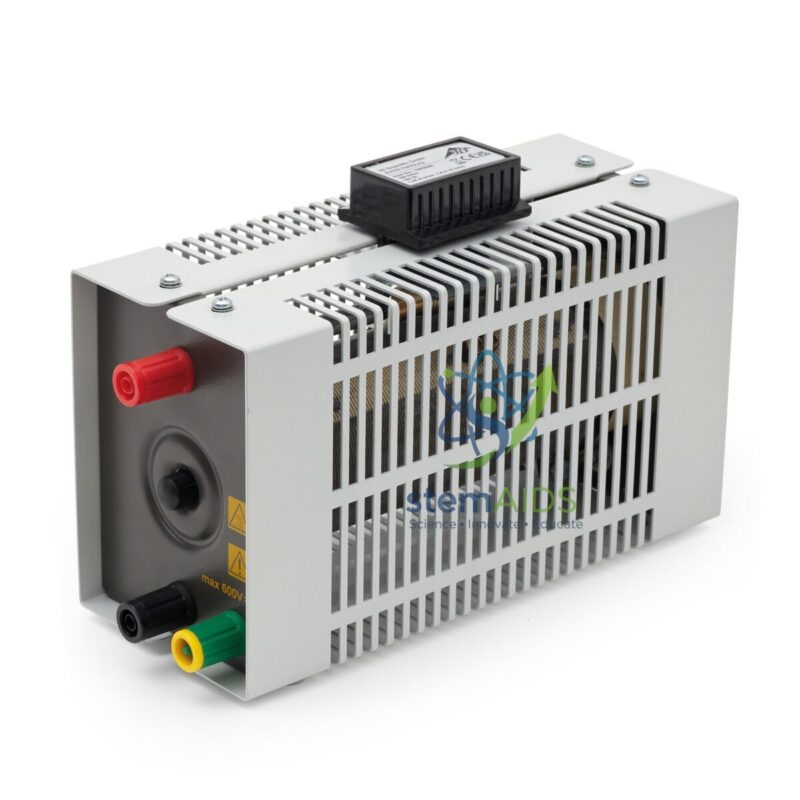
Quick Answer: The Rheostat 160 W is a sliding-contact variable resistor with a 160 W power rating, shown with a perforated cover over its winding and terminals at the ends. Teachers use the rheostat 160 W to set and vary current in bench circuits, from Ohm’s law practicals to lamp and motor demonstrations.
Setting Current in a Series Circuit
In the classic Ohm’s law practical, the rheostat is connected in series with a cell or power supply, an ammeter and the resistor under test, with a voltmeter across the resistor. Each slider position gives a different current; students record the current and voltage pairs and plot a graph whose straight line through the origin shows that the resistor obeys Ohm’s law. The rheostat changes the current without disturbing the rest of the circuit, so six or more readings are quick to collect.
Matching the rheostat to the load matters. If its resistance is far larger than that of the component under test, nearly all the useful change happens over a short part of the slider’s travel and control is coarse. If it is much smaller, moving the slider hardly changes the current. A rheostat whose full resistance is comparable to, or a few times greater than, the load gives smooth control over a useful range.
The Potential-Divider Connection
To take readings down to zero volts, as needed for a filament-lamp or diode characteristic, the same rheostat is wired as a potential divider: both ends across the supply, the component connected between the slider and one end. Sliding toward that end lowers the output voltage to zero. Because the full winding then carries current continuously, check that this current stays within the limit worked out from the 160 W rating and the marked resistance using I = √(P/R).
Experiments and Uses
- Verifying Ohm’s law by varying the current through a fixed resistor
- Plotting the current-voltage characteristic of a filament lamp from zero upward
- Controlling current through a solenoid or electromagnet to study magnetic field strength
- Adjusting the brightness of a lamp or the speed of a small motor in demonstrations
Specifications
| Type | Sliding (tubular) rheostat |
| Power rating | 160 W, as stated in the product name |
| Cover | Perforated protective cover, as pictured |
| Connections | Terminals at the winding ends and for the slider, as usual for sliding rheostats |
| Resistance value | Confirm at enquiry |
Care & Handling
- Set the slider for maximum resistance before switching on, then reduce it gradually.
- Switch off between readings in long practicals so the winding and the resistor under test do not heat up and change value.
- Keep the slider and winding clean; a dirty track gives jumpy current readings.
- Carry the rheostat by its base or end plates, not by the slider bar.
Why Choose LabEquip
This mid-power rheostat suits school and college physics laboratories running class sets of Ohm’s law and characteristic-curve practicals. LabEquip also lists the higher-rated Rheostat 320 W and the compact 100 Ω variable resistor in its Physics Equipments category.
Frequently Asked Questions
How do I choose between the 160 W and 320 W rheostats?
Work out the largest current your circuit will draw. Student circuits with resistors, lamps and small coils are often well served by the 160 W model of suitable resistance, while motors, heaters and power-supply load tests may need the larger rating.
Why should the slider start at maximum resistance?
Maximum resistance gives the smallest current when the circuit is first switched on. This protects the ammeter, the component under test and the rheostat itself, and the current can then be raised step by step.
Does the resistor under test heat up during the experiment?
Yes, if the current is large or left on for long. Heating changes the resistance of most materials, so switching off between readings keeps the results closer to a straight line for an ohmic resistor.
Can I use the rheostat to dim a lamp?
Yes. In series with a lamp, increasing the rheostat’s resistance reduces the current and the lamp dims. Wired as a potential divider, it can bring the lamp all the way down to zero.
Why is the cover perforated?
The winding turns electrical energy into heat, and the holes let air carry that heat away while the cover keeps fingers and leads off the hot wire.
What resistance should the rheostat have?
Choose a rheostat whose full resistance is similar to, or a few times larger than, the load it controls, so the slider gives smooth adjustment across its travel. The resistance value of this model can be confirmed when you enquire.
Last Updated: October 2026




Reviews
There are no reviews yet.