
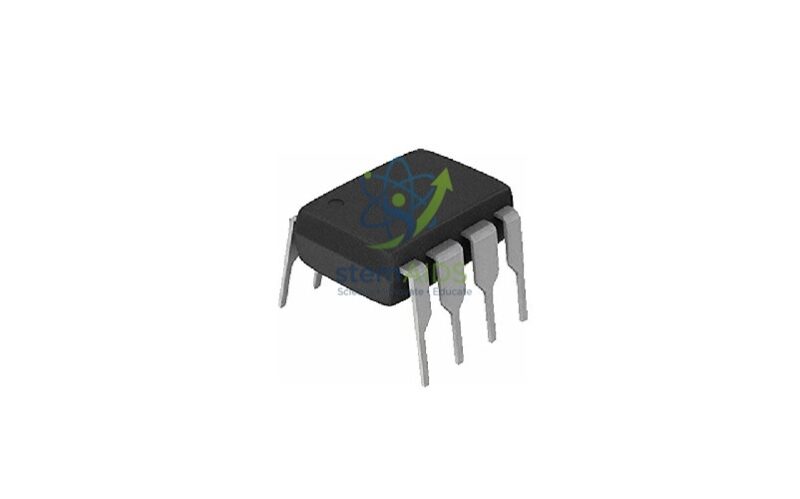
Quick Answer: The Operational Amplifier TL081 is a single JFET-input op amp, an integrated circuit that amplifies the difference between its two input voltages with very high gain. The TL081 op amp is used in college and senior-school electronics practicals to build amplifiers, comparators, integrators and active filters with negative feedback.
A Very High Gain Tamed by Feedback
An operational amplifier has an inverting input, a non-inverting input and an output. Without feedback its gain is enormous, so the slightest difference between the inputs drives the output towards one of its limits, which is how it works as a comparator. Feed part of the output back to the inverting input and the amplifier adjusts its output until the two inputs are almost equal. The gain of the circuit is then set by resistor ratios rather than by the chip, which is what makes op-amp circuits predictable.
Two standard circuits follow. In the inverting amplifier the gain is minus the feedback resistor divided by the input resistor; in the non-inverting amplifier it is one plus the feedback resistor divided by the resistor to ground. Students can predict a gain, build the circuit on a breadboard, then measure input and output on an oscilloscope and compare.
Circuits Students Build
- Inverting and non-inverting amplifiers with predicted and measured gain
- Comparators and Schmitt triggers for sensor switching circuits
- Integrators, differentiators and summing amplifiers
- Active low-pass and high-pass filters and simple audio preamplifiers
What the JFET Input Brings
The TL081 has junction field-effect transistors at its inputs, so it draws extremely little input current. That suits circuits with high-value resistors, sensors with a high output resistance, the current-to-voltage converter used with a BPW34 photodiode, and integrators, where input current would otherwise charge the capacitor and cause drift. In the usual teaching circuits it runs from a split supply within the limits on its data sheet, and its pin connections should be checked against that sheet before wiring.
Specifications
| Component | Operational amplifier integrated circuit |
| Part number | TL081 (as titled) |
| Input stage | JFET, very low input current |
| Configuration | Single op amp |
| Package | Confirm at enquiry |
Care & Handling
- Check the TL081 op amp’s pin connections against the data sheet before applying power; a reversed supply can destroy it at once.
- Switch off before changing components on the breadboard.
- Handle the chip by its body and discharge yourself before touching the pins, as static can damage input stages.
- Store chips in conductive foam or their tubes so the pins stay straight.
Why Choose LabEquip
Electronics teachers order op amps in bulk, since every student amplifier circuit needs one and the occasional chip is lost to a wiring slip. LabEquip lists the TL081 among its physics lab equipment; ask through the contact page for class quantities.
Frequently Asked Questions
What is the difference between the TL081 and the TL082?
Both use the same JFET-input design. The TL081 contains a single op amp in its package, while the TL082 contains two. Choose the single version when each student circuit needs only one amplifier.
How do I set the gain of an op-amp amplifier?
With resistors. For an inverting amplifier the gain is the feedback resistor divided by the input resistor, with the output inverted. For a non-inverting amplifier it is one plus the feedback resistor divided by the resistor from the inverting input to ground.
Why does the output stop rising before it reaches the supply voltage?
The output can only swing to within a certain margin of each supply rail, and beyond that it saturates. If the expected output exceeds that limit, reduce the gain or the input signal.
Why is a JFET input useful?
It draws an extremely small input current, so it barely loads the source it is measuring. That matters for high-resistance sensors, photodiode amplifiers and integrators, where input current would cause errors or drift.
Does the TL081 need a dual power supply?
The usual teaching circuits run it from a split supply, with positive and negative rails and a common ground, so the output can swing either side of zero. It can work from a single supply if the inputs are biased to a midpoint; the supply limits are on its data sheet.
Can the op amp be used as a comparator?
Yes. Without feedback the output swings towards one rail when the non-inverting input is higher than the inverting input and towards the other when it is lower. Adding positive feedback makes a Schmitt trigger that switches cleanly even with a noisy input.
Last Updated: October 2026






Reviews
There are no reviews yet.