
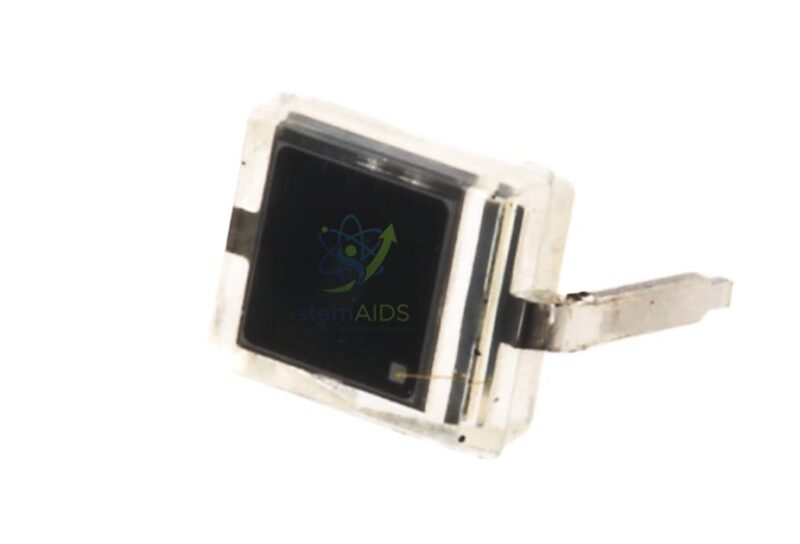
Quick Answer: The Photodiode BPW34 is a silicon PIN photodiode, a light sensor that produces a current proportional to the light falling on its active area. The BPW34 photodiode is used in physics and electronics practicals for measuring light intensity, detecting fast light pulses and building light meters with an amplifier.
How a PIN Photodiode Senses Light
A photodiode is a p-n junction designed to let light in. In a PIN device a lightly doped intrinsic layer sits between the p and n regions, widening the zone in which absorbed photons create electron-hole pairs that the junction field sweeps apart. Each separated pair adds to a photocurrent, so the current is proportional to the rate at which photons arrive: double the light and the current doubles, over a wide range. That linear response is what makes a photodiode a measuring device rather than just a switch.
The BPW34 is a widely used part of this kind, with a comparatively large, flat sensing area in a small package, convenient for bench work with lamps, LEDs and lasers. Its exact sensitivity and wavelength response belong to the part’s data sheet; for school and college work the important points are its linearity and its speed.
Two Ways to Use It
With no external bias the photodiode behaves like a tiny solar cell and produces a small voltage when lit; this photovoltaic mode gives very low noise and suits slow, careful measurements. More often it is reverse-biased, the photoconductive mode, in which the photocurrent flows through a load and the junction capacitance falls, so the response becomes much faster. That speed is a clear advantage over a light dependent resistor, which takes a noticeable time to respond.
Because the photocurrent is small, the usual circuit feeds it into an operational amplifier wired as a transimpedance amplifier, which turns current into voltage through a feedback resistor. The TL081 operational amplifier suits that role because it draws very little input current. The output voltage is then proportional to light intensity and can be read on a voltmeter or data logger.
Applications
- Inverse-square law measurements with a small light source
- Detecting light pulses and modulated signals in optical-communication demonstrations
- Building a linear light meter with an op-amp current-to-voltage converter
- Comparing the responses of a photodiode, an LDR and a solar cell
Specifications
| Component | Silicon PIN photodiode |
| Part number | BPW34 (as titled) |
| Output | Photocurrent proportional to light intensity |
| Modes | Photovoltaic (unbiased) or photoconductive (reverse-biased) |
| Sensitivity and spectral response | As given on the part data sheet |
Care & Handling
- Observe polarity: for reverse-bias use, connect the cathode of the BPW34 photodiode towards the positive supply through the load.
- Keep the sensing face clean and avoid scratching its window.
- Shield the photodiode from room light when measuring a weak source, for example with a short black tube.
- Solder briefly and avoid bending the leads at the package, since the device is small and easily damaged.
Why Choose LabEquip
Physics and electronics departments buy BPW34 photodiodes for light-measurement and optical-communication practicals, often with op amps and LEDs to match. You will find them in our physics lab equipment range; send quantities through the contact page.
Frequently Asked Questions
What is the difference between a photodiode and an LDR?
A photodiode produces a current proportional to the light, responds very quickly and gives a linear output. An LDR changes its resistance with light, responds slowly and non-linearly. Use a photodiode for measurement and fast signals, and an LDR for simple light-level switching.
Should the photodiode be reverse-biased?
For speed, yes. Reverse bias widens the depletion region, lowers the junction capacitance and gives a faster response. For the lowest noise in slow measurements it can be used unbiased, in photovoltaic mode, with an amplifier holding the voltage across it near zero.
Why do I need an amplifier with it?
The photocurrent is small, especially in room light. An op amp wired as a current-to-voltage converter turns it into a convenient voltage, with the gain set by the feedback resistor, while keeping the voltage across the photodiode steady.
What does PIN mean?
It describes the layers: p-type, intrinsic (lightly doped) and n-type. The intrinsic layer widens the region where light is absorbed and charges are separated, which improves sensitivity and speed compared with a plain p-n photodiode.
Can the BPW34 detect infrared?
Silicon photodiodes respond to near-infrared as well as visible light, which is why they are used to receive signals from infrared remote controls and LEDs. The exact spectral response is given on the part’s data sheet.
How do I check the inverse-square law with it?
Use a small lamp in a darkened room and measure the amplified photodiode output at several distances. Because the output is proportional to intensity, a graph of output against one over distance squared should be a straight line through the origin.
Last Updated: October 2026




Reviews
There are no reviews yet.