
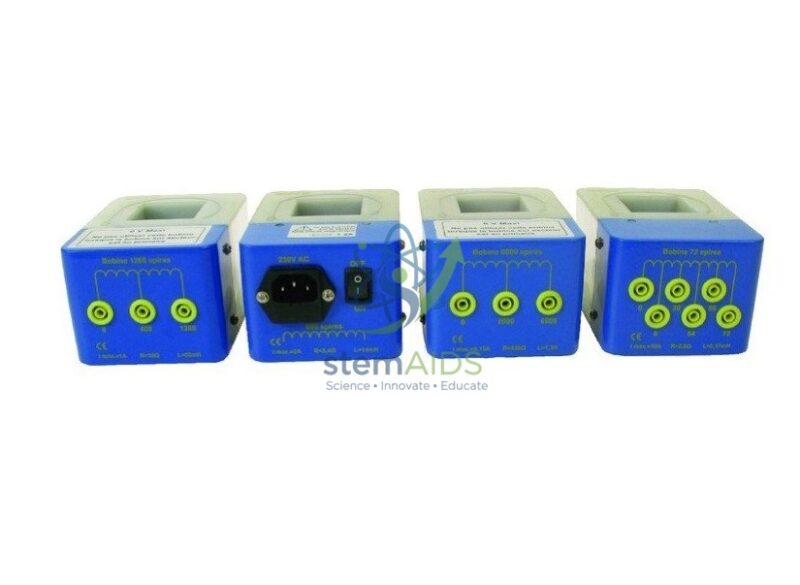
Quick Answer: The modular transformer is a set of separate boxed coil units with terminal sockets, shown in the product photograph as four blue modules, which are combined on an iron core to build transformers of different turns ratios. Students assemble the transformer themselves, which makes the role of each coil and of the core clear.
Building a Transformer from Modules
Each boxed coil is one building block. Fitting one coil onto a core as the primary and another as the secondary gives a working transformer whose turns ratio depends on the pair chosen. Swapping the secondary for a coil with more or fewer turns changes the output voltage, and students can predict the result from N_s/N_p before they measure it.
Because the coils are housed in boxes with sockets rather than left as bare windings, connections are quick and the winding is protected. The sockets also make it easy to join two coils in series for more turns, or to try the coils in different positions on the core.
Specifications
| Type | Modular transformer of boxed coil units |
| Modules | Four blue units with terminal sockets, as pictured |
| Core | Laminated iron core to link the coils |
| Supply | Low-voltage alternating current |
| Turns per module | Confirm at enquiry |
What Students Can Discover
A modular arrangement invites questions that a sealed transformer hides. What happens to the output if the core is opened? It falls sharply, because the flux linkage drops. What if the secondary is moved to the other limb, or a coil is added with its connections reversed? Each question can be tested in a few minutes and explained with Faraday’s law.
Investigations
- Testing the turns-ratio rule with different coil pairs
- Connecting coils in series to change the effective number of turns
- Showing the effect of opening or closing the core
- Comparing a loaded and an unloaded secondary
Care & Handling
- Supply the primary only from a low-voltage AC source
- Switch off before rearranging coils on the core
- Never short-circuit a secondary with few turns, which would draw a large current
- Keep modules dry and store them with the sockets protected
Why Choose LabEquip
Departments choose a modular transformer when students should build transformers rather than only measure ready-made ones. LabEquip can pair it with the transformer module and coils for front-of-class demonstrations and with other physics lab equipment.
Frequently Asked Questions
What is the advantage of a modular transformer?
Students can change the coils and the core arrangement themselves, so they see directly how the turns ratio and the magnetic circuit decide the output.
What happens if two coils are connected in series?
Their turns add if the coils are connected so that their fields aid each other, giving more turns in total. Connected the other way round, they partly cancel.
Why does opening the core reduce the output?
An open core leaves an air gap that the flux crosses poorly. Less flux links the secondary, so the induced voltage drops.
Can the coils be used as electromagnets?
Yes. A coil on an iron core with direct current flowing becomes an electromagnet, which is useful for related experiments on magnetic force.
Does the output voltage change when a load is connected?
It usually falls a little, because current in the coils causes voltage drops across their resistance and some flux does not link both coils.
Is the kit suitable for senior school?
Yes. It covers the transformer equation, efficiency and the effect of the core, which are standard topics in senior school and introductory college physics.
Last Updated: October 2026




Reviews
There are no reviews yet.