
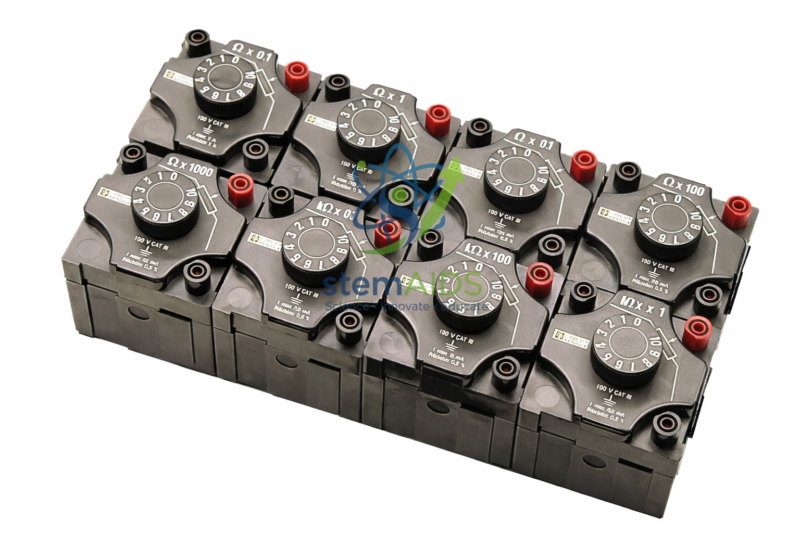
Quick Answer: The Modular resistance box is a set of single-dial decade resistance modules, each with its own selector and terminals, that clip together side by side as pictured. Linked in series, the modules act as one multi-decade box; separated, each can serve a different group or a different part of a circuit.
How the Modules Add Up
Each module is a decade unit: its dial selects whole multiples of one step value, and the step values differ from module to module by factors of ten, as marked beside each dial. Connecting the modules in series with short leads makes their resistances add, so the total is read digit by digit from the dials, exactly as on a conventional decade box. Setting a four-digit value simply means turning the dial for each decade to the matching digit.
The modular format adds flexibility that a fixed box lacks. Two modules can be connected in parallel to test 1/R = 1/R₁ + 1/R₂ with known values, individual modules can be handed to different practical groups, and a damaged module can be replaced without losing the whole set.
Accuracy Points for Low Values
Every connection adds a little resistance. Each plug, lead and switch contact contributes a small amount, which is negligible against kilohms but noticeable when the total setting is only a few ohms. When the box serves as a known resistance in a metre bridge or a substitution measurement at low values, keep the linking leads short and thick, measure the resistance with all dials at zero, and subtract it from the readings.
Applications
- Acting as the known arm of a metre bridge or Wheatstone bridge
- Substitution measurement of an unknown resistance against a meter reading
- Testing series and parallel resistance laws with known values
- Setting known loads to test cells, meters and sensor circuits
Specifications
| Type | Modular decade resistance box |
| Format | Single-dial decade modules that clip together, each with its own terminals, as pictured |
| Reading | Total resistance read digit by digit from the dials when modules are linked in series |
| Connections | Sockets on each module for leads |
| Number of modules, decade values and power rating | Confirm at enquiry |
Care & Handling
- Keep currents small: decade resistors are measurement references, not power resistors, and heat changes their value.
- Turn dials firmly to a click position; a dial left between positions can open the circuit.
- Store the modules in their case or a dry drawer, not stacked loosely where terminals can be bent.
- Check each module occasionally against a multimeter and set aside any that read out of line.
Why Choose LabEquip
Colleges and schools buy a modular box when several groups need decade resistances at once, or when one teacher wants a single large box for demonstrations. LabEquip also lists a single decade resistance box and the meter bridge used with it, in the Physics Equipments category.
Frequently Asked Questions
How is a modular resistance box different from a standard decade box?
A standard decade box has all its dials in one fixed case. The modular version splits each decade into its own unit, so the decades can be used together as one box, separately by different groups, or in parallel combinations.
How do I set a particular resistance?
Link the modules in series and turn each dial to the digit for its decade. The total resistance is the sum of each dial reading multiplied by that module’s step value.
Can the modules be connected in parallel?
Yes. Connecting two modules in parallel gives a combined resistance smaller than either, which is a useful check of the parallel-resistor formula with accurately known values.
Why does the box read slightly above zero with all dials at zero?
The switch contacts, internal wiring and linking leads have a small resistance of their own. Measure this residual value and subtract it when the settings are low.
How much current can the modules carry?
Decade resistors are designed for measurement, so the current should be kept small to avoid heating. The power rating differs between decades, and the details for this set can be confirmed when you enquire.
Is the modular box suitable for a metre bridge experiment?
Yes. It serves as the known resistance in the bridge, and adjusting it until the balance point lies near the middle of the wire gives the most accurate result.
Last Updated: October 2026








Reviews
There are no reviews yet.