
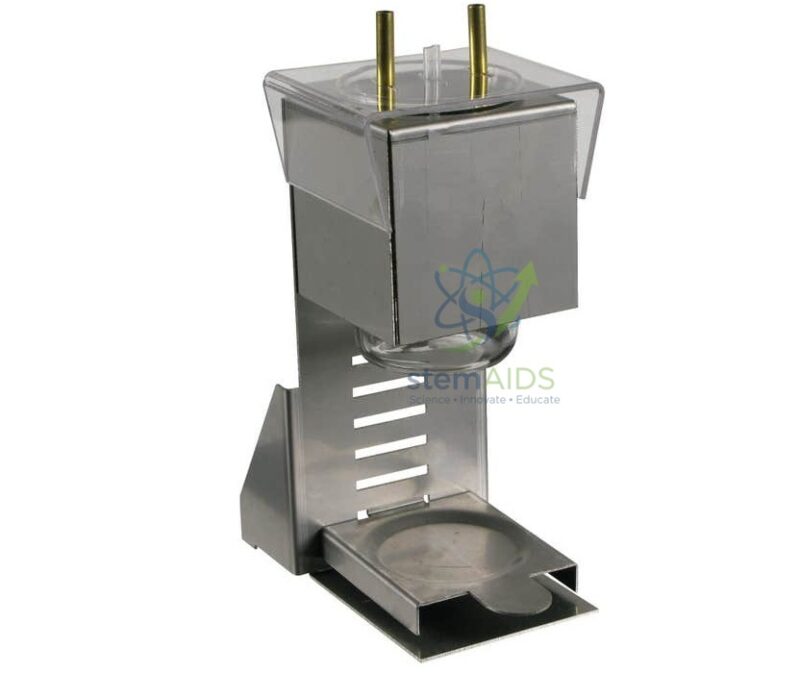
Quick Answer: This fuel energy apparatus is a stand with a burner tray at the base, a slotted metal chimney around the flame and a water vessel on top, as pictured. Students burn a weighed amount of fuel under a known mass of water and use the temperature rise to work out how much energy each gram of the fuel releases.
The Calculation Behind the Experiment
The energy transferred to the water is found from Q = m c ΔT, where m is the mass of water, c is the specific heat capacity of water (about 4.18 J per gram per degree Celsius) and ΔT is the temperature rise. The spirit burner or fuel sample is weighed before and after burning, and dividing Q by the mass of fuel burned gives the energy released per gram. Repeating the run with different fuels lets students compare them on equal terms.
With a series of alcohols, the energy released per gram follows a clear pattern, which links this practical to bond energies and the homologous series.
Why the Chimney Matters
Results from simple calorimetry are always lower than data-book values, because much of the heat escapes to the surroundings. The metal chimney on this fuel energy apparatus shields the flame from draughts and channels the hot gases up towards the water vessel, so a larger share of the heat reaches the water and the results become more consistent. Students can still discuss the remaining losses: heating the vessel itself, incomplete combustion and heat lost from the hot water.
Specifications
| Product | Fuel energy apparatus |
| Shown in photograph | Stand with burner tray, slotted metal chimney and water vessel with fittings on the lid |
| Principle | Heat released by burning fuel measured by the temperature rise of water |
| Measurements | Mass of water, temperature rise, mass of fuel burned |
| Used with | Spirit burners, thermometer, balance, stopwatch |
| Vessel capacity and burner inclusion | Confirm at enquiry |
Practical Uses
- Comparing the energy released per gram by different alcohols
- Comparing a liquid fuel with a solid fuel such as a wax candle
- Discussing heat losses and why measured values fall below data-book values
- Linking the energy of fuels to everyday choices of heating and transport fuels
Care & Handling
- Fill and refill spirit burners away from any flame and keep fuel bottles closed
- Extinguish the burner with its cap and let the apparatus cool before handling
- Stir the water gently before each temperature reading for an even value
- Wipe soot from the vessel base after use so that heat transfer stays consistent
Why Choose LabEquip
Schools choose a shielded apparatus because it gives steadier fuel comparisons than a can held over a burner. LabEquip supplies it with the economy calorimeter and other physics lab equipment; contact LabEquip to check what is included.
Frequently Asked Questions
How is the energy released per gram worked out?
Find the energy gained by the water as its mass times its specific heat capacity times its temperature rise, then divide that figure by the mass of fuel used up.
Why are the results lower than data-book values?
Heat escapes to the air, warms the apparatus and is lost from the hot water, and some fuel may burn incompletely. Only part of the energy released reaches the water.
What does the metal chimney do?
It shields the flame from draughts and guides the hot gases towards the water vessel, so more of the heat is transferred and repeat results agree better.
Which fuels can be compared?
Common choices are alcohols in spirit burners, such as methanol, ethanol and propanol, and solid fuels such as candle wax, used in small amounts.
How can the experiment be made fairer?
Use the same mass of water, the same starting temperature, the same distance from flame to vessel and the same temperature rise for each fuel.
Why does soot form on the vessel?
Soot is carbon from incomplete combustion. It shows the fuel is not burning fully, which also means less energy is released than the data-book value.
Last Updated: October 2026



Reviews
There are no reviews yet.