

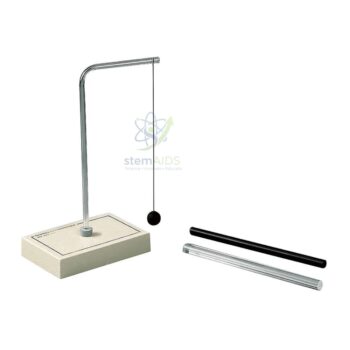
Quick Answer: Meca Ball pendulums are pendulum apparatus from the Meca Ball mechanics range, in which a ball swings on a cord from a support. Students use the Meca Ball pendulums to find out which factors change the period of a swing and to watch kinetic and potential energy exchange as the ball rises and falls.
What Changes the Period, and What Does Not
Asked to predict, most students expect a heavier ball to swing faster and a bigger swing to take longer. Testing each idea in turn shows that neither has much effect. For small swings the period is T = 2π√(L/g), which contains only the length L and the gravitational field strength g. Swapping a light ball for a heavy one of the same size leaves the period unchanged, because the larger weight is exactly matched by the larger inertia.
Amplitude has a small effect that careful students can detect. Released from 10 degrees, a pendulum’s period is within 0.2 % of the simple formula; from 30 degrees it is about 1.7 % longer. Timing twenty swings from each angle, with the same length, shows this gentle increase and explains why the small-angle condition appears in textbooks.
Energy and Galileo’s Interrupted Pendulum
A swinging ball constantly exchanges energy: at the lowest point it moves fastest and has the most kinetic energy, and at each end it stops momentarily with the most potential energy. Galileo tested this with an interrupted pendulum. A peg placed below the support catches the cord part-way through the swing, so the ball continues on a tighter arc, yet it still rises to almost the same height it started from. The ball’s energy, not the shape of its path, decides how high it can climb.
Specifications
| Range | Meca Ball |
| Item | Pendulum apparatus with ball bobs |
| Period for small swings | T = 2π√(L/g) |
| Variables investigated | Length, mass of bob, release angle |
| Parts supplied and support | Confirm at enquiry |
Applications
- Testing whether bob mass, amplitude or length changes the period
- Measuring the small increase in period at larger release angles
- Showing energy conservation with an interrupted pendulum
- Comparing a swinging ball with a ball rolling in a curved track
Care & Handling
- Clamp the support firmly to the bench so it does not rock with the swing.
- Check the cord for fraying and replace it before it breaks during a run.
- Keep the swing clear of faces and keep students out of its path.
- Store balls and cords together so a set is complete for the next class.
Why Choose LabEquip
Teachers choose a pendulum set from the Meca Ball range when they want pendulum work to connect with the same unit’s ball tracks and planes. LabEquip lists these pendulums in its physics lab equipment range with the Meca Ball identical tracks; individual pendulum bobs are also available for extra masses. Use the contact page to ask what the set contains.
Frequently Asked Questions
Does a heavier ball swing faster?
No. A heavier bob has a larger weight pulling it back, but also more inertia resisting the change in motion, and the two effects cancel. The period depends on length, not mass.
Does the size of the swing change the period?
Only slightly. For swings under about 10 degrees the change is negligible, but at 30 degrees the period is roughly 1.7 % longer than the small-angle value.
What does Galileo’s interrupted pendulum show?
A peg catches the cord part-way down, yet the ball still rises to nearly its starting height on the other side. This shows that the height reached depends on the energy the ball has, not on the path it follows.
Where should the pendulum length be measured to?
Measure from the point where the cord leaves the support to the centre of the ball. Measuring to the top or bottom of the ball gives a systematic error.
Why does the swing slowly die away?
Air resistance and friction at the support take a little energy on every swing and turn it into heat. The amplitude shrinks, while the period stays almost the same.
How many swings should be timed?
Time at least ten, and preferably twenty, complete swings and divide by the number timed. Reaction-time errors at the start and stop are then spread over many periods.
Last Updated: October 2026




Reviews
There are no reviews yet.