
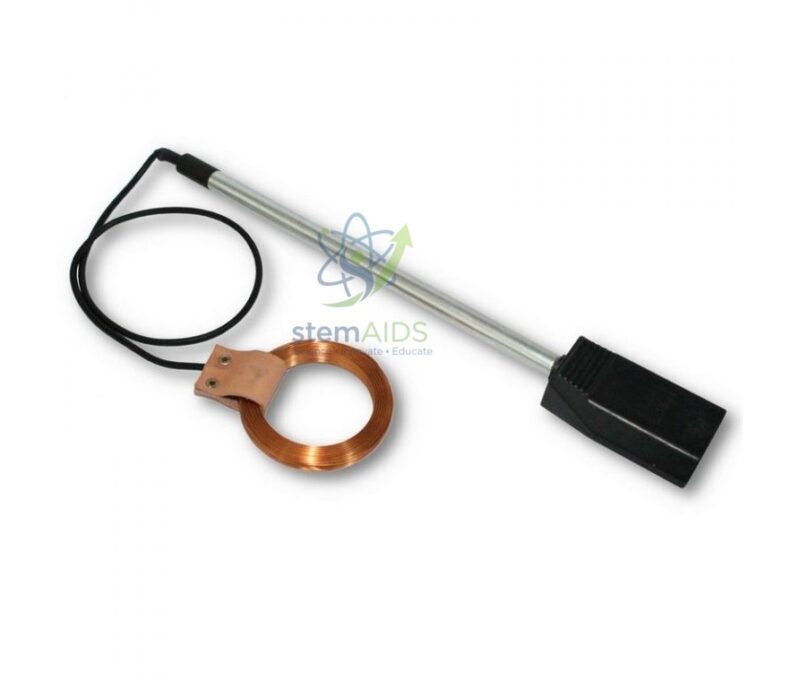
Quick Answer: The maximum flux coil is a flat search coil on the end of a rod and handle, with a lead for connecting to a meter or oscilloscope. Placed in an alternating magnetic field, the maximum flux coil gives an induced voltage that is largest when its face is perpendicular to the field, where the flux through it is greatest.
Induction in a Search Coil
Faraday’s law says that a coil develops an EMF equal to its number of turns times the rate of change of the magnetic flux through it. In an alternating field the flux changes all the time, so the coil produces an alternating voltage whose size depends on three things: the strength of the field, how fast it alternates, and how much of the field passes through the coil’s area.
That last factor depends on orientation. Facing the field squarely, the coil catches the most flux and the voltage peaks; turned edge-on, it catches none and the voltage drops to zero. The name of the coil comes from this behaviour: searching for the position of maximum flux reveals the direction of the field.
Exploring a Field Point by Point
In the product photograph the copper coil sits at the end of a long rod, with a black handle and a lead running back to the connector. The rod lets the coil reach inside or around a solenoid, a transformer core or a pair of coils carrying alternating current, without the hand disturbing the field.
At each point, students rotate the coil until the reading is largest; the coil’s axis then lies along the field. Moving the coil and repeating builds a map of field direction and relative strength. Steady fields from permanent magnets or DC coils give no reading unless the coil is moved, a useful contrast with a Hall probe.
Applications
- Finding the direction of the field around a coil carrying alternating current
- Comparing field strength at different points by the induced voltage
- Showing that induced voltage doubles when the supply frequency doubles at the same current
- Investigating flux leakage around a transformer
Specifications
| Product | Maximum flux coil: flat search coil on a rod with handle |
| Coil | Flat copper winding at the tip |
| Connection | Lead to a meter or oscilloscope |
| Responds to | Alternating or changing magnetic fields |
| Number of turns and coil area | Confirm at enquiry |
Care & Handling
- Hold the probe by its handle and keep the coil away from hot or sharp edges
- Do not bend the rod or pull on the lead at the coil end
- Never touch the coil to bare terminals or uninsulated conductors in the circuit being explored
- Store with the lead loosely coiled
Why Choose LabEquip
Teachers covering electromagnetic induction use a maximum flux coil to let students find field directions by measurement rather than by drawing. LabEquip supplies it with the protected solenoid and the variable-spacing flat coils among its physics equipment; turn and area details can be confirmed via the contact page.
Frequently Asked Questions
Why does the coil only respond to alternating or changing fields?
An EMF is induced only when the flux through the coil changes. A steady field gives a constant flux and no voltage, unless the coil itself is moved or turned.
How is the direction of the field found with this coil?
Rotate the coil at one point until the voltage is greatest. The field then lies along the coil’s axis, perpendicular to its flat face; the reading falls to a minimum when the coil is edge-on.
Why does the reading double when the frequency doubles?
The flux changes twice as fast, and the induced EMF is proportional to the rate of change. With the same field strength, doubling the frequency doubles the voltage.
What instrument should be connected to the coil?
An AC millivoltmeter or an oscilloscope. The oscilloscope also shows the waveform and lets students compare the phase of the induced voltage with the current in the field coil.
Can the coil measure the Earth’s magnetic field?
Not easily. The Earth’s field is steady and weak, so the coil gives only a tiny signal when it is flipped quickly. A Hall probe is the practical choice for the Earth’s field.
How does a search coil differ from a Hall probe?
A Hall probe measures the field itself, including steady fields. A search coil measures the rate of change of flux, so it suits alternating fields and needs no battery or electronics.
Last Updated: October 2026




Reviews
There are no reviews yet.