
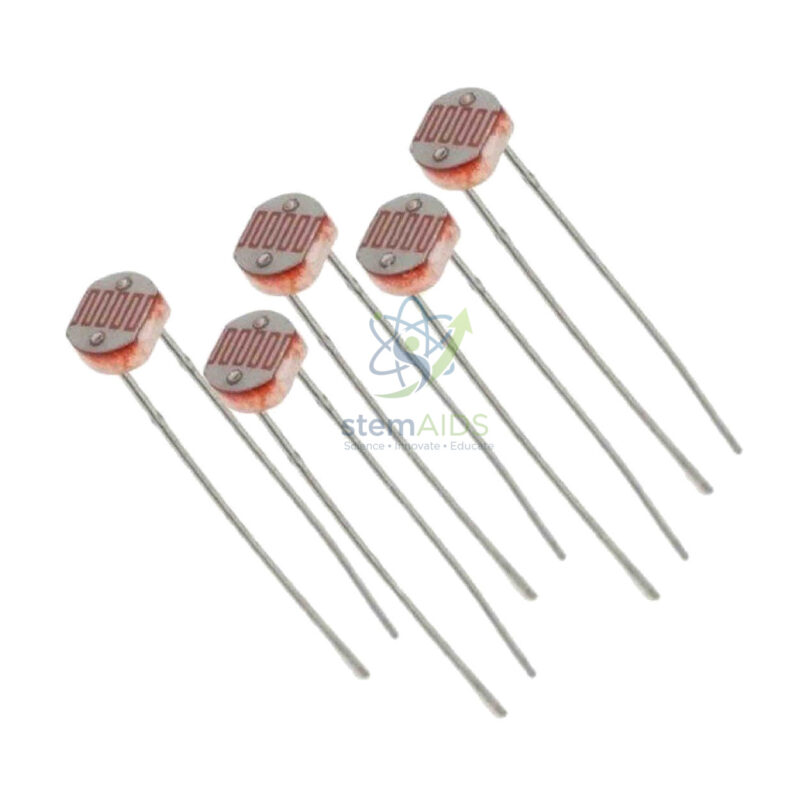
Quick Answer: The LDR Light Dependent Resistor is a photoresistor whose resistance falls as the light on it gets brighter, because light frees charge carriers in its semiconductor track. A light dependent resistor is used in physics practicals on sensors, potential dividers and light-operated switching circuits.
How Light Lowers the Resistance
An LDR has a zig-zag track of photoconductive semiconductor, commonly cadmium sulfide, laid between two electrodes under a clear window. In the dark the material has few free charge carriers and a high resistance. Light of sufficient energy frees electrons in the track, the number of carriers rises and the resistance falls. The brighter the light, the lower the resistance, and the change spans a very wide range between darkness and daylight.
Two features set it apart from a photodiode. It is slow, taking a noticeable fraction of a second to respond and longer to recover after a bright light is removed, so it suits ambient-light sensing rather than fast signals. And its response is non-linear: resistance falls steeply at first and then more gradually as light increases, which is why its graphs are usually drawn on logarithmic scales. The BPW34 photodiode is the better choice where speed or a linear response matters.
The Potential Divider Circuit
On its own the LDR changes resistance, but most circuits need a changing voltage. Connected in series with a fixed resistor across a supply, it forms a potential divider whose junction voltage rises or falls with light level. Feeding that voltage to a transistor or comparator gives a switch that turns a lamp on at dusk or sounds a buzzer when a beam is broken. Swapping the positions of the LDR and the fixed resistor reverses the action, so the same parts make either a dark-activated or a light-activated circuit.
Applications
- Measuring how resistance varies with light intensity or distance from a lamp
- Building dark-activated night lights and light-activated alarms
- Making a simple light meter from an ohmmeter and a calibration graph
- Comparing the response speed of an LDR and a photodiode
Specifications
| Component | Light dependent resistor (photoresistor) |
| Principle | Photoconductivity in a semiconductor track |
| Behaviour | Resistance falls as light intensity rises |
| Response | Non-linear and relatively slow |
| Dark and light resistance values | Confirm at enquiry |
Care & Handling
- Keep the window of the light dependent resistor clean, as dust and fingerprints reduce the light reaching the track.
- Shield the LDR from stray light when taking readings, for example with a short tube, so room lighting does not swamp the effect being measured.
- Allow the resistance to settle after each change in light, especially when moving from bright light into darkness.
- Most LDRs contain cadmium compounds, so dispose of damaged ones as electronic waste rather than general rubbish.
Why Choose LabEquip
Light sensors are a fixture of school electronics courses, so departments buy LDRs in quantity with matching resistors and transistors. LabEquip supplies them in our physics lab equipment range; ask for class quantities through the contact page.
Frequently Asked Questions
What does LDR stand for?
Light dependent resistor, also called a photoresistor or photocell. Its resistance depends on the amount of light falling on it and drops as the light gets brighter.
Why does an LDR’s resistance fall in bright light?
Light gives electrons in the semiconductor track enough energy to break free and carry current. More light frees more carriers, so the material conducts better and its resistance falls. In darkness few carriers are free and the resistance is high.
How do I make a circuit that switches on a lamp when it gets dark?
Connect the LDR and a fixed or variable resistor in series across the supply as a potential divider, with the LDR placed so that the junction voltage rises as light falls. Feed that voltage through a resistor to the base of a transistor, with the lamp or a relay in the transistor’s collector circuit.
Is an LDR fast enough to detect a flashing light?
Only slow flashing. An LDR takes a noticeable time to respond and longer to recover after the light is removed. For fast pulses, such as data sent by light or measuring flicker, a photodiode or phototransistor is used instead.
Why is the graph of resistance against light usually drawn on logarithmic scales?
The resistance changes over a very wide range, from a high value in darkness to a low one in bright light. On ordinary scales most readings would be squashed against one axis; logarithmic scales spread them out and show the relationship clearly.
Is an LDR safe to handle?
Yes, in normal use. Many LDRs use cadmium sulfide sealed inside the component, so the only precautions are not to break them open and to dispose of damaged ones through electronic waste collection.
Last Updated: October 2026




Reviews
There are no reviews yet.