
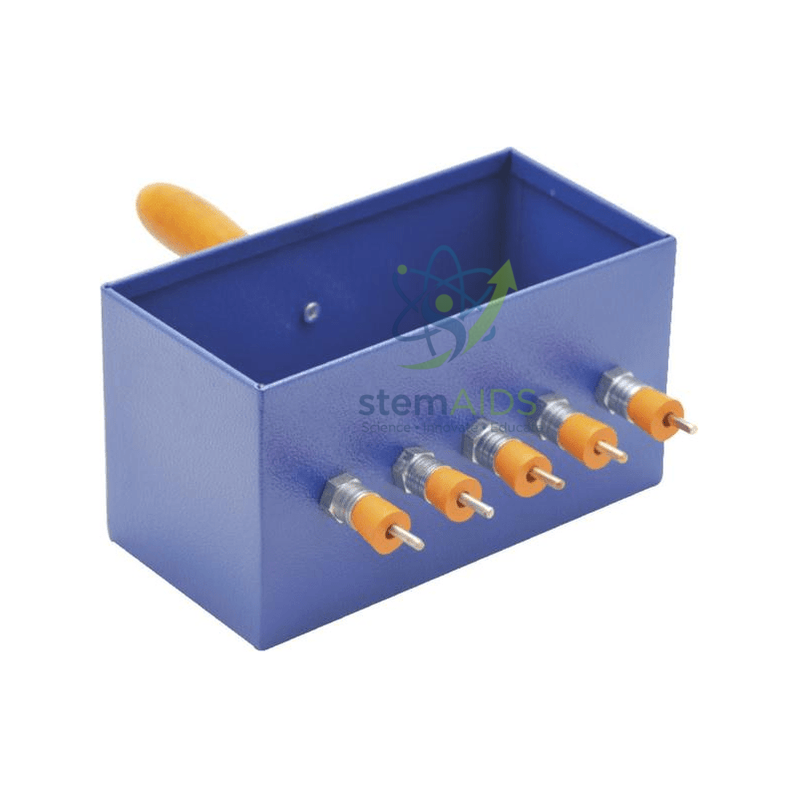
Quick Answer: This Ingenhousz apparatus compares the thermal conductivities of different metals. Rods of equal length and thickness project from the side of a hot-water or steam trough, and a coating of wax on each rod melts back from the hot end to a distance that depends on how well the metal conducts heat; in the steady state, conductivities are in the ratio of the squares of the melted lengths.
How the Apparatus Is Arranged
In the usual form, a rectangular metal trough has several rods of different metals fixed through one side, with their inner ends exposed to the hot water or steam inside. The rods are of equal length and diameter and are given the same surface treatment so that they lose heat to the air in the same way. Before the experiment each rod is coated with a thin, even layer of wax, usually by dipping it in molten wax and letting it set. The number of rods, the metals supplied and the size of the trough should be confirmed at enquiry.
Why the Square of the Melted Length
Each rod carries heat along its length from the hot trough and loses heat from its surface to the surrounding air. Once nothing is changing any more, the steady state, the temperature falls off along the rod over a distance that grows with the square root of the metal’s thermal conductivity. Wax melts wherever the rod is hotter than its melting point, and that temperature is the same for every rod, so the melted length is proportional to the square root of conductivity.
Squaring the measured lengths therefore gives the ratio of conductivities: K1/K2 = l1²/l2². The result holds only when the rods match in size and surface and are long enough that their far ends stay cool.
Running the Experiment
Fill the trough with boiling water or pass steam through it, and leave the apparatus undisturbed while the wax melts back along each rod. The melting front moves quickly at first, then slows and stops; only when every front has stopped are the lengths measured from the trough wall with a ruler. Expressing each result relative to copper gives a ranking that can be compared with published values.
Applications
- Ranking metals by thermal conductivity in school and college practicals
- Showing the difference between steady-state and transient heat flow
- Calculating conductivity ratios from the squares of melted lengths
- Discussing heat loss from surfaces and why rods are given identical coatings
Specifications
| Type | Ingenhousz thermal conductivity apparatus |
| Principle | Steady-state length of wax melted along heated rods |
| Heat source | Boiling water or steam in the trough |
| Rods | Different metals of equal length and diameter |
| Number of rods, metals, trough material and size | Confirm at enquiry |
Care & Handling
- Handle boiling water and steam with care and never heat the trough empty.
- Keep wax away from open flames and melt it only in a water bath.
- Clean wax off the rods after use with warm water and a soft cloth, not a sharp tool.
- Drain and dry the trough after each use so it does not corrode.
Why Choose LabEquip
Physics teachers buy the Ingenhousz apparatus because it turns an abstract property into lengths students can measure with a ruler. LabEquip lists it with its physics lab equipment; the heat conductivity apparatus gives a quick qualitative comparison, and Searle’s thermal conductivity apparatus measures a single metal absolutely. Ask about rod sets through the contact page.
Frequently Asked Questions
Why does conductivity depend on the square of the melted length?
In the steady state the temperature along each rod falls over a distance proportional to the square root of the conductivity. The wax melts back to the same temperature on every rod, so squaring the melted lengths gives the conductivity ratio.
Why must the rods be identical in size and surface?
Heat leaks from each rod through its surface. Differences in diameter, length or surface finish would change that loss and alter the melted lengths for reasons other than conductivity.
Why wait for the wax to stop melting?
The squared-length relation applies only to the steady state. Lengths measured while the fronts are still moving reflect how fast each rod is warming, not its final temperature profile.
Why might the rod that starts melting first not finish with the longest melted length?
Early melting depends on how fast a rod warms up, which involves its heat capacity as well as its conductivity. The final melted length depends on conductivity alone, so the order can change.
Can steam be used instead of boiling water?
Yes. Steam passed through the trough keeps the hot ends at a steady temperature with less need for topping up. It must be handled with care because steam scalds.
How does this compare with Searle’s apparatus?
The Ingenhousz apparatus gives ratios of conductivity for several metals at once. Searle’s apparatus measures the conductivity of one good conductor in absolute units, using a thick insulated bar and a measured flow of cooling water.
Last Updated: October 2026




Reviews
There are no reviews yet.