
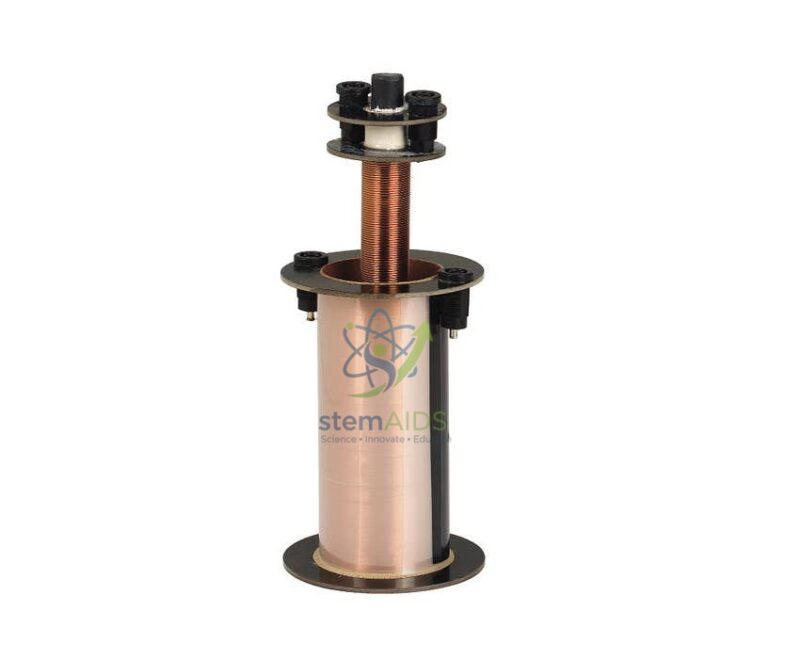
Quick Answer: This Faraday induction coil is a pair of coaxial copper windings, a narrower coil standing inside a wider one, with terminals at the top, as shown in the product photograph. It is used to show mutual induction and Faraday’s law: changing the current or the magnetic flux in one coil induces a voltage in the other.
Faraday’s Experiment with Two Coils
In 1831 Michael Faraday wound two coils on the same iron ring and found that a galvanometer on one coil kicked whenever the current in the other was switched on or off, but not while it was steady. The induction coil repeats that discovery in compact form. Connect the inner coil, the primary, to a low-voltage DC supply through a switch, and the outer coil, the secondary, to a centre-zero galvanometer.
Closing the switch makes the meter kick one way; opening it makes the meter kick the other way. A steady current, however large, gives no reading. Faraday’s law sums this up: the induced emf equals the rate of change of flux linkage, ε = −N dΦ/dt, and the minus sign is Lenz’s law.
Experiments
- Mutual induction when the primary current is switched on and off
- Induction by moving the primary coil or a magnet
- Effect of an iron core on the induced emf
- Introducing the transformer with an AC primary supply
Varying the Experiment
Sliding the inner coil in and out of the outer one while current flows in it produces readings too, since moving the coil changes the flux through the secondary. Replacing the primary with a bar magnet shows the same effect with a permanent field. A soft iron rod placed inside the inner coil, where the design allows, increases the flux and the size of the kicks. With an alternating supply on the primary, the secondary gives a continuous alternating voltage, the principle of the transformer.
Specifications
| Apparatus | Inner and outer coaxial coils, as pictured |
| Winding | Copper wire on bobbins |
| Connections | Terminals at the top of the assembly |
| Detector needed | Centre-zero galvanometer or sensitive meter |
| Number of turns | Confirm at enquiry |
Care & Handling
- Use a low-voltage supply with a switch, and do not leave the primary connected for long
- Protect the galvanometer by starting on its least sensitive range
- Handle the coils by their bobbins, not by the windings or leads
- Keep the windings dry and free from scratches
Why Choose LabEquip
Faraday’s two-coil experiment is a core practical in senior school and college physics, and this coil set makes it quick to repeat. LabEquip also offers the U core for transformer work and other physics lab equipment; class sets can be requested on the contact page.
Frequently Asked Questions
Why does the meter kick only when the switch is opened or closed?
An emf is induced only while the magnetic flux through the secondary is changing. A steady primary current gives a constant flux, so no emf is induced.
Why are the kicks in opposite directions?
Switching on increases the flux and switching off decreases it. By Lenz’s law the induced current opposes each change, so it flows in opposite directions.
What does an iron core do?
Iron greatly increases the flux produced by the primary current, so the change in flux is larger and the induced emf is bigger.
Is this the same as a Ruhmkorff spark coil?
No. A spark coil uses an interrupter and a very large number of secondary turns to produce high voltages. This coil set is meant for low-voltage induction experiments.
What meter should be used?
A centre-zero galvanometer is ideal because it shows the direction of the induced current as well as its size.
Can the coils show the transformer effect?
Yes. With a low-voltage alternating supply on the primary, the secondary gives a continuous alternating voltage that an AC voltmeter or oscilloscope can display.
Last Updated: October 2026





Reviews
There are no reviews yet.