
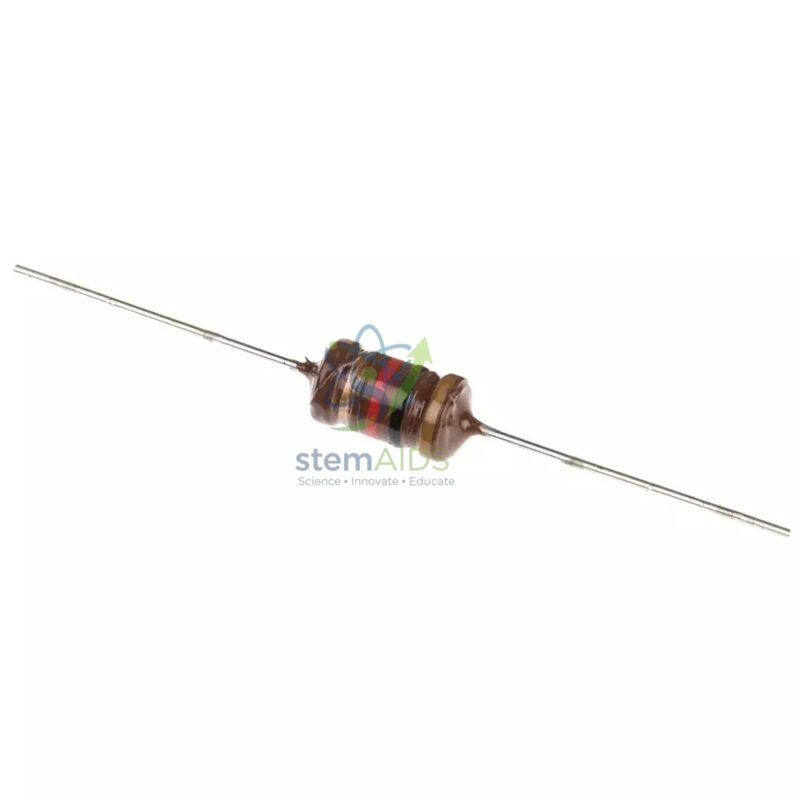
Quick Answer: This is a 10 mH inductor rated for a current of 110 mA, the two values given in its name: a coil that opposes changes in the current through it by self-induction. The 10 mH inductor is used in physics and electronics practicals on RL time constants, inductive reactance, LC resonance and filtering.
Self-Induction in a Coil
Current in a coil sets up a magnetic field linked with its own turns. If the current changes, that linked flux changes, and by Faraday’s law an emf is induced in the coil which, by Lenz’s law, opposes the change. Inductance measures how large that emf is for a given rate of change of current: one henry gives one volt for a change of one ampere per second. At 10 mH, a current changing at a hundred amperes per second induces one volt.
The 110 mA figure is the current the component is rated to carry. Above it the winding may overheat or, if the coil has a magnetic core, the core may begin to saturate so that the inductance falls. The winding resistance and the type of core, if any, are not given in the name and should be confirmed when ordering, because the resistance enters every RL calculation.
Practicals With Worked Numbers
In an RL circuit switched on from a steady supply, the current rises towards its final value with a time constant equal to inductance divided by total resistance. With 10 mH and 100 ohms in total that is 0.1 ms, so the rise is most easily seen on an oscilloscope by driving the circuit with a square wave rather than a switch.
On alternating current the reactance is 2πfL. At 50 Hz a 10 mH coil offers only about 3 ohms, but at 10 kHz about 630 ohms, which is why inductors pass low frequencies and hold back high ones. Paired with a capacitor it forms a resonant circuit at f = 1/(2π√(LC)); with a 1 µF capacitor the resonance falls near 1.6 kHz, easy to find with a signal generator. Our decade capacitance box shifts that resonance in steps.
Applications
- Measuring the RL time constant with a square-wave input and oscilloscope
- Showing how inductive reactance rises with frequency
- Building series and parallel LC resonant circuits
- Simple low-pass filters and supply-noise chokes in electronics projects
Specifications
| Component | Inductor (coil) |
| Inductance | 10 mH (as titled) |
| Rated current | 110 mA (as titled) |
| Uses | RL, LC and filter circuits |
| Winding resistance and core type | Confirm at enquiry |
Care & Handling
- Keep the current through the 10 mH inductor within its 110 mA rating.
- Expect a voltage spike when current in the coil is interrupted; in switched circuits add a diode or resistor to absorb it.
- Keep the inductor away from strong magnets and other coils while measuring, as stray coupling alters readings.
- Do not strain the leads where they join the winding.
Why Choose LabEquip
Electronics and physics departments use a fixed inductor of this value for resonance, filter and transient practicals, alongside capacitors and resistors chosen to match. It is listed in our physics lab equipment; ask through the contact page about the winding resistance.
Frequently Asked Questions
What does 10 mH mean?
It is the inductance: 10 millihenries, or 0.01 henry. A current through the coil changing at one ampere per second induces an emf of 10 millivolts across it.
What does the 110 mA rating mean?
It is the current the inductor is rated to carry. Exceeding it can overheat the winding or, in a cored inductor, saturate the core so that the inductance falls. Keep currents in practicals below this value.
What is the time constant of an RL circuit with this inductor?
It is the inductance divided by the total resistance in the circuit, including the coil’s own winding resistance. With 100 ohms in total, the time constant is 0.1 milliseconds.
How does the inductor behave on AC?
Its reactance is 2πfL, so it grows in proportion to frequency. At low frequencies the coil offers little opposition; at high frequencies it offers a lot. This is why inductors are used to block high-frequency noise while passing low-frequency or steady currents.
What capacitor gives resonance at a convenient frequency?
The resonant frequency is one divided by 2π times the square root of LC. With this 10 mH inductor, a 1 µF capacitor gives about 1.6 kHz and a 0.1 µF capacitor about 5 kHz, both easy to find with a signal generator.
Why can a spark appear when the circuit is broken?
Breaking the circuit forces the current to fall almost instantly, and the coil opposes that change by inducing a large emf, which can jump a small gap as a spark. A diode connected across the coil gives the current a path to decay and prevents it.
Last Updated: October 2026



Reviews
There are no reviews yet.