
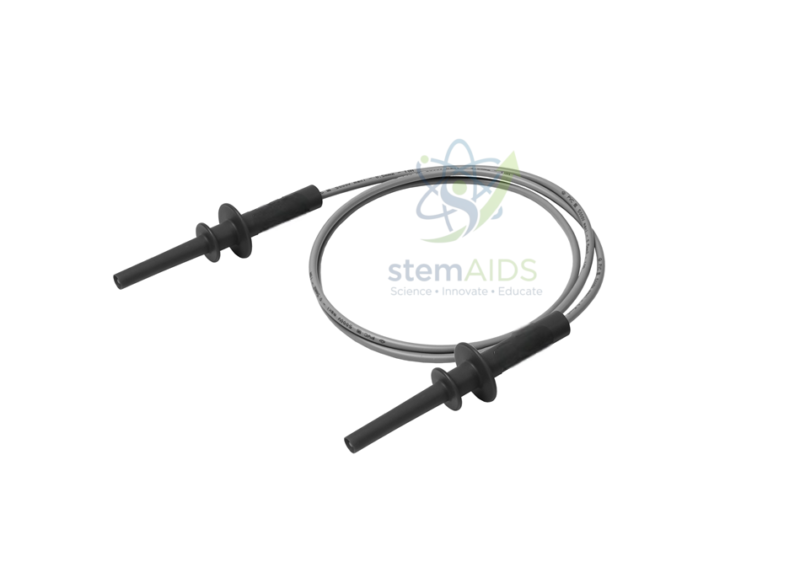
Quick Answer: The High Tension Cord 10A is a connecting lead for high-voltage (high tension) circuits, with a thin grey cable and a black plug at each end, as pictured, and the 10 A current rating given in its title. A high tension cord connects apparatus such as induction coils, discharge tubes and high-voltage supplies where ordinary circuit leads are not intended.
Voltage Rating and Current Rating Are Different Things
A lead has two separate limits. The current rating, 10 A for this cord, depends on the conductor: a thicker copper core carries more current before it heats up. The voltage rating depends on the insulation, which must withstand the electric field between the conductor and anything outside without breaking down. A high tension cord is made with the second limit in mind, which is why it is chosen for high-voltage circuits even when the current is tiny.
In school high-voltage experiments the current is usually very small, often deliberately limited by the supply, so the 10 A figure is rarely approached. What matters is the insulation, the shrouding of the plugs and the condition of the cable, because those protect the user from the voltage.
Specifications
| Product | High tension (high-voltage) connecting cord |
| Current rating, from title | 10 A |
| Construction in photograph | Thin grey cable with a black plug at each end |
| Use | Connecting high-voltage supplies and apparatus |
| Voltage rating and length | Confirm at enquiry |
Using High-Voltage Leads Safely
Connect the cord with the supply switched off and its output turned to zero. Route the lead so it does not cross low-voltage leads or lie against metal, and keep hands away from the circuit while the supply is on. After switching off, allow the apparatus to discharge, or discharge it with the earthing arrangement the equipment provides, before touching any connection.
Inspect each cord before use. A cut, crushed or stiff section of insulation, or a plug whose shroud is cracked, takes the lead out of service, because the damage that matters at high voltage is often small.
Care & Handling
- Look over the insulation and plug shrouds before every use
- Hang leads straight or coil them loosely; sharp bends crack insulation over time
- Keep leads clean and dry, since dirt and moisture let charge leak across insulation
- Never use the cord beyond its stated voltage rating
Applications
- Connecting a high-voltage supply to discharge tubes or spark gaps
- Wiring an induction coil to its electrodes or load
- Linking electrostatic apparatus to an electroscope or electrode
- Teaching the difference between the voltage and current ratings of cables
Why Choose LabEquip
Physics departments with induction coils, discharge tubes or high-voltage supplies keep dedicated high-voltage leads, separate from ordinary circuit leads, so the right lead is always used. For low-voltage multimeter work choose a measurement lead instead; contact LabEquip to confirm the voltage rating you need, or browse more physics lab equipment.
Frequently Asked Questions
What does high tension mean?
High tension is an older term for high voltage. A high tension cord is a lead built with insulation intended for high-voltage circuits.
Is the 10 A rating a voltage rating?
No. 10 A is the current the conductor can carry. The voltage the insulation can withstand is a separate rating, and both must suit the circuit.
Why are currents in high-voltage experiments so small?
School high-voltage supplies and electrostatic machines usually deliver only small currents, often limited on purpose. The hazard comes from the voltage, so insulation matters more than conductor size.
Can I use an ordinary lead for a high-voltage supply?
No. Ordinary leads are intended for low voltages, and their insulation and plugs may not withstand high voltage. Use leads made for the voltage involved.
Why must leads be kept clean and dry?
Dust, grease and moisture on the insulation surface can let charge leak across it, and at high voltage that leakage can track or spark. Clean, dry leads keep the charge where it belongs.
What voltage can the cord withstand?
The listing states the 10 A current rating only, so the voltage rating can be confirmed at enquiry before the cord is used with a particular supply.
Last Updated: October 2026




Reviews
There are no reviews yet.