
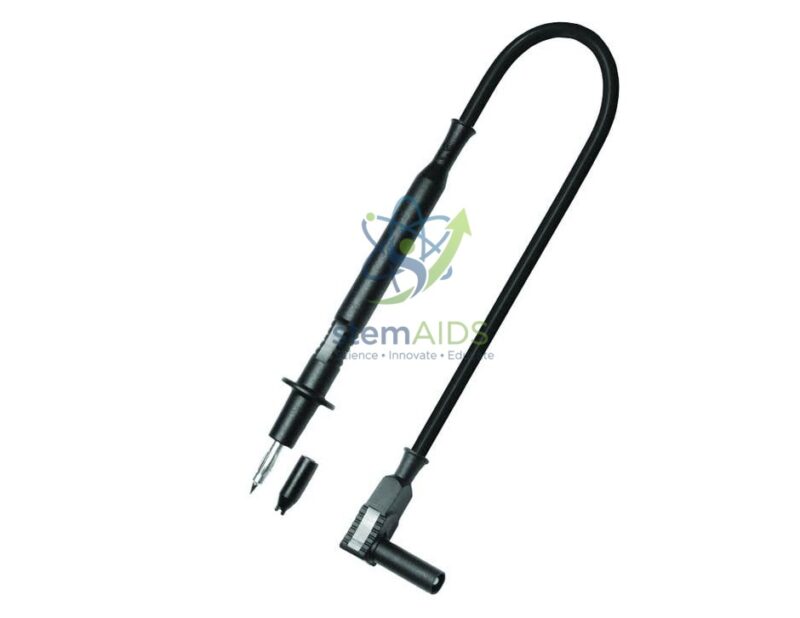
Quick Answer: The Measurement Lead is a test lead with a pointed probe tip at one end and a right-angled plug at the other, as pictured, for connecting a multimeter or other instrument to test points in a circuit. A measurement lead is used in pairs, normally one red and one black, for voltage, resistance and continuity readings.
Making Good Contact With a Probe
A probe tip concentrates the contact onto a small point, so a measurement lead can touch a component leg, a solder joint or a terminal screw without bridging to the next one. Press firmly and hold still: a light, wobbling contact adds resistance and makes the reading flicker.
The right-angled plug at the meter end lets the lead lie flat alongside the meter instead of sticking straight out, which reduces the leverage that would otherwise loosen the plug or strain the meter socket over time.
Lead Resistance in Low-Resistance Measurements
Every test lead has a small resistance of its own, usually a fraction of an ohm for the pair. On a 100 kΩ resistor that is negligible, but on a 1 Ω resistor or a short copper wire it is a significant error. Touch the two probe tips together on the ohms range, note the reading and subtract it from later readings, or use the meter’s relative or zero function if it has one.
For very small resistances, physics practicals use a four-wire method: one pair of leads drives a known current and a second pair measures the voltage directly across the sample, so the resistance of the leads drops out of the result.
Uses
- Voltage, current and resistance readings with a multimeter
- Probing points on a breadboard or circuit board
- Checking continuity of wires, fuses and switches
- Four-wire resistance measurements with a second pair of leads
Care & Handling
- Inspect the insulation and probe shroud before each use and replace damaged leads
- Use leads whose category rating suits the circuit, and never exceed it
- Unplug by gripping the plug, not by pulling the cable
- Hang leads straight for storage
Specifications
| Product | Measurement (test) lead |
| Construction in photograph | Probe tip at one end, right-angled plug at the other |
| Use | Connecting instruments to test points |
| Typical pairing | One red and one black lead per meter |
| Length and measurement category rating | Confirm at enquiry |
Why Choose LabEquip
Schools and colleges replace test leads more often than any meter, because leads are flexed, stepped on and pulled. LabEquip supplies replacement leads along with test hook clips for hands-free readings and the rest of our physics lab equipment; contact LabEquip for length and rating.
Frequently Asked Questions
Why does my resistance reading not start at zero with the probes touching?
The leads and contacts have a small resistance of their own. Note that reading and subtract it, or use the meter’s relative function, when measuring small resistances.
Why is the plug right-angled?
A right-angled plug lets the lead lie flat by the meter. It reduces the leverage on the socket and the strain on the cable where it enters the plug.
How do I get a steady reading with a probe tip?
Press the tip firmly onto clean metal and hold it still. Oxidised or dirty contacts and a wobbling hand both add varying resistance.
What is a four-wire measurement?
A way of measuring very small resistances. One pair of leads carries a known current through the sample and a second pair measures the voltage across it, so lead resistance does not affect the result.
When should a measurement lead be replaced?
When the insulation is cut, cracked or melted, when the plug or shroud is damaged, or when the lead gives intermittent readings as it is flexed.
What measurement category is the lead rated for?
The listing names the lead only, so its length and category rating can be confirmed at enquiry. Always choose leads rated for the circuit being measured.
Last Updated: October 2026






Reviews
There are no reviews yet.