
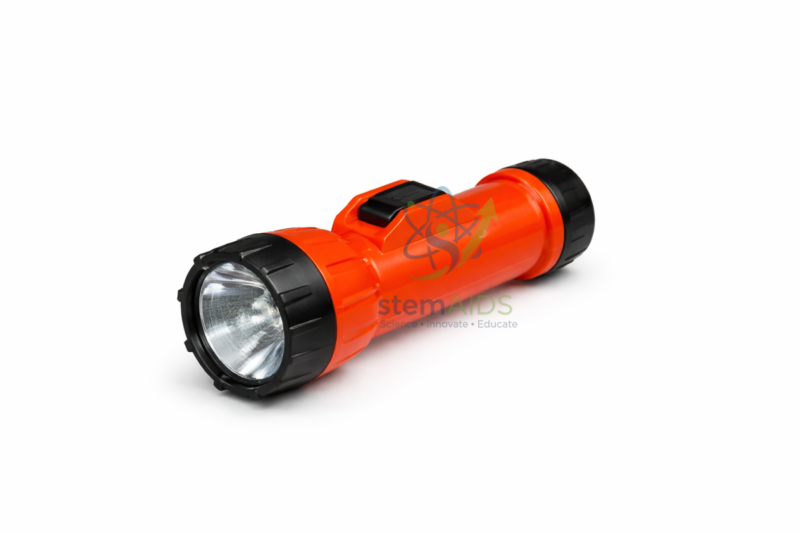
Quick Answer: The Handheld Flashlight is a portable, battery-powered torch that sends a directed beam from a lamp or LED placed in front of a curved reflector. In the laboratory a handheld flashlight is a portable light source for inspection work and power cuts, and a ready-made example for lessons on circuits and light.
A Complete Circuit in Your Hand
Inside the torch, the cells, the switch, the lamp or LED and the metal contacts form a simple series circuit. Sliding or pressing the switch closes the gap and current flows; opening it breaks the circuit everywhere at once. Taking a torch apart, with the cells removed, and drawing its circuit diagram is a classic introduction to circuit symbols, cells in series and the job of a switch.
The cells must be fitted the right way round so that their voltages add. An LED adds a further lesson: it conducts in one direction only, so a torch with an LED will not light at all if the cells are reversed, whereas a filament lamp would.
How the Reflector Shapes the Beam
The curved reflector behind the light source is close to a parabola in shape. Light from a source placed at its focus is reflected into a nearly parallel beam, which is why a torch throws a bright spot rather than lighting the whole room. Torches with adjustable focus move the source slightly away from the focus, so the beam spreads into a wider, dimmer pool.
Using It in Optics Demonstrations
Shining the torch at a ball in front of a wall shows a sharp shadow; moving the torch closer, so that the light source looks larger from the ball, produces a dark central umbra surrounded by a lighter penumbra, a model for solar and lunar eclipses. A beam reflected from a plane mirror and the straight edges of shadows show that light travels in straight lines. The light-source type, battery type and body material of this flashlight can be confirmed at enquiry.
Applications
- Looking into apparatus, cupboards and instruments in poorly lit corners
- Emergency lighting in laboratories and stores during power cuts
- Shadow, eclipse and straight-line propagation demonstrations
- Taking apart a real torch to study a series circuit and a reflector
Specifications
| Type | Portable battery-powered torch |
| Beam | Directed by a curved reflector behind the light source |
| Lab uses | Inspection, emergency lighting and optics demonstrations |
| Teaching value | A real series circuit and reflector to examine |
| Light source, battery type and body material | Confirm at enquiry |
Care & Handling
- Remove the cells if the handheld flashlight will be stored for a long time, to prevent leakage damage.
- Never shine the beam directly into anyone’s eyes.
- Keep the contacts clean and dry; corrosion on them is a common cause of a dim or flickering light.
- Dispose of used cells through a battery recycling route, not with general waste.
Why Choose LabEquip
Schools and laboratories buy torches as dependable portable lights that double as teaching examples. LabEquip lists this one with its physics lab equipment; for building circuits on the bench, a 1.5 V lamp is the matching component. Ask about quantities through the contact page.
Frequently Asked Questions
How does the circuit in a flashlight work?
The cells, switch, light source and metal contacts form one series loop. Closing the switch completes the loop so current flows and the lamp or LED lights; opening it breaks the loop and the light goes out.
Why does the reflector give a narrow beam?
The reflector is curved so that light from a source at its focus is reflected into an almost parallel beam. Most of the light is sent forward instead of spreading in all directions.
Why must the cells be inserted the right way round?
The cells are connected in series, and their voltages only add when each positive terminal touches the next negative terminal. Reversing one cell cancels part of the voltage, and an LED will not light at all if the overall polarity is reversed.
What is the difference between an LED and a filament bulb in a torch?
A filament bulb produces light by heating a thin wire until it glows, wasting much energy as heat. An LED produces light directly from a semiconductor junction, so the same cells usually last longer.
How can a flashlight show umbra and penumbra?
Shine it at a ball in front of a wall. With the torch far away the shadow is sharp; bring it closer so the source appears larger, and a dark umbra appears with a lighter penumbra around it, as in an eclipse.
Why should the cells be removed before long storage?
Old cells can leak corrosive chemicals that damage the contacts and spring. Removing them keeps the flashlight in working order for when it is needed.
Last Updated: October 2026




Reviews
There are no reviews yet.