
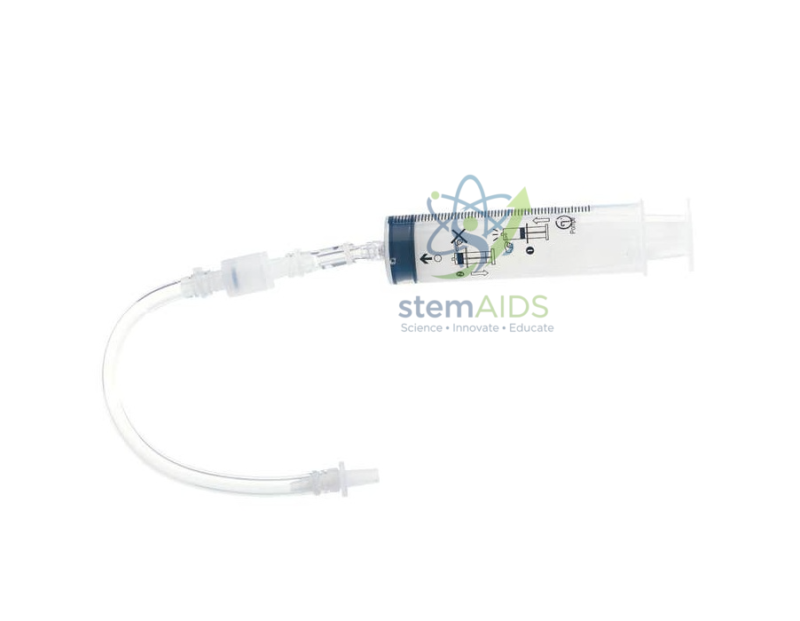
Quick Answer: This is a 60 mL graduated syringe used as a hand pump and gas measurer, fitted with a short flexible tube and a connector, as pictured. The 60 mL graduated syringe draws in, pushes out and measures volumes of gas, so it is used for collecting gas from a reaction, sampling air and showing how gas pressure changes with volume.
Measuring Gas with a Syringe
A syringe is the simplest gas volume meter in a school lab. As gas enters through the tube, the plunger moves back and the scale on the barrel shows how much has arrived. Because the barrel is sealed by the plunger, the gas is collected at roughly room pressure and does not dissolve in water on the way, which matters for gases such as carbon dioxide.
With a capacity of 60 mL the syringe suits small-scale reactions: a few centimetres of magnesium ribbon in dilute acid, a marble chip in acid, or a small volume of hydrogen peroxide with a catalyst. Timed readings give a volume against time curve from which students can find the rate of reaction.
Pressure and Volume
Closing the tube and pushing the plunger in shows directly that a trapped gas resists compression and springs back when released. Connected to a pressure sensor, the 60 mL graduated syringe can be used to collect pairs of pressure and volume readings at constant temperature and test whether their product stays roughly constant, which is Boyle’s law.
Specifications
| Product | Graduated syringe used as a gas pump and gas measurer |
| Capacity | 60 mL, as titled |
| Shown in photograph | Syringe with locking tip, flexible tube and end connector |
| Reads | Gas volume on the printed barrel scale |
| Used with | Reaction vessels with outlets, delivery tubes, pressure sensors |
Common Uses
- Collecting and measuring gas from small-scale reactions for rate experiments
- Taking pressure and volume readings with a pressure sensor for Boyle’s law
- Drawing samples of air or exhaled breath for testing with limewater
- Pumping a measured volume of air into a closed vessel
Care & Handling
- Keep the plunger seal clean and free of grit so it slides without leaking
- Do not pull the plunger out of the barrel when the tube is closed, as this strains the seal
- Rinse with clean water after use with acids or limewater and let it dry with the plunger out
- Store away from heat and direct sunlight to keep the barrel clear
Why Choose LabEquip
Schools use 60 mL syringes as everyday gas meters because they are robust and simple to use, unlike fragile glass gas syringes. LabEquip supplies them with the soda bottle adapter cap and the complete gas collection set as part of its physics lab equipment; contact LabEquip for bench sets.
Frequently Asked Questions
How does a syringe measure the volume of a gas?
Gas entering the barrel pushes the plunger back, and the scale on the barrel shows the volume of gas collected. Read it with the plunger moving freely so the gas is close to room pressure.
Why is a syringe better than a water trough for carbon dioxide?
Carbon dioxide dissolves a little in water, so some is lost when collected over water. A syringe keeps the gas away from water and gives a more accurate volume.
Can the syringe be used to show Boyle’s law?
Yes. Close the outlet or connect it to a pressure sensor, then change the volume in steps and record the pressure. At constant temperature, pressure times volume stays roughly constant.
Why does the plunger sometimes stick?
Friction between the plunger seal and the barrel can hold the plunger back, which makes readings low. Twist the plunger gently before reading, and keep the barrel clean and dry.
What reactions suit a 60 mL syringe?
Small-scale reactions that release less gas than the syringe holds, such as a short strip of magnesium in dilute acid. Scale the amounts down so the plunger does not reach the end.
Can the syringe be used with liquids?
It can draw and deliver liquids, but use separate syringes for gases and liquids. Liquid left in the barrel spoils gas volume readings.
Last Updated: October 2026








Reviews
There are no reviews yet.