
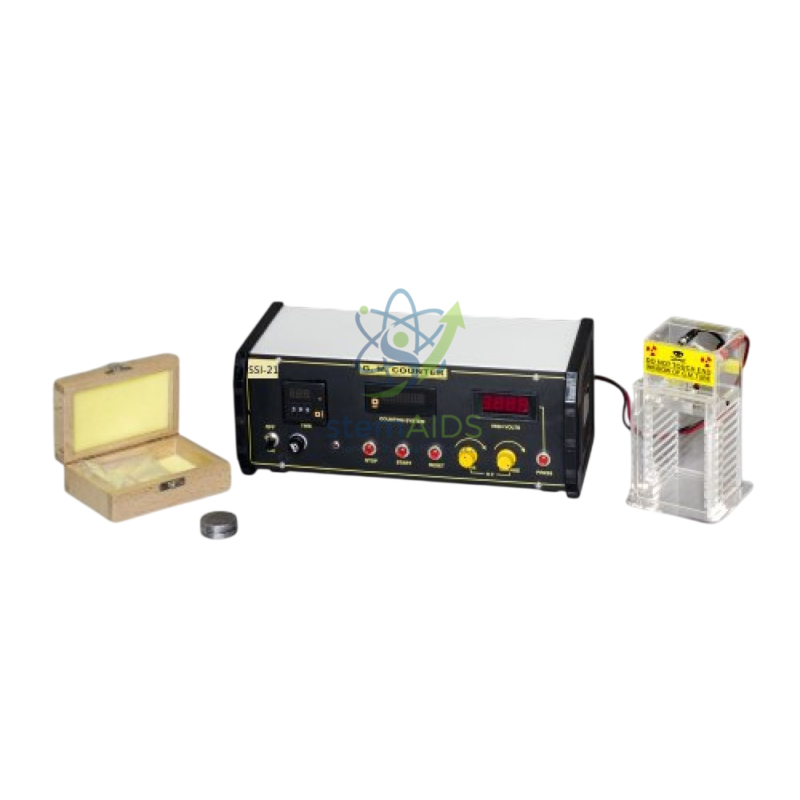
Quick Answer: The Geiger Muller Counter is a radiation-counting instrument in which a gas-filled Geiger-Muller tube gives an electrical pulse each time ionising radiation triggers it, and a counter totals the pulses over a set time. As pictured, this Geiger-Muller counter is a bench counting unit with a tube in a holder, used for practical work on radioactivity in colleges.
How a Geiger-Muller Tube Counts
The tube has a thin central wire inside a cylindrical outer electrode, filled with gas at low pressure, and a high voltage is applied between the two. When ionising radiation frees an electron in the gas, the electron is accelerated towards the wire and frees more electrons on the way, so an avalanche of ionisation spreads along the tube. The result is a pulse of current that the counting unit registers. A quenching gas or circuit then stops the discharge so the tube is ready for the next event.
Every pulse is the same size whatever the energy of the radiation that started it, so a GM counter counts events but does not measure their energy. After each pulse the tube is briefly unable to respond. This dead time causes some events to be missed at high count rates, which is why very active sources give readings that are too low.
Classic College Experiments
The first experiment is usually the plateau curve: the count rate from a steady source is recorded as the tube voltage is raised. The rate climbs from the starting voltage, levels off across a plateau, then rises steeply as the tube approaches continuous discharge; the working voltage is chosen in the plateau. Students then measure the background count, which must be subtracted from every later reading, and go on to the inverse square law, absorption by paper, aluminium and lead, and the random statistics of decay, where repeated counts scatter by about the square root of the count.
What the Set Includes
The listing picture shows a counting unit with a display and controls, a tube in a stand and further accessories. The tube type and window, the counter’s timing and voltage functions, and the exact accessories supplied should be confirmed at enquiry. Radioactive sources are controlled materials and are not assumed to form part of this listing; their purchase, storage and use follow national regulations.
Practicals
- Plotting the plateau characteristic of a GM tube and choosing its operating voltage
- Measuring background radiation in the laboratory
- Investigating absorption of radiation by paper, aluminium and lead
- Verifying the inverse square law and studying the randomness of radioactive decay
Specifications
| Type | Counting unit with Geiger-Muller tube |
| Detector | Gas-filled GM tube operated at high voltage |
| Output | Number of counts in a set time, giving count rate |
| Typical practicals | Plateau curve, background, inverse square law, absorption, statistics |
| Tube type and window, counter functions and accessories | Confirm at enquiry |
Care & Handling
- Switch the counter off before connecting or disconnecting the tube, since the tube operates at high voltage.
- Handle the GM tube by its body and keep fingers and objects away from any thin end window.
- Handle any radioactive source only as local rules require: tongs, minimum time, maximum distance and shielded storage.
- Keep the Geiger-Muller counter dry, dust-free and on a stable bench away from strong electrical interference.
Why Choose LabEquip
College and university physics departments buy a GM counting set to give students hands-on measurements in nuclear physics. LabEquip lists it with its physics lab equipment; for introducing nuclei and isotopes before the practical, the isotopes of hydrogen model is a simple visual aid. Discuss the configuration you need through the contact page.
Frequently Asked Questions
Can a GM counter tell alpha, beta and gamma radiation apart?
Not directly, because every pulse looks the same. The type of radiation is inferred from absorption tests with paper, aluminium and lead. Detecting alpha particles at all requires a tube with a very thin end window.
What is the plateau, and why operate the tube there?
It is the range of tube voltage over which the count rate from a steady source hardly changes. Working in the plateau means small drifts in voltage do not alter the results.
Why measure the background count first?
Natural radiation from the surroundings and cosmic rays reaches the tube all the time. Measuring it with no source present lets it be subtracted, so the corrected count rate belongs to the source alone.
Why do repeated counts of the same source differ?
Radioactive decay is random. For a count of N, the natural scatter is about the square root of N, so longer counting times give relatively more precise results.
What is dead time?
It is the short interval after each pulse during which the tube cannot register another event. At high count rates some events fall into dead time and are lost, so the measured rate is slightly lower than the true rate.
Is the counter itself radioactive?
No. The Geiger-Muller counter only detects radiation. Any radioactive sources used with it are separate items that must be bought, stored and handled under the applicable regulations.
Last Updated: October 2026




Reviews
There are no reviews yet.