
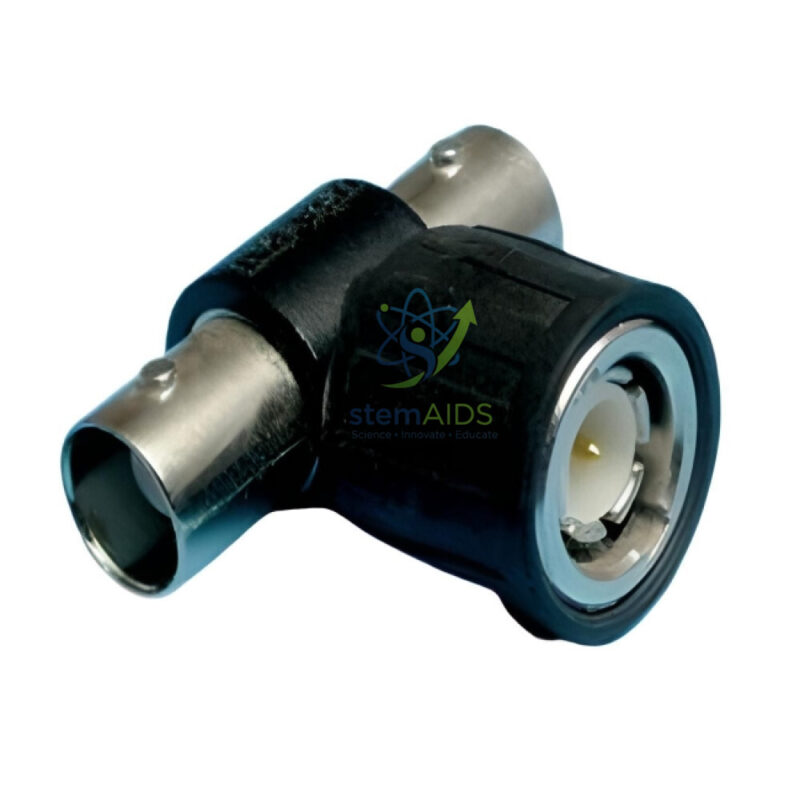
Quick Answer: The Electro PJP 7041 MI is a BNC T adapter: a T-shaped coaxial fitting with one BNC plug and two BNC sockets, all sharing the same centre conductor and the same screen. It lets one signal feed two destinations at once, such as an oscilloscope input and a load, a second instrument or a terminator.
What Happens Inside a T Connector
Inside the Electro PJP 7041 MI, the three centre contacts are joined to one another and the three outer shells are joined to one another, so the fitting is simply a parallel junction in coaxial form. The plug end, seen on the right of the product photograph, locks onto an instrument socket with the usual quarter-turn bayonet, and the two sockets accept ordinary BNC cables. Nothing is amplified, divided or switched: every port sees the same voltage, and the currents drawn by the two branches add.
That last point is why the adapter belongs in a physics lab rather than only in an electronics workshop. Teeing a signal is the coaxial version of connecting a voltmeter in parallel, and students can reason about it in the same way. If one branch is a high-impedance oscilloscope input and the other is a low-impedance load, almost all of the current flows into the load while the oscilloscope simply reports the voltage across it.
Typical Bench Arrangements
The most common set-up places the tee directly on the oscilloscope input: one socket takes the cable from a signal generator and the other carries the signal onward to the circuit under test, so the trace shows exactly what is being delivered. For pulse experiments on a long coaxial cable, the tee at the oscilloscope lets the class see the outgoing pulse and its echo on one trace, and the far end of the cable can then be left open, shorted or fitted with a 50 ohm BNC terminator to compare reflections.
Specifications
| Product | Electro PJP 7041 MI T BNC/BNC adapter |
| Form | T-shaped coaxial adapter |
| Ports in the photograph | One BNC plug (male) and two BNC sockets (female) |
| Coupling | Bayonet BNC locking on all three ports |
| Electrical function | Passive parallel junction: centre to centre, screen to screen |
| Rated impedance and voltage | Confirm at enquiry |
Where the T Adapter Is Used
- Teeing a signal generator output at the oscilloscope so the delivered waveform is displayed while it drives a circuit
- Pulse reflection and signal-speed experiments on a long coaxial cable, with the far end open, shorted or terminated
- Sending one signal to two oscilloscope channels, or to an oscilloscope and a counter, for comparison
- Adding a terminator at an instrument input without giving up the cable connection
Care & Handling
- Push and turn the bayonet collar fully home on the Electro PJP adapter, and unlock it the same way rather than pulling on the cable
- Keep spare adapters capped or in a closed box, because grit in the sockets makes the centre contact unreliable
- Do not let a long cable hang from the tee, as its weight levers on the instrument’s own BNC socket
- Use it on signal-level circuits only; BNC fittings on teaching equipment are not intended for mains voltages
Why Choose LabEquip
Teachers who run oscilloscope practicals usually find they need more tees and terminators than they first ordered, because every bench wants one. LabEquip can supply the Electro PJP 7041 MI together with BNC cords and terminators so that a class set arrives complete; send the quantities through our contact page, or see the wider physics lab equipment range.
Frequently Asked Questions
Does a BNC T adapter split the signal power in half?
No. A T adapter is a parallel junction, so both outputs carry the same voltage as the input. How the current divides depends on what is connected: a high-impedance oscilloscope input draws very little, while a 50 ohm load draws most of it. Unlike a matched power splitter, a plain tee does not keep every port at 50 ohms.
Which end of the adapter is the plug?
In the product photograph one port is a BNC plug with a locking bayonet collar and the other two are BNC sockets. The plug is usually fitted straight onto an instrument socket, such as an oscilloscope input, and the two sockets receive cables.
Why fit the tee at the oscilloscope instead of at the circuit?
Placing it at the oscilloscope means the cable to the circuit continues from the tee, so the trace shows the signal arriving at the instrument and, in reflection experiments, any echo returning along the cable.
Can the adapter be used for a pulse reflection experiment?
Yes. Feed short pulses from a generator into one socket, connect a long coaxial cable to the other, and watch the oscilloscope. An open far end returns an echo of the same polarity, a short circuit returns an inverted echo, and a matched terminator absorbs the pulse so almost no echo appears. The delay gives the signal speed in the cable.
Is it compatible with 75 ohm BNC equipment?
BNC fittings exist in 50 ohm and 75 ohm versions that mate with each other. At the low frequencies of most school and college experiments the difference has little effect, but for transmission-line work it is sensible to keep cable, tee and terminator to one impedance. The rated impedance of this adapter can be confirmed when you enquire.
How should the adapter be cleaned?
Blow dust out of the sockets and wipe the body with a dry cloth. Avoid spraying cleaner into the connector, since liquid left inside affects the insulation between centre pin and shell.
Last Updated: October 2026




Reviews
There are no reviews yet.