
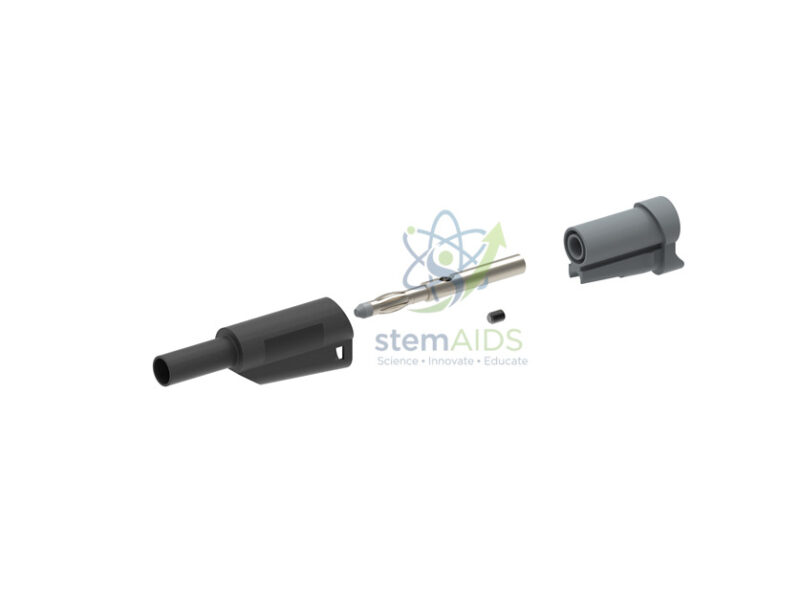
Quick Answer: This 4 mm safety banana plug for soldering is a connector supplied in parts, pictured as a black insulating plug body, a metal contact and a small insulating piece, from which a touch-protected test lead is made by soldering a wire to the contact. A 4 mm safety banana plug keeps its metal inside a rigid insulating shroud, so no live part is exposed when the plug is out of its socket.
What Makes a Banana Plug a Safety Plug
On a standard banana plug the metal contact is exposed whenever it is unplugged, so a lead still connected at its other end can present a live pin. A safety banana plug surrounds the contact with a fixed insulating sleeve that reaches past the end of the metal, so a finger cannot touch it, and the sleeve slides over a shrouded socket as the plug goes in.
Shrouded plugs pair with shrouded sockets, and they also fit many instruments whose 4 mm sockets are recessed. Look at the sockets on your equipment before making a set of leads, because an exposed binding post may not accept the sleeve.
Assembling a Lead by Soldering
Thread the insulating parts of the 4 mm safety banana plug onto the cable first; forgetting this is the most common mistake, and it means the joint has to be unsoldered. Strip a short length of insulation, twist and tin the strands, and solder them to the contact with enough heat for the solder to flow but not so long that the cable insulation melts back. Let the joint cool without moving it.
Assemble the body over the contact as the plug design requires, then test the finished lead with a multimeter: close to zero ohms from end to end, and no connection between the conductor and anything outside the shroud. A firm tug confirms the joint and the strain relief are sound.
Specifications
| Product | Safety banana plug for soldering |
| Contact size, from title | 4 mm |
| Shown in photograph | Black insulating body, metal contact and a small insulating part |
| Termination | Soldered wire connection |
| Protection | Rigid shroud around the contact |
| Rating and colour options | Confirm at enquiry |
Care & Handling
- Slide all insulating parts onto the cable before soldering
- Use cable whose diameter suits the plug’s cable entry
- Look for cracks in the shroud; a cracked shroud no longer protects
- Keep contacts clean so the spring section grips the socket evenly
Applications
- Making custom-length safety test leads for student circuits
- Repairing leads whose plugs have broken
- Fitting shrouded plugs to sensors and modules built in-house
- Matching leads to shrouded sockets on power supplies and meters
Why Choose LabEquip
Technicians who make their own leads buy plugs in quantity, because a lab’s set of leads wears out one plug at a time. Pair them with safety crocodile clips with 4 mm female connector or the setting tool for 4mm sockets when building panels, see our other physics lab equipment, and contact LabEquip for colours and quantities.
Frequently Asked Questions
What is the difference between a safety plug and a standard banana plug?
A safety plug has a fixed insulating sleeve around its metal contact, so the contact cannot be touched when the plug is unplugged. A standard plug leaves the metal exposed.
Will a safety plug fit an ordinary 4 mm socket?
It fits shrouded sockets and many recessed 4 mm sockets. Some exposed binding posts do not accept the sleeve, so look at the sockets on your equipment first.
What is the most common assembly mistake?
Soldering the wire before threading the insulating parts onto the cable. Slide them on first, then strip, tin and solder.
How do I avoid melting the cable insulation?
Tin the wire and the contact first, then heat the joint just long enough for the solder to flow. A hot, clean iron does the job faster, with less heat spreading into the cable.
How should a finished lead be tested?
Check near-zero resistance from plug to plug with a multimeter, confirm that nothing outside the shroud is connected, and give the cable a firm pull to test the joint.
Which wire suits the plug?
Flexible stranded test-lead cable whose outer diameter fits the plug’s cable entry. Stranded wire survives repeated bending far better than solid wire.
Last Updated: October 2026





Reviews
There are no reviews yet.