
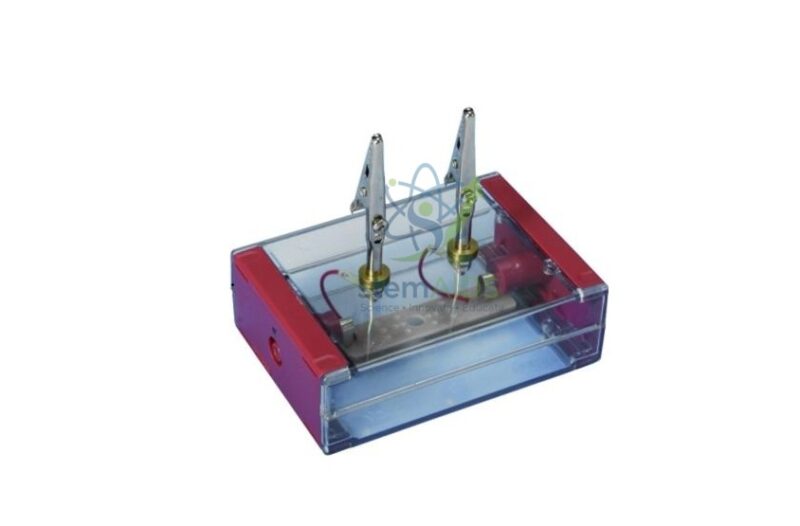
Quick Answer: Crocodile Clips on Stand are spring-loaded crocodile clips carried on a stand or support, so that a wire, a sample or a component can be gripped between them and connected into a circuit without being held by hand. They are used for testing conductors and insulators, measuring the resistance of wires and holding sensors in position during experiments.
A Third Hand for Circuit Experiments
Many electricity practicals involve something awkward to connect: a strip of material under test, a length of resistance wire, a pencil lead, a thermistor that must sit in a beaker of water. With ordinary crocodile-clip leads one student usually holds the item while another reads the meter, and the contacts shift as hands move. A clip on a stand keeps the item still, keeps the contact pressure constant and leaves both hands free.
Because the clips are fixed to a support, the gap between them can be set once and kept for a whole series of readings, which makes results more repeatable. The leads from the meter or supply connect to the stand rather than to the sample itself. The number of clips, the height of the stand and the terminal style should be matched to the work planned and confirmed when ordering.
Typical Practicals
- Conductor and insulator testing: clamp each sample in turn and watch a lamp, buzzer or meter
- Measuring how the resistance of a wire depends on its length or thickness
- Holding a thermistor sensor or other component in position above a water bath
- Comparing pencil leads of different hardness as resistors
Getting Reliable Readings
Contact resistance at the jaws matters when the sample itself has a low resistance, such as a short piece of copper wire. Clean jaws and firm, square contact give the most consistent results, and for accurate work on low resistances a four-terminal arrangement, with separate connections for current and for voltage, removes the effect of the clips altogether. For a quick check of whether a material conducts, the clips alone are entirely adequate.
Specifications
| Item | Crocodile clips mounted on a stand or support |
| Function | Hands-free gripping and connection of samples and components |
| Use | Conductor tests, wire resistance, holding sensors |
| Connection | Leads attach to the stand terminals |
| Number of clips, height and terminal type | Confirm at enquiry |
Care & Handling
- Open the jaws fully before inserting a thick sample; forcing them stretches the springs.
- Clean the jaws of the crocodile clips on stand now and then with fine abrasive paper so that oxide does not add resistance.
- Use the stand only with the low voltages of student work, and do not clamp hot objects.
- Check that the stand sits firmly before suspending a component over liquid.
Why Choose LabEquip
LabEquip supplies crocodile clips on stands to schools that run conductor tests and resistance practicals with several groups at once. They pair with the meters, lamp holders and sources in our physics lab equipment range; ask us through the contact page about the number of clips per stand.
Frequently Asked Questions
Why use crocodile clips on a stand rather than crocodile-clip leads?
Leads have to be held or propped up, so the contact moves and a second person is needed. Clips fixed to a stand hold the sample still at a constant contact pressure, free both hands for the meter and notebook, and keep the same spacing for repeated readings.
How do I test whether a material is a conductor?
Clamp the sample between the clips and connect them in series with a cell and a lamp, buzzer or ammeter. If the indicator responds, the material conducts. Testing metals, plastics, wood, graphite and glass in turn builds a clear class table of conductors and insulators.
Can I measure the resistance of a wire with these clips?
Yes. Clamp the wire between two clips, pass a current through it and measure the current and the voltage across the wire. Changing the length held between the clips shows that resistance is proportional to length. For very low resistances, connect the voltmeter to the wire just inside the clips.
Do the clips themselves add resistance?
Slightly. Each jaw has a small contact resistance that depends on how clean and tight it is. It is negligible for most samples but noticeable for a short length of thick copper, where cleaning the jaws or using separate voltage connections improves accuracy.
Can the stand hold a sensor in a liquid?
It can hold the leads of a sensor so that the sensing tip hangs in a beaker. Keep the metal jaws themselves out of the liquid, because wet jaws corrode and can create an unwanted conduction path between the two connections.
What kinds of sample can be held?
Wires, thin strips of metal or plastic, pencil leads, small resistors, thermistors and other components with leads are all suitable. Very thick or heavy items are better held in a laboratory clamp, with crocodile-clip leads used only for the electrical connection.
Last Updated: October 2026








Reviews
There are no reviews yet.