
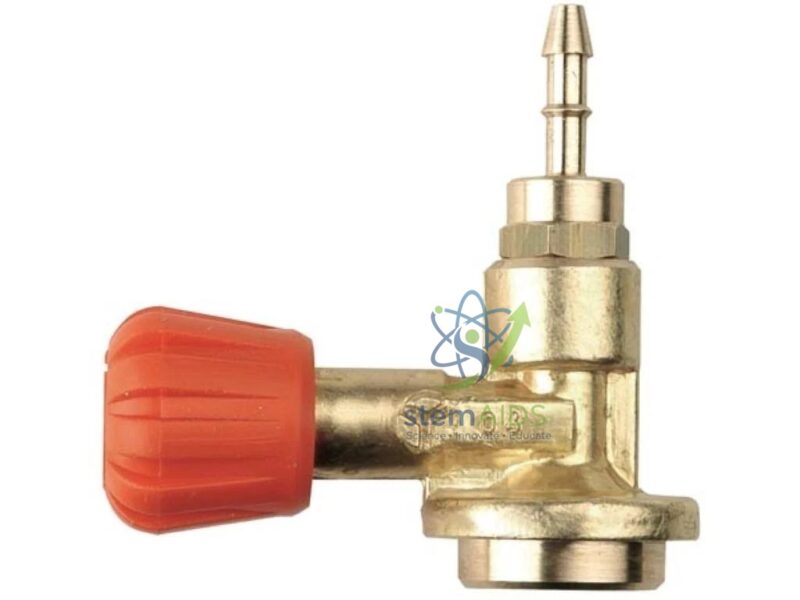
Quick Answer: This compressed gas valve is a brass flow valve that screws onto a 10 bar compressed-gas can; turning its orange handwheel releases gas in a controlled stream through the upward-pointing hose-tail outlet seen in the product photograph. The compressed gas valve has no gauge, so it is the simple choice when only a gentle, adjustable flow is needed.
Controlling Flow From a Small Gas Can
Turning the handwheel of the compressed gas valve moves a stem away from its seat and opens a narrow gap through which gas escapes. Because the gap widens gradually, a small turn gives a small flow, and the valve can be set to release a few bubbles per second through water or a steady stream into a gas jar. Turning the handwheel back presses the stem onto the seat and stops the flow.
A gentle flow matters in practice. Gas delivered too fast bubbles past the mouth of a gas jar and is wasted, and a sudden burst can push water back along a delivery tube. Opening in small steps and watching the bubbles gives a rate that students can follow, record and repeat.
Fitting the Valve and Collecting a Gas
Check that the handwheel is closed, then screw the valve onto the can by hand until it seats; do not use tools on the can. Push flexible tubing over the hose-tail outlet and lead it to the apparatus, for example under an inverted gas jar or test tube filled with water in a trough. Open the handwheel slowly until bubbles appear, and close it as soon as enough gas has been collected.
Because this valve has no gauge, the remaining contents are judged from how readily gas flows and from the weight of the can. Where the pressure needs to be watched, the gauge valve with horizontal outlet is the alternative.
Specifications
| Product | Compressed gas valve for 10 bar gas cans |
| Construction in photograph | Brass body, orange handwheel, vertical hose-tail outlet |
| Pressure in title | 10 bar (can pressure) |
| Gauge | None; flow control only |
| Used with | 10 bar compressed-gas cans and flexible tubing |
| Can thread compatibility | Confirm at enquiry |
Practicals the Valve Supports
- Collecting a gas over water in a gas jar or test tube for tests on its properties
- Supplying a slow gas stream to a reaction vessel or gas syringe
- Filling a balloon or plastic bag with gas for density comparisons
- Discussing why an expanding gas cools, using the chill felt on the can after a long flow
Care & Handling
- Close the handwheel before removing the valve from a can
- Keep the outlet and thread clean; dirt on the seat causes slow leaks
- Use the valve only with cans of the type it is listed for
- Store cans and valves away from heat sources
Why Choose LabEquip
Schools that run small-scale gas practicals with a 10 bar compressed gas can need a valve that turns the can into a controllable supply. LabEquip supplies the valve, cans and tubing together within our Physics Equipments range; contact LabEquip to match the valve to your cans.
Frequently Asked Questions
What does 10 bar mean for this valve?
It refers to the 10 bar compressed-gas cans the valve is listed for. One bar is close to normal atmospheric pressure, so gas in the can is held at roughly ten times the pressure of the room.
Why should the handwheel be opened slowly?
A sudden rush of gas can blow water out of a trough, lift a gas jar or push liquid back up a delivery tube. Opening slowly in small steps gives a controlled stream of bubbles from the start.
What is the difference between this valve and the gauge valve?
This valve controls flow only and has a vertical outlet. The gauge valve adds a pressure gauge that shows how full the can is, and has a horizontal outlet. Both give a gentle, adjustable flow from a 10 bar can.
How do I collect a gas over water with the valve?
Fill a gas jar or test tube with water and invert it in a trough. Lead tubing from the outlet under its mouth and open the handwheel slowly. Gas displaces the water, and the jar is closed underwater before it is lifted out.
Can the valve be left on the can between lessons?
It can stay fitted with the handwheel closed, provided the can is stored upright, restrained and away from heat. Test the joint with soapy water before the next use.
Why does the can feel cold during use?
As gas leaves, the gas still inside expands and does work pushing it out, so it cools, and the can cools with it. A long, fast flow chills the can noticeably, which is a useful talking point about expanding gases.
Last Updated: October 2026





Reviews
There are no reviews yet.