
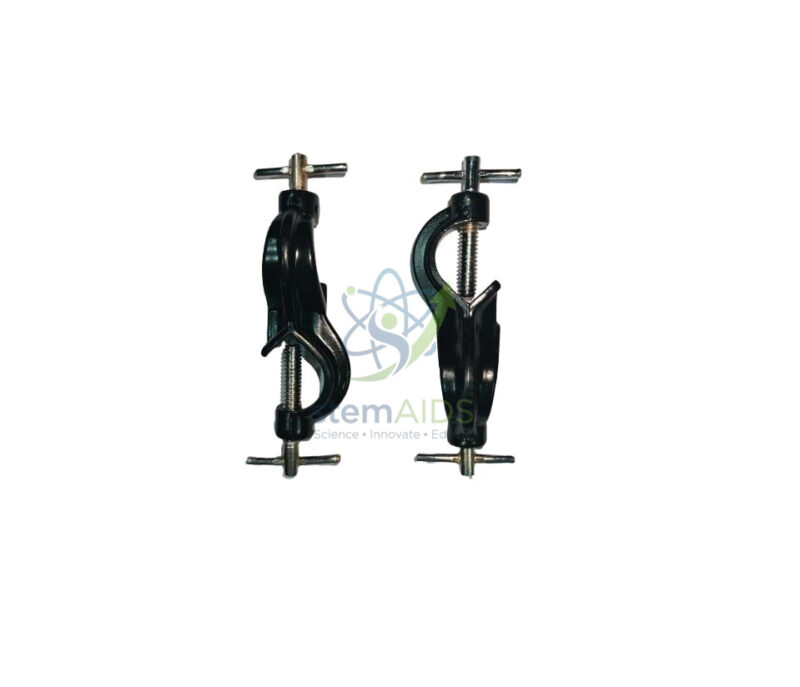
Quick Answer: The Standard Boss Head, Pressure Die Cast, Aluminium is an aluminium boss head with two open, hook-shaped jaws, each closed by its own screw. It joins the rod of a clamp or ring to the upright of a retort stand; the listing photograph shows two views of a black-finished body.
The Standard Double-Hook Pattern
The standard boss head is the most familiar connector in school labs. Its body carries two jaws shaped like open hooks, set at right angles to each other, and a screw threads through each to trap a rod against the inside of the hook. One jaw goes on the stand upright; the other takes the rod of a clamp, a ring or a cross-bar.
Because the jaws are open, the boss head can be put on or taken off a rod from the side without dismantling anything above it. That is the main practical difference from boss heads with closed holes, and it makes this pattern quick to use in class. The rectangular Euro boss head does the same job in a squarer body.
Aluminium is light, roughly a third of the density of steel or iron, so a stand carrying several boss heads is not made top-heavy by its fittings. Pressure die casting gives each body the same shape, so the screws line up and the jaws close evenly. Aluminium is attacked by strong alkalis and by mercury, so keep this fitting away from sodium hydroxide spills and mercury work.
Care & Handling
- Tighten each screw of the aluminium boss head by hand; overtightening can strip the thread in soft metal or split a jaw.
- Wipe off alkali spills immediately and rinse, since sodium hydroxide attacks aluminium.
- Put a drop of light oil on the screw threads if they become stiff.
Applications
- Fixing a burette clamp or a three-finger clamp to a retort stand
- Mounting a retort ring without boss head at any height and reach
- Joining two stands with a horizontal rod for pendulums or suspended weights
- Acting as a stop collar below a heavily loaded fitting to keep it from sliding down
Specifications
| Type | Standard boss head, two open jaws |
| Material | Aluminium, pressure die cast (as titled) |
| Fixing | Two screws, one per jaw (as pictured) |
| Finish | Black in the listing photograph |
| Joins | Stand upright to clamp, ring or cross-bar rods |
| Largest rod diameter per jaw | Confirm at enquiry |
Why Choose LabEquip
Boss heads are the fitting labs run short of most, because every clamp and loose ring needs one. LabEquip lists this standard aluminium pattern in General Lab Products; tell us your rod diameters through the contact page.
Frequently Asked Questions
Why are both jaws open instead of closed holes?
Open jaws let the boss head go onto a rod from the side. You can add or remove it in the middle of a set-up without sliding off everything above it.
What are the advantages of aluminium for a boss head?
It is light, so several fittings do not make a stand top-heavy, and it does not rust as iron does. It is softer than steel, so the screws should be tightened by hand only.
How do I fit a clamp rod into the boss head?
Put one jaw on the stand upright and tighten it. Then lay the clamp rod into the second jaw, with the opening facing upward where possible so the weight presses the rod in, and tighten that screw.
Which chemicals damage aluminium?
Strong alkalis such as sodium hydroxide, and mercury, attack aluminium. Hydrochloric acid also corrodes it. Rinse spills off promptly with water.
Why does my boss head slip on the rod?
The rod may be greasy or thinner than the jaw is shaped for, or the load may be too far out. Clean the rod, tighten the screw firmly by hand and bring the load closer to the stand.
How is it different from the Euro rectangular boss head?
Both join two rods at right angles. The standard pattern uses open hook-shaped jaws on a slimmer body, while the Euro version has a squarer rectangular body with slots.
Last Updated: September 2026




Reviews
There are no reviews yet.