

In Stock
Micro Bio-observation Kit
₹1,065.00
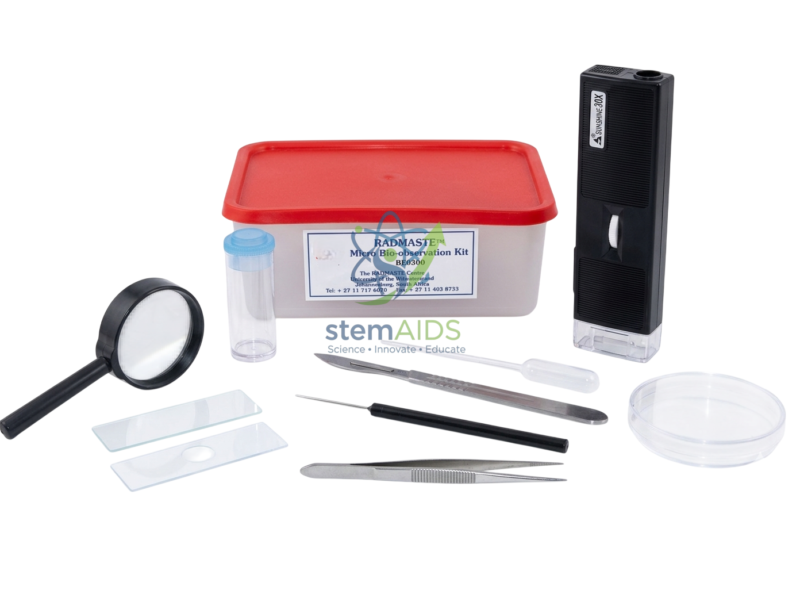
The StemAids Micro Bio-observation Kit is an educational life-sciences kit designed to help learners observe biological specimens collected from their natural surroundings. It supports hands-on study of leaves, insects, seeds, soil particles, water samples, plant parts, fibres, small organisms, and other biological materials using compact observation tools.
Product Description
The StemAids Micro Bio-observation Kit is developed for primary, secondary, senior secondary, STEM, and biology classrooms where students need practical exposure to real biological observation. It encourages learners to collect, examine, compare, sketch, classify, and discuss specimens from their environment.
The kit may include handheld observation tools, magnifiers, a compact microscope, specimen collection accessories, slides, coverslips, forceps, droppers, observation containers, and worksheet support depending on the selected configuration. It is useful for outdoor learning, classroom practicals, field visits, nature-study activities, and introductory microscopy sessions.
This kit helps bridge classroom theory and real-life biology by allowing students to observe structure, texture, shape, movement, colour, segmentation, veins, roots, stems, seeds, small invertebrates, and microscopic details under guided supervision.
Product Specifications
| Parameter | Details |
|---|---|
| Product Name | Micro Bio-observation Kit |
| Brand | StemAids |
| Product Type | Educational biology observation and microscience kit |
| Subject Area | Biology, life sciences, environmental science, STEM education, and nature study |
| Learning Level | Primary school, middle school, secondary school, senior secondary, science clubs, and teacher-training programs |
| Core Learning Concepts | Observation skills, biological specimens, plant structure, animal structure, microscopy, classification, comparison, biodiversity, habitats, and field study |
| Typical Components | Handheld microscope, magnifying glass, specimen containers, slides, coverslips, droppers, forceps, collection tools, labels, worksheets, and observation guide depending on kit configuration |
| Observation Tools | Hand lens, compact microscope, specimen viewer, or other small observational tools depending on supplied model |
| Specimen Type | Leaves, stems, roots, seeds, flowers, fibres, soil particles, pond-water samples, small insects, and other safe biological specimens |
| Microscope Slides | May include blank slides and coverslips, depending on supply configuration |
| Reusable Components | Yes, most observation tools and accessories are reusable after proper cleaning |
| Storage | Supplied in a storage box, tray, or compartment case depending on kit version |
| Safety Requirement | Teacher supervision, clean specimen handling, safe collection practices, and proper disposal of biological material are required |
| Application | Biology observation, field study, classroom practicals, microscopy introduction, specimen comparison, and STEM learning |
| Suitable For | Schools, colleges, science clubs, STEM labs, biology departments, teacher-training institutes, and educational laboratories |
Key Features
- Designed for hands-on observation of biological specimens
- Supports indoor classroom work and outdoor field-study activities
- Includes compact observational tools depending on kit configuration
- Helps learners study specimens collected from natural surroundings
- Useful for plant, soil, water, insect, fibre, and small organism observation
- Encourages scientific skills such as collecting, observing, sketching, comparing, and classifying
- Suitable for primary to senior secondary biology learning
- Reusable components support repeated practical sessions
- Compact kit format supports easy storage, distribution, and classroom management
How to Use
- Read the activity guide or teacher instruction before starting the observation task.
- Select a safe specimen such as a leaf, seed, flower part, fibre, soil particle, or pond-water sample.
- Place the specimen in a clean observation container, on a slide, or under the handheld microscope as required.
- Use a magnifying lens or microscope to observe colour, shape, size, texture, pattern, veins, segments, or movement.
- Adjust light and focus carefully to get a clear view.
- Use forceps or droppers for handling small or wet specimens.
- Draw the observed specimen in a notebook or worksheet.
- Label important parts such as root, stem, leaf vein, seed coat, wing, leg, body segment, or cell-like structure where visible.
- Compare observations with another specimen and record similarities and differences.
- Clean reusable tools after the activity.
- Dispose of biological material safely according to teacher instruction.
- Return all components to the kit box after drying and inspection.
Applications
- Plant-part observation
- Leaf venation and texture study
- Seed and fruit structure observation
- Soil and sand particle comparison
- Pond-water observation under teacher supervision
- Small insect and invertebrate observation
- Fibre, hair, and surface texture comparison
- Introductory microscope learning
- Environmental science field activities
- Biology practicals and STEM classroom projects
- Science club and nature-study activities
Safety and Handling Guidelines
- Use the kit under teacher, instructor, or trained adult supervision.
- Collect only safe, non-toxic, non-harmful specimens.
- Do not handle unknown insects, fungi, sharp plant parts, or contaminated samples without supervision.
- Wear gloves when collecting soil, water, or unknown biological material.
- Do not taste, smell directly, or touch unknown specimens with bare hands.
- Handle slides and coverslips carefully to avoid cuts or breakage.
- Do not point microscope light directly into the eyes.
- Clean droppers, containers, slides, and tools after use.
- Dispose of biological samples according to classroom safety rules.
- Wash hands thoroughly after completing the activity.
- Store the kit in a clean, dry place away from heat, dust, and moisture.
- Keep small components away from very young children when not supervised.
Quality and E-E-A-T Notes
The StemAids Micro Bio-observation Kit supports evidence-based biology learning by encouraging direct specimen observation, careful comparison, labelled drawing, field collection, and guided scientific discussion. For reliable learning outcomes, activities should be performed with safe specimen selection, clean tools, correct observation method, teacher supervision, and proper recording of results.
FAQ
1. What is the StemAids Micro Bio-observation Kit used for?
It is used for observing biological specimens such as leaves, seeds, soil particles, fibres, small insects, plant parts, and safe natural samples.
2. Is this kit suitable for primary school students?
Yes, it is suitable for primary learners under teacher supervision and can also be used by secondary and senior secondary students for structured observation activities.
3. Does the kit include a microscope?
Depending on the supplied configuration, the kit may include a handheld microscope, compact microscope, magnifier, or other observation tools.
4. Can the kit be used outdoors?
Yes, the kit is suitable for outdoor observation activities, field visits, nature-study tasks, and specimen collection when supervised properly.
5. What specimens can students observe?
Students can observe leaves, stems, roots, seeds, flowers, fibres, soil particles, pond-water samples, and small safe organisms depending on the activity.
6. Are slides and coverslips included?
Slides and coverslips may be included depending on kit configuration. In many school setups, slides and dissection tools are managed by the teacher.
7. Is the kit reusable?
Yes, most tools and accessories are reusable after proper cleaning, drying, and storage.
8. Does it require chemicals?
Most basic observation activities do not require chemicals. Some advanced microscopy or staining activities may require teacher-controlled reagents.
9. Can it be used for microbiology?
It can be used for basic observation of safe samples. It should not be used for culturing unknown microorganisms unless proper biosafety procedures are available.
10. How should students record observations?
Students should draw the specimen, label visible parts, note colour, shape, size, texture, and movement, and compare observations with other samples.
11. How should the kit be cleaned?
Wash or wipe reusable parts according to the material type, dry all components properly, and store them in the kit box after use.
12. Why is bio-observation useful for STEM education?
It develops observation, comparison, classification, drawing, questioning, and evidence-based reasoning skills, which are important for biology and STEM learning.
Why Choose StemAids?
StemAids educational science kits are selected for practical learning, classroom usability, and curriculum-supportive laboratory work. The StemAids Micro Bio-observation Kit supports hands-on biology learning, field-based observation, student curiosity, environmental awareness, STEM skill development, and economical practical education for schools, colleges, science clubs, teacher-training institutes, and institutional laboratories.
SEO Keywords
StemAids Micro Bio-observation Kit, Micro Bio Observation Kit, Biology Observation Kit, Life Sciences Kit, School Biology Kit, Handheld Microscope Kit, Microscope Observation Kit, STEM Biology Kit, Nature Study Kit, Biological Specimen Observation Kit, Educational Biology Kit, Science Observation Kit
You must be logged in to post a review.
Bestsellers


Reviews
There are no reviews yet.