





In Stock
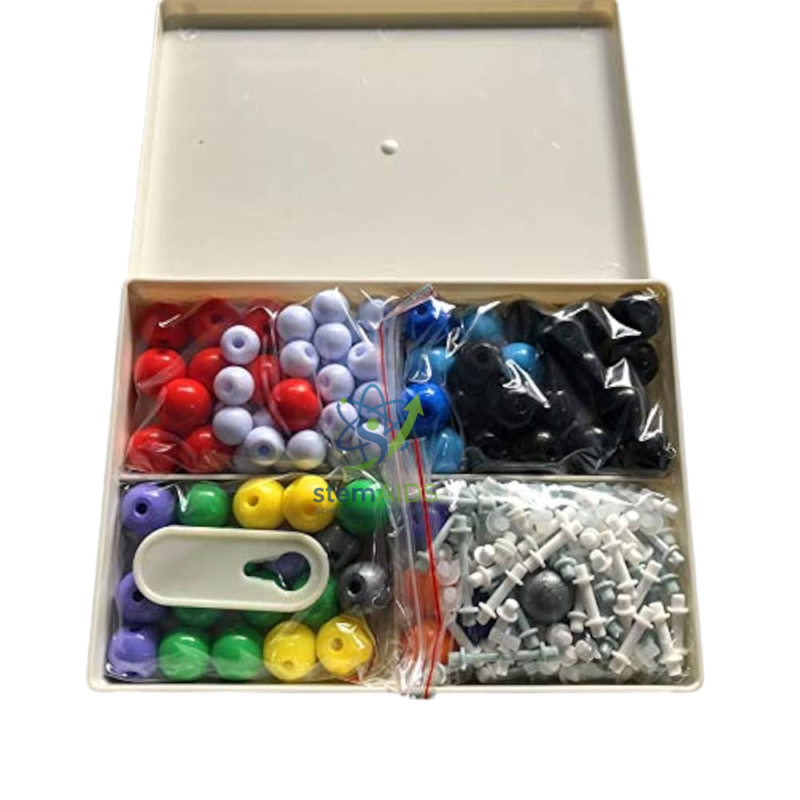
Learner’s Molecular Modelling Kit
₹985.00
The StemAids Learner’s Molecular Modelling Kit is an educational chemistry model set designed to help students build and understand three-dimensional molecular structures. It is suitable for schools, colleges, chemistry laboratories, STEM classrooms, teacher demonstrations, science clubs, and introductory organic and inorganic chemistry learning.
Product Description
The StemAids Learner’s Molecular Modelling Kit helps learners visualise atoms, bonds, molecular geometry, valency, isomerism, organic functional groups, inorganic structures, and chemical bonding in a practical hands-on format. Instead of studying only flat textbook diagrams, students can build physical molecular structures and rotate them to understand shape, bond angle, spatial arrangement, and molecular orientation.
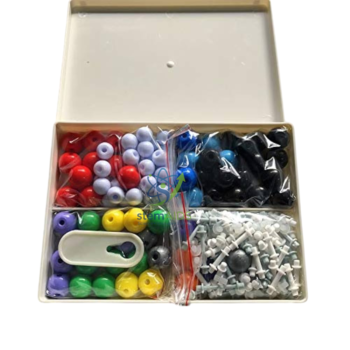
The kit includes colour-coded atom pieces and bond connectors that allow students to construct simple and advanced molecular models such as methane, water, ammonia, carbon dioxide, ethane, ethene, ethanol, benzene, carboxylic acids, amino acids, salts, and crystal structure representations depending on the supplied configuration.
This learner-friendly kit supports classroom demonstrations, individual practical work, group activities, model-based assignments, organic chemistry practice, stereochemistry learning, and conceptual understanding of molecular structures.
Product Specifications
| Parameter | Details |
|---|---|
| Product Name | Learner’s Molecular Modelling Kit |
| Brand | StemAids |
| Product Type | Educational molecular model kit / chemistry modelling kit |
| Subject Area | Chemistry, organic chemistry, inorganic chemistry, stereochemistry, chemical bonding, and STEM education |
| Learning Level | Middle school, secondary school, senior secondary, college foundation, science clubs, and teacher-training programs |
| Model Type | Ball-and-stick molecular model system |
| Core Learning Concepts | Atoms, molecules, covalent bonds, valency, bond angles, molecular geometry, VSEPR theory, functional groups, isomerism, chirality, and stereochemistry |
| Typical Atom Pieces | Carbon, hydrogen, oxygen, nitrogen, halogen, sulfur, phosphorus, metals, and other atom types depending on kit configuration |
| Typical Bond Pieces | Short bonds, long bonds, flexible bonds, single bond connectors, double bond connectors, and model-specific link pieces |
| Colour Coding | Colour-coded atoms for easier identification of different elements |
| Material | Durable plastic atom pieces with plastic or flexible bond connectors |
| Reusable | Yes, reusable for repeated model-building activities |
| Storage | Supplied in box, tray, pouch, or compartment case depending on configuration |
| Manual / Guide | Instruction sheet or model-building guide depending on supply configuration |
| Application | Molecular structure building, organic chemistry practice, classroom demonstrations, stereochemistry learning, and STEM activities |
| Suitable For | Schools, colleges, chemistry labs, STEM labs, science clubs, coaching institutes, and educational laboratories |
Key Features
- Helps students visualise molecules in three-dimensional form
- Colour-coded atom pieces support easy element identification
- Bond connectors help demonstrate single, double, and flexible bonding arrangements depending on configuration
- Useful for organic, inorganic, and general chemistry learning
- Supports molecular geometry, valency, VSEPR theory, and bond-angle understanding
- Helps explain isomerism, chirality, stereochemistry, and functional groups
- Reusable components support repeated classroom and laboratory activities
- Compact kit format supports easy storage and student distribution
- Suitable for individual learning, group work, and teacher demonstrations
How to Use
- Open the StemAids Learner’s Molecular Modelling Kit and arrange atom pieces and bond connectors on a clean table.
- Select the molecule to be built, such as water, methane, ammonia, carbon dioxide, ethanol, benzene, or any assigned structure.
- Identify the required atom pieces according to colour and valency.
- Connect atom pieces using suitable bond connectors.
- Use short or long connectors as required by the model type and teacher instruction.
- Check whether each atom has the correct number of bonds according to its valency.
- Rotate the completed model to observe molecular shape, bond angle, and spatial arrangement.
- Compare the model with the textbook structural formula or molecular formula.
- For organic chemistry, build chain isomers, position isomers, functional group isomers, or stereoisomers as assigned.
- For group activities, ask students to explain the molecule name, formula, bond type, and geometry.
- After use, separate the model gently without forcing the connectors.
- Return all atom pieces and connectors to the storage box after counting and inspection.
Applications
- Building simple molecules such as water, ammonia, methane, and carbon dioxide
- Organic chemistry structure practice
- Functional group identification
- Alkane, alkene, alkyne, alcohol, acid, ester, and amine modelling
- VSEPR theory and molecular geometry demonstrations
- Isomerism and stereochemistry activities
- Chirality and mirror-image molecule demonstrations
- Covalent bonding and valency learning
- Classroom chemistry demonstrations
- STEM and science club activities
- College foundation chemistry practical learning
Safety and Handling Guidelines
- Use the kit under teacher, instructor, or trained adult supervision for younger learners.
- Do not put atom pieces or bond connectors in the mouth.
- Keep small parts away from very young children to prevent choking risk.
- Do not force connectors into incorrect holes, as this may damage the model pieces.
- Do not bend rigid connectors beyond their intended limit.
- Keep the kit away from heat, flame, chemicals, and direct sunlight.
- Clean pieces with a dry or slightly damp cloth if required.
- Store all parts in the kit box after use to avoid loss.
- Replace damaged, cracked, or broken pieces before classroom use.
- Count components before and after practical sessions in group-use classrooms.
Quality and E-E-A-T Notes
The StemAids Learner’s Molecular Modelling Kit supports evidence-based chemistry education by helping students physically build molecular structures, observe three-dimensional shapes, compare bond arrangements, identify functional groups, and understand molecular geometry through direct manipulation. For reliable learning outcomes, model-building should be linked with molecular formula, structural formula, valency rules, bond-angle discussion, and teacher-guided explanation.
FAQ
1. What is the StemAids Learner’s Molecular Modelling Kit used for?
It is used to build three-dimensional molecular models for learning chemistry, molecular geometry, valency, bonding, organic structures, and stereochemistry.
2. What type of models can be built?
Students can build simple molecules, organic compounds, functional group models, hydrocarbons, isomers, and selected inorganic structures depending on kit contents.
3. Is this kit suitable for school students?
Yes, it is suitable for school chemistry classes, STEM labs, science clubs, and teacher demonstrations.
4. Can it be used for organic chemistry?
Yes, it is especially useful for organic chemistry topics such as hydrocarbons, functional groups, isomerism, chirality, and stereochemistry.
5. What do the coloured balls represent?
The coloured balls represent different atoms such as carbon, hydrogen, oxygen, nitrogen, halogens, sulfur, phosphorus, and metals depending on the kit configuration.
6. What do the connectors represent?
The connectors represent chemical bonds between atoms. Different connectors may be used for single, double, or flexible bond arrangements depending on kit design.
7. Can students learn VSEPR theory with this kit?
Yes, the kit helps demonstrate molecular geometry and spatial arrangement, making it useful for VSEPR theory learning.
8. Is the kit reusable?
Yes, the atom pieces and bond connectors are reusable when handled carefully and stored properly after use.
9. Does the kit include an instruction manual?
An instruction sheet or model-building guide may be supplied depending on the selected kit configuration.
10. Can it be used for group learning?
Yes, it is suitable for individual work, pair activities, small-group tasks, and teacher-led demonstrations.
11. How should the kit be maintained?
Keep all pieces clean, avoid forcing connectors, store components in the box, and replace damaged parts when required.
12. Why is molecular modelling useful in chemistry?
Molecular modelling helps students understand three-dimensional structure, bonding, molecular shape, isomerism, and spatial arrangement more clearly than flat diagrams alone.
Why Choose StemAids?
StemAids educational science kits are selected for practical learning, classroom usability, and curriculum-supportive laboratory work. The StemAids Learner’s Molecular Modelling Kit supports hands-on chemistry learning, molecular visualisation, student participation, STEM skill development, and economical practical education for schools, colleges, chemistry labs, science clubs, and teacher-training institutes.
SEO Keywords
StemAids Learner’s Molecular Modelling Kit, Molecular Modelling Kit, Chemistry Molecular Model Kit, Organic Chemistry Model Kit, Molecular Structure Kit, Ball and Stick Model Kit, School Chemistry Model Kit, VSEPR Model Kit, Molecular Geometry Kit, Isomerism Model Kit, STEM Chemistry Kit, Educational Chemistry Model Set
You must be logged in to post a review.
Bestsellers


Reviews
There are no reviews yet.