
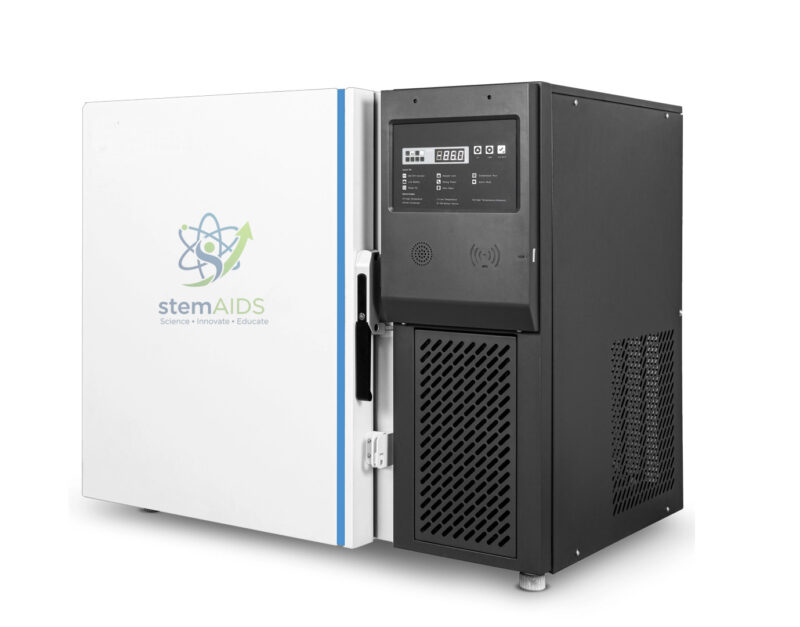
Quick Answer: The under-counter freezer -86°C is a compact ultra-low temperature (ULT) laboratory freezer made to fit below a bench, as its name says. Labs use it for long-term storage of nucleic acids, proteins, enzymes, cell pellets and bacterial glycerol stocks.
Why Store Samples Near -80 °C
At ordinary freezer temperatures, around -20 °C, slow chemical and enzymatic changes continue in many biological samples. Ultra-low storage close to -80 °C slows these processes much further, which is why RNA, purified proteins and frozen bacterial stocks are usually kept in a ULT unit. The -86°C in this product’s title is the low temperature figure given for the freezer.
The format is what sets this unit apart. Upright ULT freezers occupy floor space and often stand in a separate equipment room. An under-counter laboratory deep freezer can sit at the bench where samples are prepared, which suits small research groups, teaching labs running molecular biology practicals and labs adding a second ULT unit as a backup. The photo shows a front-opening cabinet with a control display beside a ventilated machine section.
Because the compressor sheds heat into the room, the space around and behind the cabinet must allow air to circulate. Ask LabEquip for the required clearances, internal capacity and power supply before planning the bench layout.
Specifications
| Product | Ultra-low temperature freezer, under-counter format |
| Temperature in title | -86°C |
| As pictured | Front-opening cabinet with control display and ventilated machine section |
| Typical contents | Nucleic acids, proteins, enzymes, cell pellets, glycerol stocks |
| Capacity, power supply and clearances | Confirm at enquiry |
Applications
- Long-term storage of RNA and DNA extracts in molecular biology labs
- Bacterial and yeast glycerol stocks for teaching and research
- Enzymes, antibodies and purified proteins that lose activity at -20 °C
- Backup ULT capacity for a lab whose main upright freezer is full or under service
Loading & Care
- Load warm items in small batches so the cabinet temperature recovers quickly
- Keep an inventory by rack and box position to cut the time the door stays open
- Scrape frost from the door seal and inner doors regularly so the door closes fully
- Clean the condenser filter and test the alarm on a regular schedule
- Wear cryogenic gloves and eye protection when handling racks at ultra-low temperature
Why Choose LabEquip
Research groups, university teaching labs and biotech start-ups pick an under-counter ULT unit when floor space is tight or a backup is needed. It sits in LabEquip’s general lab products range beside the ATEX drawer freezers, which serve flammable cold storage instead; send your bench dimensions and storage needs through the contact page.
Frequently Asked Questions
What is the difference between a -20 °C freezer and a -86°C freezer?
A -20 °C freezer suits many reagents and kits, but enzymatic and chemical changes continue slowly at that temperature. A ULT freezer near -80 °C slows them much further and is the usual choice for RNA, proteins and long-term cell stocks.
Can the under-counter freezer hold flammable solvents?
No. A ULT freezer for biological samples is not designed for flammable contents. Store flammable materials in a freezer intended for that purpose, such as an ATEX-listed unit.
How long does a ULT freezer take to cool down?
Pull-down time varies with model, room temperature and load. Let the empty freezer reach its set point and run stably before loading samples, and then load them in stages rather than all at once.
How should samples be organised inside?
Use labelled racks and boxes and keep a written or digital map of where each box sits. This reduces door-open time, which matters because every opening lets in warm, moist air that turns to frost.
What happens to samples if the power fails?
A closed ULT freezer warms slowly, but samples are at risk within hours. Connect it to a monitored supply where possible, respond to alarms promptly and keep dry ice or another freezer available as a backup.
Why does frost build up on the door seal?
Moist room air entering during door openings freezes on the coldest surfaces, especially the seal and inner doors. If the frost is not removed, the door may not close fully, which lets in more air and makes the problem worse.
Last Updated: October 2026




Reviews
There are no reviews yet.