
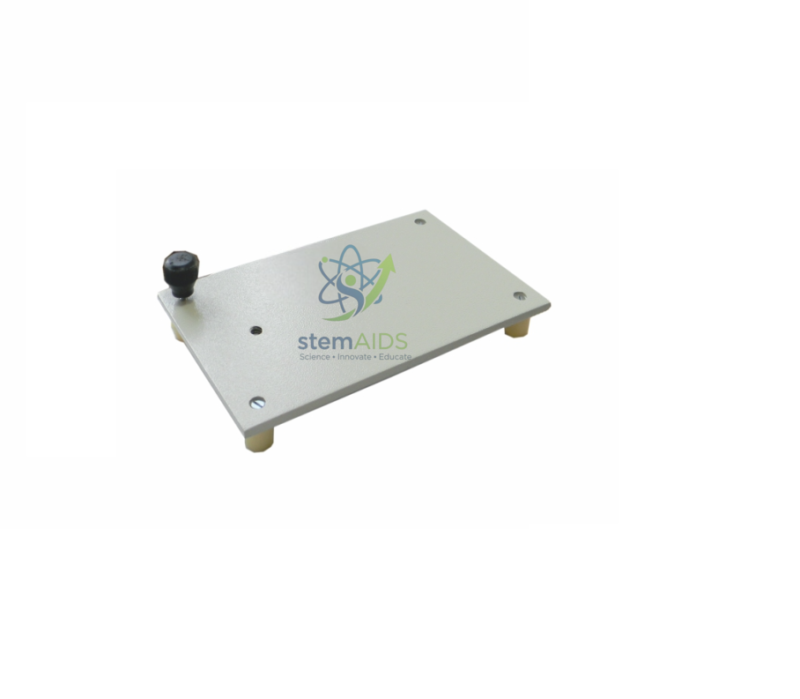
Quick Answer: The Retort Stand, Sheet Type with Leveling Screw is a retort stand with leveling screw feet: a flat sheet base whose feet screw up or down so the base can be set level on an uneven bench. The listing photograph shows a pale grey plate on four cylindrical feet, with a black-knobbed rod fixing at one end.
Why Level a Retort Stand
Most stands simply sit on the bench, and if the bench is out of level the rod leans with it. For many jobs a small lean does not matter. For some it does: a burette should hang vertically so the meniscus is read square to the scale, a pendulum or plumb line must hang clear of the rod, and a column needs to be upright for liquid to run evenly. Leveling screws let you correct the base instead of wedging it with folded paper.
The photograph shows four cylindrical feet under the corners of the plate. Screwing a foot out raises that corner, so the plate can be brought level in both directions and any rocking removed. A small spirit level laid on the plate, or held against the rod, shows when it is right. The feet also lift the plate off the bench and clear of spilled liquid.
The fixing at one end, shown with a black knob, holds the upright rod. ‘Sheet type’ means a flat plate rather than a heavy casting, so the base is lighter than a cast iron stand. Compared with the plain sheet metal retort stand, the adjustable feet are what make this model the one to choose for measurement work.
Applications
- Holding a calibrated glass burette truly vertical for titration readings
- Simple pendulum and plumb-line experiments, where the thread must hang parallel to the rod
- Supporting chromatography or adsorption columns that need an even flow
- Physics measurement set-ups on old or sloping benches
Specifications
| Type | Retort stand, sheet type base |
| Feet | Four adjustable leveling screws (as pictured) |
| Rod fixing | At one end of the plate, black knob (as pictured) |
| Base colour | Pale grey in the listing photograph |
| Purpose | Setting the rod vertical on uneven benches |
| Rod length and plate size | Confirm at enquiry |
Care & Handling
- Level the base after positioning it, and tighten any lock nuts on the feet so they do not creep.
- Do not unscrew a foot so far that only a few threads remain engaged; the stand becomes unstable.
- Keep the threads free of dried reagent and wipe the plate dry after spills.
Why Choose LabEquip
Physics departments and titration-heavy chemistry labs are the usual buyers, because both depend on a vertical rod. LabEquip lists this leveling stand with its other stands and fittings in General Lab Products; mention the number of stations on the contact page.
Frequently Asked Questions
How do I level the stand?
Place a small spirit level on the base plate and turn the feet until the bubble is centred in both directions. Then hold the level against the rod and adjust again if needed.
Why does a burette need to be vertical?
A tilted burette makes the meniscus look higher or lower against the scale depending on the side you view it from. Vertical mounting lets you read the bottom of the meniscus at eye level without parallax.
What is the difference from an ordinary sheet metal stand?
The adjustable feet. An ordinary base rests flat and follows any slope or unevenness in the bench, while this one can be corrected to level.
Can the feet stop the stand rocking?
Yes. Rocking happens when a base rests on two diagonal corners; raising or lowering one foot brings all four into contact.
Is it suitable for heavy apparatus?
A sheet plate is lighter than a casting, so it suits burettes, columns, pendulums and light clamps. For heavy flasks, keep them over the plate or use a heavier stand.
Do I need to relevel it every time?
Only if the stand is moved to a different spot or the feet have been knocked. It is worth checking with a spirit level at the start of a measurement practical.
Last Updated: September 2026





Reviews
There are no reviews yet.