



In Stock
Retort Stand, A-Shaped
High-Stability A-Frame Geometry: The widespread "A" base distributes weight more effectively than standard bases, significantly lowering the center of gravity.
Heavy Cast-Iron Construction: The base is forged from high-density cast iron, providing the necessary "dead weight" to keep the stand anchored during vigorous stirring or boiling.
$2.03
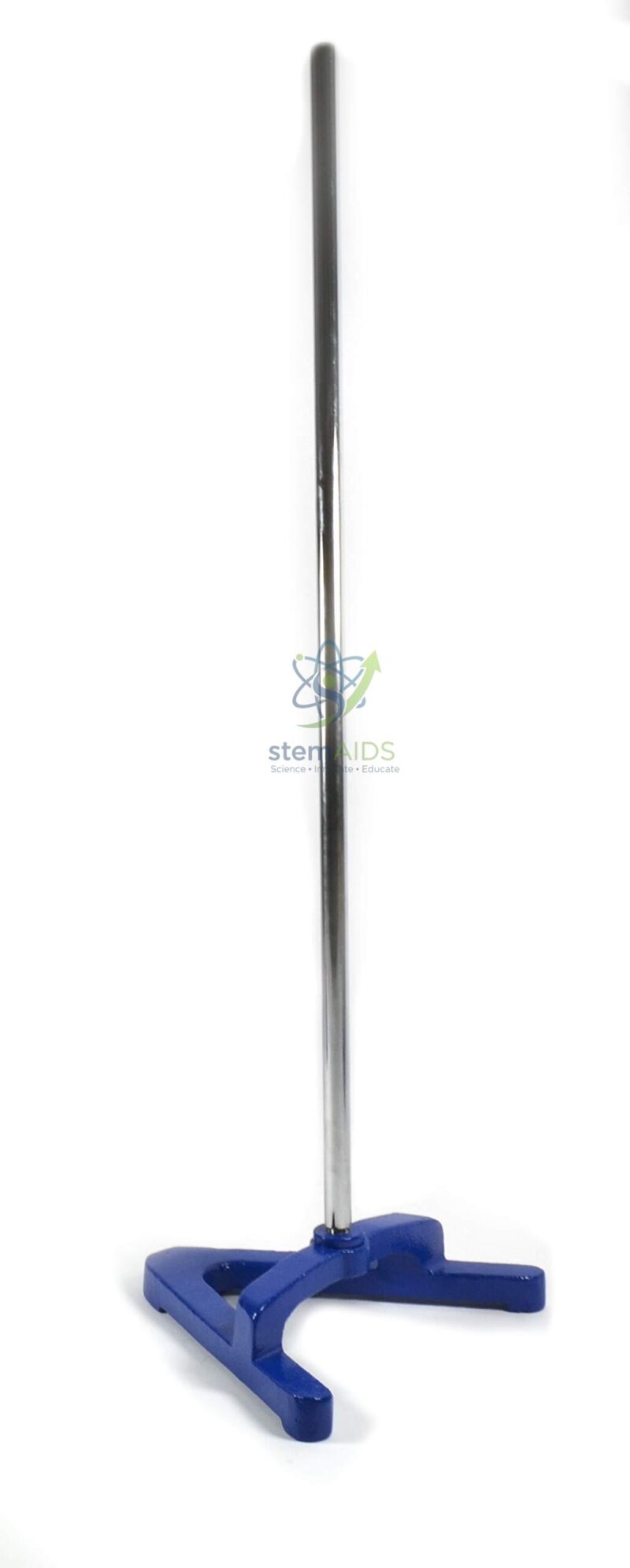
Quick Answer: The Retort Stand, A-Shaped is an a-shaped retort stand: a laboratory support stand whose base is shaped like the letter A instead of a flat rectangle, carrying an upright rod for boss heads, clamps and rings. The listing photograph shows only the upright rod, so the base is described here from the general A-pattern.
How an A-Shaped Base Behaves
A flat rectangular base touches the bench over its whole underside, and if the bench or the base is slightly warped it rocks on two corners. An A-shaped base usually rests on three feet instead, one at the end of each leg and one at the point, and three points always sit firm on a surface. That makes an a-shaped retort stand steady on older wooden benches and on tiled or uneven tops where a plate base wobbles.
The open shape is the other practical difference. The space between the legs can take a heating mantle, a magnetic stirrer or a water bath, so the flask held on the rod sits directly above its heat source while the stand’s feet spread around it. With a rectangular plate, the same apparatus has to sit beside the base and the clamp must reach further out.
Where the rod is fixed and how far the legs spread vary between patterns and are not given in the title. The photograph on the listing is cropped to the rod, so ask for a picture of the base if the footprint matters for your bench. For a base with the rod in the centre of three arms, compare the tripod type retort stand.
Specifications
| Type | Retort stand with A-shaped base and upright rod |
| Base contact | Usually three feet (general A-pattern) |
| Open area | Between the legs, for mantles, stirrers or baths |
| Rod | Upright rod for boss heads, clamps and rings (pictured) |
| Base material and rod length | Confirm at enquiry |
Applications
- Reflux or distillation with a round-bottom flask sitting in a heating mantle placed between the legs
- Titrations on benches with uneven tops, where a flat base rocks
- Holding a thermometer or probe in a beaker on a magnetic stirrer set inside the base footprint
- Supporting a condenser and flask on older wooden benches
Care & Handling
- Place the load over the area enclosed by the legs, never beyond the point of the A.
- Tighten the rod into its socket before each session; a loose rod lets the whole set-up lean.
- Wipe spills off the base straight away; stand bases are usually painted or coated metal, and chipped coatings rust.
Why Choose LabEquip
Organic chemistry labs that run many heated reactions like bases that leave room for a mantle or stirrer under the flask. LabEquip offers the A-shaped stand beside the cast iron rectangular stand in General Lab Products, so a footprint can be chosen for each bench.
Frequently Asked Questions
Why is an A-shaped base steadier on an uneven bench?
Three points of contact always sit firmly on a surface, whereas a flat four-cornered base rocks if the bench or base is slightly out of flat. A-shaped bases are usually made to stand on three feet for this reason.
Can I put a heating mantle between the legs?
That is one of the main reasons to choose this shape. Measure the mantle or stirrer and compare it with the gap between the legs, which varies with the pattern.
Where should the flask be positioned relative to the rod?
Over the area enclosed by the legs. Loads that hang beyond the point of the A have little base under them and can tip the stand.
How does it differ from a tripod type stand?
A tripod base has three arms radiating from a central rod socket, so the rod is in the middle. An A-shaped base usually carries the rod towards one end, leaving the open area of the A on one side for apparatus.
Is the base heavy enough for a large flask?
The title does not give the base weight or material. For heavy loads keep the clamp short, set the flask over the base and consider a second stand for the condenser.
Can the rod be removed for storage?
Most stand rods screw into the base and can be unscrewed for packing, but the listing does not describe the fixing, so confirm it at enquiry if flat storage matters.
Last Updated: September 2026
You must be logged in to post a review.
Bestsellers





Reviews
There are no reviews yet.